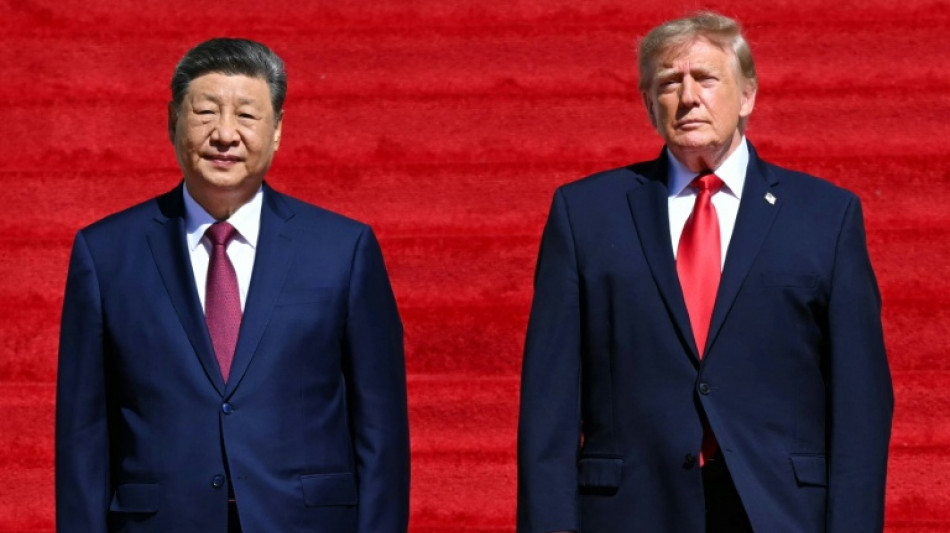
US, China buy time with trade truce as pressure builds / Photo: © AFP
Washington and Beijing may have bought themselves breathing space with an extended trade truce, but analysts warn that time is running out for the world's two biggest economies to resolve their strategic rivalry.
President Donald Trump and Chinese counterpart Xi Jinping concluded a pomp-filled summit Friday, with the US leader confirming they would meet twice more this year.
But even as Trump and Xi "are making nice," their countries "remain locked in a bitter competition over trade, tech, Taiwan, defense, rare earths and industrial policy," said Daniel Russel of the Asia Society Policy Institute.
Daniel Kritenbrink, a former US official now with The Asia Group consultancy, said there's "no doubt that both leaders would like to see stability in the relationship, at least through the end of the year."
However, "you'd have to see further tangible outcomes for this truce to extend in the long run."
Some feel Beijing has "largely not lived up to the commitments it made" at earlier meetings, he added, noting many US officials "have articulated their profound frustration with the Chinese."
Xi and Trump agreed to a trade truce last year during a meeting in South Korea, after a bitter tit-for-tat fight that saw tariffs soar over 100 percent at one point.
As part of the agreement, Beijing agreed to buy more US soybeans and other agriculture products, and to suspend rare earths restrictions for a year.
The pact was originally due to expire in November but both sides agreed this week to extend it until January 10, US Treasury Secretary Scott Bessent said.
- 'Short leash' -
Trump's top trade official Jamieson Greer told CNBC on Friday that Washington views such extensions as "compliance periods."
"I think US officials would say China is doing just barely enough to maintain the agreement and no more," Kritenbrink said.
"That's unsustainable over the long run," he added.
The brief extension "was the preferred position of the Americans," Mary Lovely of the Peterson Institute for International Economics told AFP.
She added that while Beijing would have preferred a longer rollover, the current situation points to Washington's anxiety about the delivery of rare earth magnets and how officials "want to keep this on a short leash."
"It's not clear anymore how much their threats of high tariffs actually move China," she said.
- 'Bitter competition' -
For now, Greer said that both countries have made "progress" on other economic outcomes and expect to release more details Monday.
"We want to have some subset of goods that we can trade with the Chinese on a more preferential basis," he said.
He added that both sides have agreed on products that can be left aside in future trade disputes.
Greer is set to host G20 trade ministers in Wisconsin next week, with US tariff threats and the issue of excess capacity -- a key concern surrounding Chinese industry -- expected to be discussed.
Washington and Beijing have also agreed to set up some kind of notification system for artificial intelligence threats between the two countries, Bessent said.
Peter Richardson of Counterpoint Research said the channel could be as simple as a hotline, but it will be tough to define what triggers it.
"It is often very difficult to tell quickly whether an AI incident was state-directed, a rogue actor or an accident," he said.
"Given the rivalry we don't expect this to lead to any comprehensive international framework for AI regulation, but it would be the first practical guardrail," he added.
Kritenbrink, for his part, said the summit has done "nothing to curb the competitive instincts of both sides on AI."
"I don't think you'll see any slowing down."
P.Barry--TNT