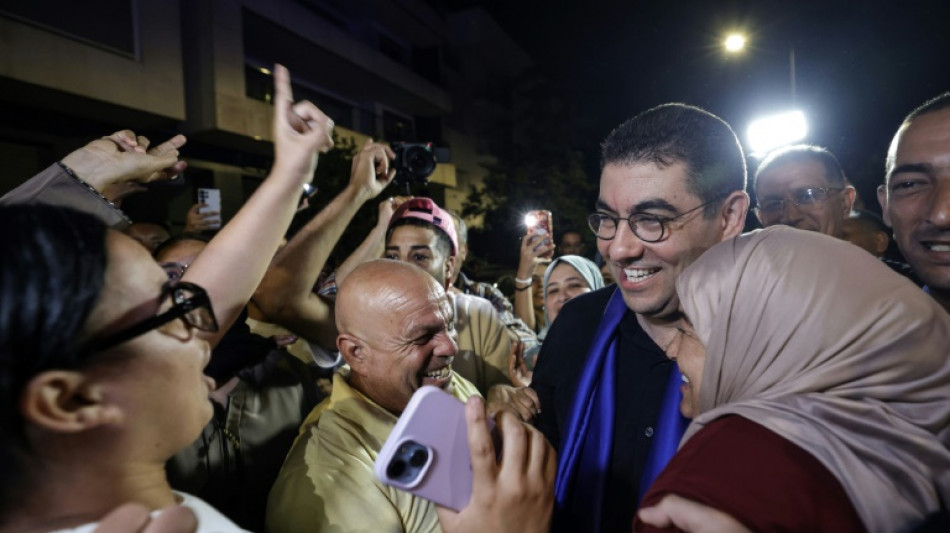
Morocco's ruling coalition dominates low-turnout parliament election / Photo: © AFP
Morocco's ruling coalition dominated parliamentary elections, provisional results on Thursday showed, in a poll marked by low turnout and an improved showing for the Islamist opposition.
The centre-right Authenticity and Modernity Party (PAM) won 97 out of 395 seats in the House of Representatives, with the National Rally of Independents (RNI), which heads the outgoing coalition, came in second with 66 seats.
"Today, we celebrate the valuable trust citizens have placed in us, a trust born of 18 years of relentless struggle," said Fatima Ezzahra El Mansouri, the PAM's national coordinator, at a news conference.
Yet turnout, especially among young Moroccans, proved a challenge for the parties in contention, weeks after tens of thousands of mainly young Moroccan migrants rushed into the Spanish enclave of Ceuta.
The crisis highlighted socioeconomic frustrations among the youth, even as the kingdom records economic growth and is ramping up major infrastructure projects as it prepares to co-host the 2030 World Cup alongside Spain and Portugal.
The election, which saw a turnout of 38 percent from 16 million registered voters, also came a year after a Gen-Z protest movement took to the streets in Morocco to demand better health and education.
Wednesday's turnout was the lowest since 2007 when the figure was 36.8 percent.
Political scientist Mohamed Tozy said the results "have been fairly predictable", adding that the PAM "did not achieve a landslide victory" despite "significant resources deployed".
Without an outright majority, the PAM will have to form a new coalition with other parties, and the next head of government -- appointed by the king -- will come from its ranks.
El Mansouri said there was "no party with which we refuse to sit down", adding, however, that the PAM had not begun talks on forming the new coalition.
- 'Great honour' -
One prominent figure tipped to become the kingdom's next premier is PAM's Fouzi Lekjaa, the current budget minister better known as chief of the Royal Moroccan Football Federation, which has racked up sporting feats in recent years.
But El Mansouri, who serves as the current territorial planning minister and mayor of Marrakesh, could also be in line to become Morocco's first woman premier.
On Thursday, El Mansouri said it would be a "great honour".
Her party has pledged average annual economic growth of five percent, inflation of two percent and at least 1 million new jobs over its five-year term.
The PAM was founded in 2008 by current royal adviser Fouad Ali El Himma as a counterweight to the Islamist movement.
The PAM and RNI were followed by the right-wing Istiqlal party with 65 seats, while the Islamist opposition's Justice and Development Party (PJD) took 54 seats.
The PJD made a significant comeback from winning 13 seats in 2021, after its campaign focused in part on fighting corruption.
Its chief, former prime minister Abdelilah Benkirane, hailed a "victory" but ruled out joining a coalition led by the PAM, which he said was "tainted by fraud", without providing details.
For Tozy, the PJD's resurgence came as a "sanction vote" against the outgoing government, after the Islamist party's campaign messaging sought to "bring morality to political life" and combat corruption.
- Development at 'two speeds' -
The PJD campaigned on fighting corruption and criticised the outgoing government's record, focusing on purchasing power, youth unemployment and public services such as healthcare.
Those issues helped fuel the Ceuta migration crisis and the Gen Z-led mass protests, which had appealed directly to King Mohammed VI and called for incumbent Prime Minister Aziz Akhannouch -- who heads the RNI -- to resign.
During protests last year, young demonstrators repeatedly chanted: "We want hospitals, not just stadiums", in reference to the kingdom's sporting investments.
Morocco, which also hosted football's last edition of the Africa Cup of Nations, has embarked on major projects, including stadiums, a high-speed rail network and renovating several airports.
But social and regional disparities remain significant, with young people particularly affected by unemployment.
In an address following the Gen Z protests, the king himself had denounced what he described as development taking place at "two speeds".
R.T.Gilbert--TNT