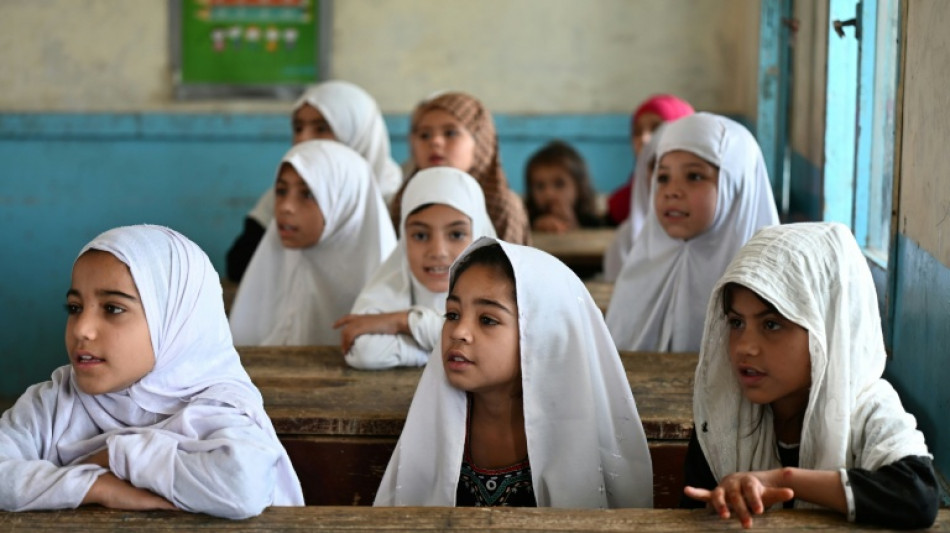
NGO chief sees 'hypocrisy' in Afghan women's rights calls amid aid cuts / Photo: © AFP/File
The head of the Norwegian Refugee Council aid group, Jan Egeland, criticised on Thursday what he called the "hypocrisy" of countries demanding rights for Afghan women while cutting humanitarian assistance.
Afghanistan has seen a sharp decline in international aid since 2021, when the Taliban authorities returned to power. They have since imposed a series of rules limiting women's access to education and public life.
In an interview with AFP in Kabul, Egeland said that it was right of foreign countries "to demand, like we do, education for Afghan girls, work rights for Afghan women".
"But it is hypocrisy when one does that from abroad in a seminar in some capital in Europe and cut aid for food to Afghan girls and even for primary education for Afghan girls," he said.
International aid to Afghanistan has dropped sharply, with the United Nations saying it had received less than 30 percent of the funding needed to provide life-saving assistance as of late August.
The humanitarian situation has been further worsened by several natural disasters and the forced return of millions of Afghans from Iran and Pakistan since 2023.
Acute child malnutrition has reached critical levels this year, affecting around one million children, UNICEF warned in August.
"The funding cuts are disastrous for the girls and the women of Afghanistan and those who believe that it is a good thing punishing the Taliban by taking away aid from the Afghan people, as some seem to believe, haven't understood anything of the realities here," said Egeland, who was touring his organisation's projects across Afghanistan.
The Norwegian Refugee Council (NRC) employs around 400 people, including women, in the country, providing food aid, education, shelter and protection for vulnerable communities.
Egeland said the NRC was forced to lay off "female aid workers and female teachers on the primary school level for girls because we don't have enough money".
Some 175 centres offering services related to combatting gender-based violence have shut down due to a lack of funding in the first six months of this year, affecting 1 million people, according to the UN.
An Afghan woman working for an international humanitarian group told AFP this week that "when you see the cuts every year in aid, you start to feel hopeless".
"These organisations are one of the last opportunities for us" to work, said the woman, requesting anonymity for security reasons.
- Education 'now' -
Since returning to power in 2021, the Taliban authorities have banned girls from attending high school and university, while also imposing restrictions on women's access to public life and employment.
It is the only country in the world where girls' education is banned after primary school.
"My message to Taliban authorities... is by not giving education to girls beyond primary school you will have a catastrophe on your hand," Egeland said.
"There will be no skilled Afghan female teachers, nurses, doctors, midwives in the future."
"It's a basic universal right to have education," he said. "We need it now and we should have it now."
He called on governments in Europe and North America and elsewhere to reopen embassies in Afghanistan and engage with the Taliban authorities -- whose rule is only officially recognised by Russia.
Egeland said action does not mean recognising the Taliban government, but rather "our appeal is... come here and engage with us" to "demand rights for women and girls, but also offer assistance to women and girls".
"We are on the front lines now of humanity here and we the humanitarian groups feel utterly alone," he said.
F.Jackson--TNT