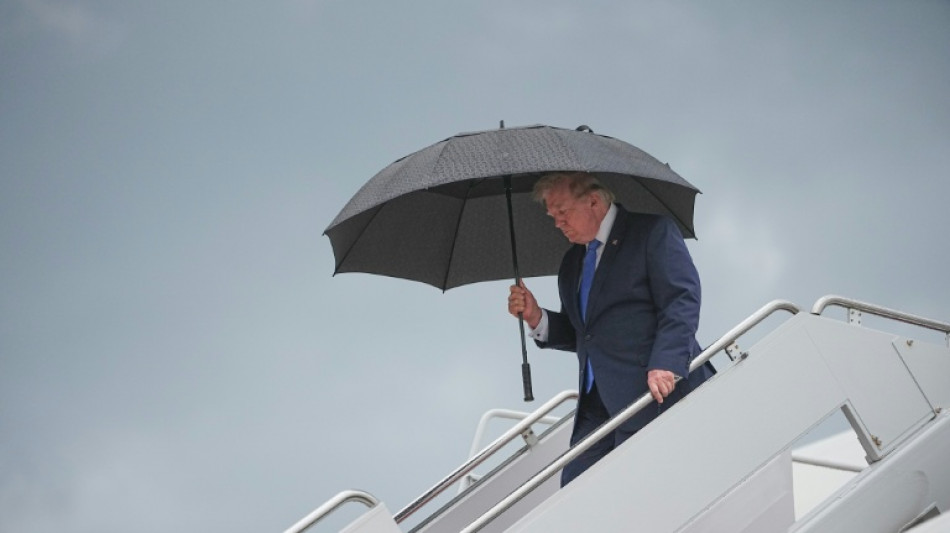
Trump says new Iran talks set to start after calling off massive attack / Photo: © AFP
US President Donald Trump said that new negotiations with Iran will begin Monday after he decided to hold off on striking the Islamic republic to pursue a deal to end the war entering its sixth month.
Trump told reporters on Sunday that the talks would cover the Strait of Hormuz –- a route for global energy supplies that has become a key sticking point in the conflict -- and ultimately, the denuclearization of Iran.
For its part, Iran said it was nearing a deal with Oman over a new route through the strait, where a tanker reported an explosion nearby on Sunday, underscoring the continued volatility of the strategic waterway.
Oil prices fell on Monday at the opening of Asian trade after Trump announced the new negotiations, with West Texas Intermediate dropping 4.7 percent to $80.72 per barrel.
Washington and Tehran have been at war since February 28, when the US and Israel launched surprise strikes against Iran, though months of on-off diplomacy have led to periods of relative calm.
Following a return to strikes last month, fears had mounted that the fighting could escalate once again. Trump had threatened to hit Iran "very hard" and was reportedly considering renewed attacks including against energy infrastructure, with US embassies across the region on alert.
Trump pulled back from that threat Saturday, saying the "perimeters" of a deal were there.
"Now what we're doing is we're talking to them in the form of a negotiation. It begins tomorrow afternoon," Trump told reporters aboard Air Force One on Sunday, without providing details of the venue or participants in the talks.
The US president said he had been asked by Iran as well as US partners Saudi Arabia, the United Arab Emirates and Qatar to hold off on the strikes, which he claimed would have been "the biggest attack since World War II."
Iranian media denied that Tehran had asked Trump not to strike.
A previous ceasefire deal that included the reopening of the Strait of Hormuz fell through, and Iran has since tightened its control over the waterway.
The US president said at the start of the conflict that the war was necessary to deal with Iran's nuclear programme. Western nations accuse Iran of seeking a bomb, though Tehran insists the programme is entirely civilian in nature.
- 'Exchange of views' -
Iranian lawmaker Hassan Ghashghavi, spokesman for the parliament's national security commission, said on Sunday that mediators were trying to revive the US-Iran memorandum of understanding that was agreed in June.
That agreement was not intended as a final peace deal, but as a stepping stone to negotiations on a comprehensive agreement, though it did include provisions on Hormuz.
"They know that the main issue and, in fact, the key to the matter right now is the issue of the Strait of Hormuz, so yes, there is an exchange of views," Ghashghavi said.
Posting on X, Iranian President Masoud Pezeshkian said: "We must strive to compel the enemy to remain committed to what it has signed."
- Iran deal with Oman? -
Before the war, there was free passage for all vessels through the Strait of Hormuz, but Iran closed the strait during the war and now insists on retaining control and charging tolls, something the US rejects.
That dispute sparked the return to strikes last month, as Tehran refused to let ships travel any route other than one which hugs the Iranian coast.
On Sunday, Iranian foreign ministry spokesman Esmaeil Baqaei told state television that a deal was close with Oman, which sits on the other side of the strait, over a new route through it.
"We are now going to reach an understanding on a route acceptable to both sides -- neither the northern route nor the southern route -- but one that respects the sovereign rights of both sides and safeguards our national interests and security," he said.
He insisted though that such an agreement did not mean the reopening of the strait.
Maritime trade tracking firm Kpler said Friday that traffic through Hormuz had dropped sharply.
On Sunday, a tanker off the coast of Oman reported hearing an explosion near the vessel, the United Kingdom Maritime Trade Operations (UKMTO) Centre reported, adding that the vessel and crew were all safe.
W.Baxter--TNT