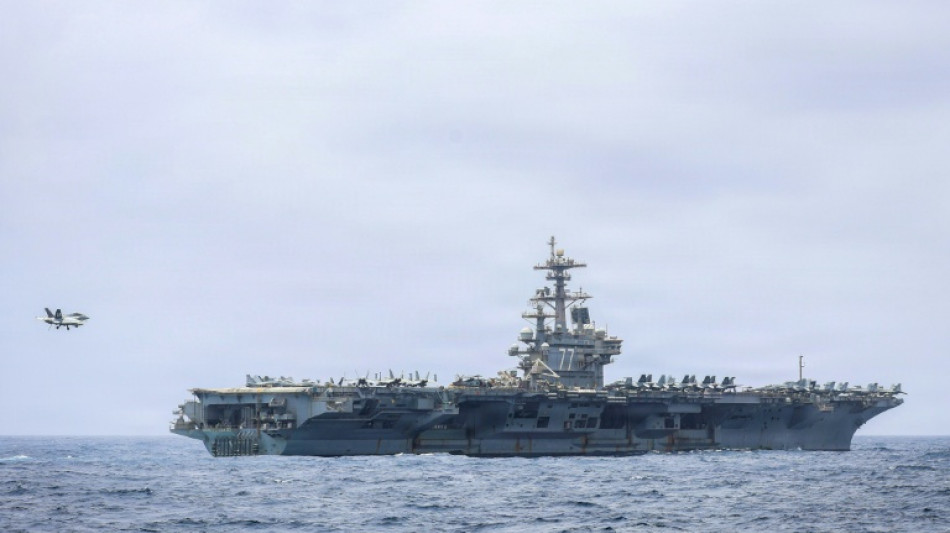
US, Saudi strike Iraq alliance in expanding war / Photo: © US NAVY/AFP/File
US and Saudi forces said they struck an Iraqi militant alliance on Wednesday, as the Middle East war expands beyond its main focus in Iran to involve the Islamic republic's proxies.
The strikes follow a short lull in direct US attacks on targets in Iran, with Tehran's allies in Yemen and beyond becoming increasingly drawn in.
Iran, meanwhile, launched missiles at Jordan, in its first attack in the region since the pause in fighting with the US began.
Crude oil prices leapt as the strikes revived fears about global supplies, already hit hard by Iran's blockade of the Strait of Hormuz and more recently by Houthi threats to Saudi exports.
- 'Dangerous' -
The joint air operation in Iraq followed attacks by what Saudi Arabia called "terrorist militias loyal to Iran" on its oil facilities. Riyadh had previously reported intercepting drones it said were launched by the groups.
The US military said logistics and weapons sites belonging to an Iran-aligned group were targeted in the Iraq strikes.
According to Iraq's Hashed al-Shaabi alliance, the attacks killed at least 20 of its members across seven provinces, including Baghdad.
It denounced a "dangerous escalation" against an "official security institution".
The Hashed al-Shaabi alliance, also known as the Popular Mobilisation Forces, was created in 2014 to fight jihadists before it was formally integrated into the armed forces.
It includes brigades belonging to Iran-backed groups that have a reputation for acting unilaterally.
The US and Iran are Iraq's main allies, but their enmity has long turned the country into a proxy battleground and left successive governments struggling to maintain a delicate balance between the foes.
The strikes follow growing US pressure on Iraq to disarm pro-Iran groups there. Earlier this month, Prime Minister Ali al-Zaidi visited both the United States and Iran.
- Netanyahu in Washington -
The US had said a days-long cessation in fighting was aimed at kickstarting a new round of negotiations, including over the Strait of Hormuz.
Iran's Revolutionary Guards said Wednesday that they had attacked and stopped three tankers in the strait, maintaining it has "full control" of the waterway.
Jordan's army, meanwhile, said it had intercepted five Iranian missiles.
The Guards said they had "targeted a US airbase and the US Central Command Centre in Jordan with several ballistic missiles".
"As long as the threats against the Islamic Republic of Iran continue... the resistance will continue," they added.
The attacks came as Prime Minister Benjamin Netanyahu of Israel, Iran's arch-nemesis, visited Washington to meet with President Donald Trump.
Trump hosted Netanyahu at the White House on Tuesday for closed-door talks that the administration described as "positive and productive".
The discussions lasted for about an hour and a half and took place as Netanyahu and Trump seek to patch over public disagreements on the war.
Netanyahu said in a video message after the meeting that it was "one of the best conversations I've ever had with the president of the United States" and that it touched on "our common goal: ensuring that Iran does not obtain nuclear weapons".
Trump said that the pair had a "very good meeting".
Israel has not taken part in the recent round of hostilities between the United States and Iran, which flared earlier this month when an April ceasefire collapsed.
M.Wilson--TNT