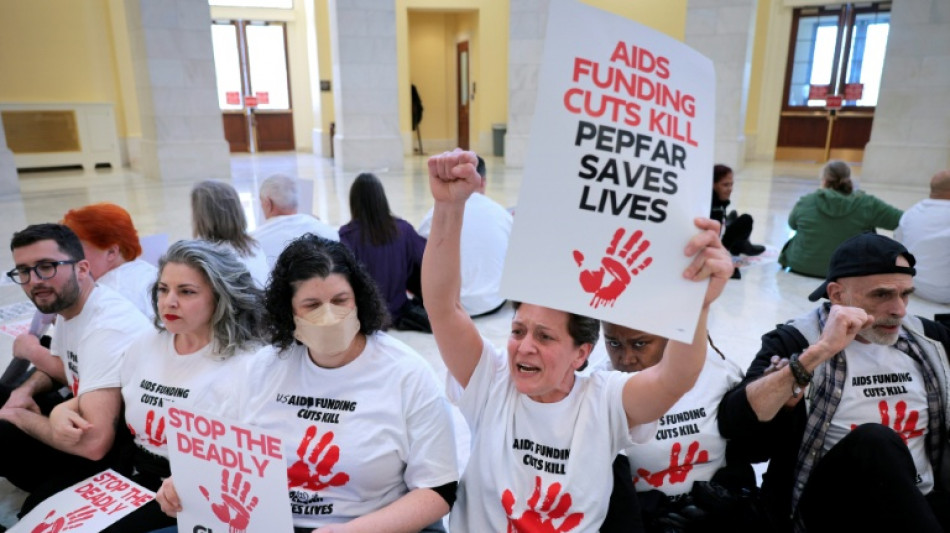
HIV progress in 'real danger' as global funding plummets / Photo: © GETTY IMAGES NORTH AMERICA/AFP/File
The science has never been better, but political will has reached a new low: AIDS experts warned Monday that the fight against HIV was in real danger as funding fell by a fifth last year.
A major international AIDS conference got underway in Rio de Janeiro for the first time since the United States began to dramatically slash foreign aid following Donald Trump's return to the White House last year.
European nations including France, Germany and the UK followed suit.
"Never has donor funding fallen so far, so fast, and those most vulnerable are already paying the price," said Beatriz Grinsztejn, president of the International AIDS Society (IAS), warning that the gathering was taking place at a time of "real danger" for the battle against HIV.
Once a fatal and terrifying diagnosis, scientific breakthroughs and massive funding efforts have transformed HIV into a manageable disease for millions of people.
"The end of AIDS is no longer limited by science. The scientists have done their part. It's limited by inequality. Science has done its job, now politics must do its job," said UNAIDS chief Winnie Byanyima.
She said the world was living through "one of the most exciting moments in the history of HIV science," with prevention medicines that have almost vaccine-like effectiveness.
But millions still do not have access.
"When prevention disappears, infections rise. When treatment is interrupted, people die. We know how this story ends if we fail to act," warned Byanyima.
- Developing nations 'step up' -
International financing for HIV in developing countries fell by 18 percent in 2025 alone, according to a UNAIDS report released at the 26th International AIDS Conference.
Since 2011, HIV funding from European countries has fallen by 58 percent, according to the report. As the European contribution decreased, the US share of the funding rose.
This meant that despite the sweeping cuts by the Trump administration last year, the United States still provides 74 percent of funding given by donor governments, the report said.
Developing countries with the highest HIV rates -- many of which are in sub-Saharan Africa -- are meanwhile "stepping up", UNAIDS deputy executive director Angeli Achrekar told AFP.
Domestic funding rose four percent last year and now represents nearly 60 percent of the total HIV response, according to the report.
However, these figures are still "a drop in the ocean" compared to what is needed, Byanyima told AFP last month.
Many low-income countries in Africa are dependent on overseas development assistance for 90 percent of their HIV response, the report said.
Experts have cautioned that it is still too early to see the full impact of the funding cuts.
The number of new HIV cases and AIDS-related deaths dropped to their lowest levels in more than 30 years in 2025, according to the report.
New infections, however, rose in 21 countries.
- New drugs -
The UN aims to end AIDS as a public health threat by 2030.
One of the goals is for 20 million people to have access to anti-retroviral drugs which prevent the spread of HIV.
Almost half of all children living with HIV were not receiving these drugs last year, the report warned.
Achrekar called on pharmaceutical firms which make a range of new drugs seen as breakthroughs "accessible and affordable to all".
Ahead of the conference in Rio, the US pharma giant Merck announced plans to allow some manufacturers in Africa and India to make cheaper generic versions of its once-monthly anti-retroviral pill alimatravir, which has not yet been approved.
Also last week, Doctors Without Borders (MSF) called on US pharma company Gilead to make its preventative drug lenacapavir -- which has been hailed as a game-changer because it only needs to be injected twice a year -- available to more nations in need.
Countries where clinical trials were held to test the drug -- such as Brazil, Argentina, Mexico and Peru -- are excluded from current deals allowing for the sale of generic versions, the NGO pointed out.
Research has shown lenacapavir can be made for $40 per person a year, but it costs up to $28,000 per patient annually in the United States, MSF added.
P.Barry--TNT