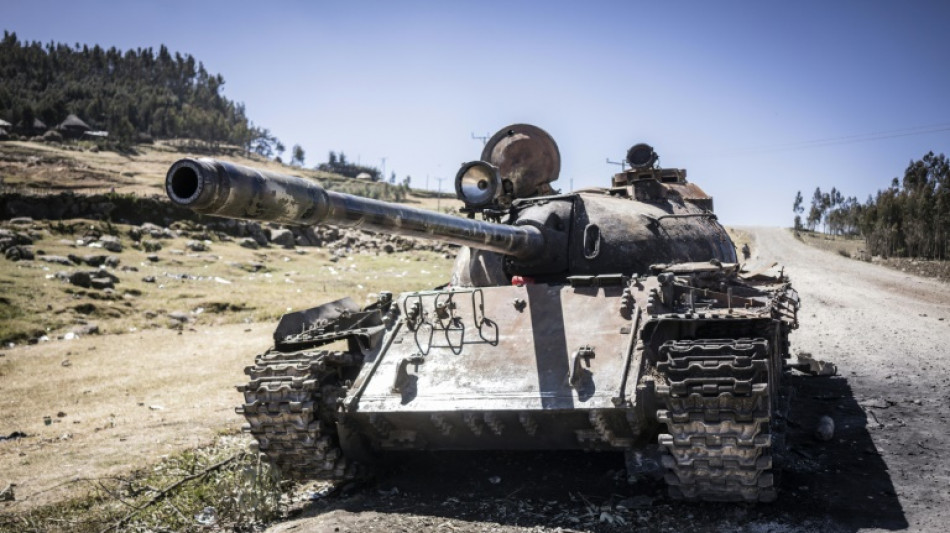
Fighting resumes in northern Ethiopia after five-month lull / Photo: © AFP/File
Fighting erupted between government forces and Tigrayan rebels in northern Ethiopia on Wednesday, with the warring sides blaming each other for shattering a five-month-old truce.
The renewed warfare was unleashed after both sides repeatedly blamed each other for the lack of progress in efforts to hold negotiations to try to end the brutal 21-month conflict.
The Tigray People's Liberation Front (TPLF) said government forces and their allies had launched a "large scale" offensive in the direction of southern Tigray early Wednesday.
But the Government Communication Service accused the TPLF of striking first, saying it had "destroyed the truce".
"Disregarding the numerous peace options presented by the Ethiopian government, the armed wing of the terror group TPLF, pushing with its recent provocations starting 5 am (0200 GMT) today committed an attack" around southern Tigray, it said in a statement.
The rival claims could not be independently verified as access to northern Ethiopia is restricted, but there were reports of fighting around southern Tigray in areas bordering the Amhara and Afar regions.
"They launched the offensive early this morning around 5 am local time. We are defending our positions," TPLF spokesman Getachew Reda told AFP in Nairobi in a brief message.
He said on Twitter that the "large-scale" offensive was launched "against our positions in the southern front" by the Ethiopian army and special forces and militias from the neighbouring Amhara region.
The March truce led to a lull in the brutal conflict that first began in November 2020, allowing a resumption of international aid to war-stricken Tigray.
On Tuesday, the Ethiopian National Defence Force had issued a statement accusing the TPLF of seeking to "defame" the army by claiming government forces were moving towards their positions or shelling them with heavy weapons.
Prime Minister Abiy Ahmed's government and the TPLF have been locked in a war of words in recent weeks even as both sides have raised the prospect of peace talks.
The two sides disagree on who should lead negotiations, and the TPLF also insists basic services must be restored to Tigray's six million people before dialogue can begin.
Abiy's government says any negotiations must be led by the African Union's Horn of Africa envoy Olusegun Obasanjo, who is leading the international push for peace, but the rebels want outgoing Kenyan President Uhuru Kenyatta to mediate.
- Humanitarian crisis -
The conflict in Africa's second most populous country has killed untold numbers of people, with widespread reports of atrocities including mass killings and sexual violence.
Millions of people need humanitarian assistance in Tigray, the country's northernmost region, and neighbouring Afar and Amhara.
The conflict has left Tigray in the grip of a serious humanitarian crisis, with the UN's World Food Programme saying last week that nearly half the population in suffering from a severe lack of food.
"Hunger has deepened, rates of malnutrition have skyrocketed, and the situation is set to worsen as people enter peak hunger season until this year's harvest in October," the WFP said.
The dire assessment came despite the humanitarian truce in March allowing the resumption of desperately needed international aid convoys to the stricken region's capital Mekele, with fuel shortages making it difficult to distribute supplies.
Tigray is largely cut off from the rest of Ethiopia, without basic services such as electricity, communications and banking.
Abiy sent troops into Tigray in November 2020 to topple the TPLF after months of seething tensions with the party that had dominated Ethiopian politics for three decades.
The 2019 Nobel Peace Prize winner said it came in response to rebel attacks on army camps.
The TPLF mounted a comeback, recapturing Tigray and expanding into Afar and Amhara, before the war reached a stalemate.
Last Wednesday, an Ethiopian government committee tasked with looking into negotiations called for a formal ceasefire to enable the resumption of services to Tigray as part of a proposal it planned to submit to the AU.
But Abiy's spokeswoman Billene Seyoum on Thursday claimed that the rebels had "not a shred of interest" in peace.
D.Cook--TNT