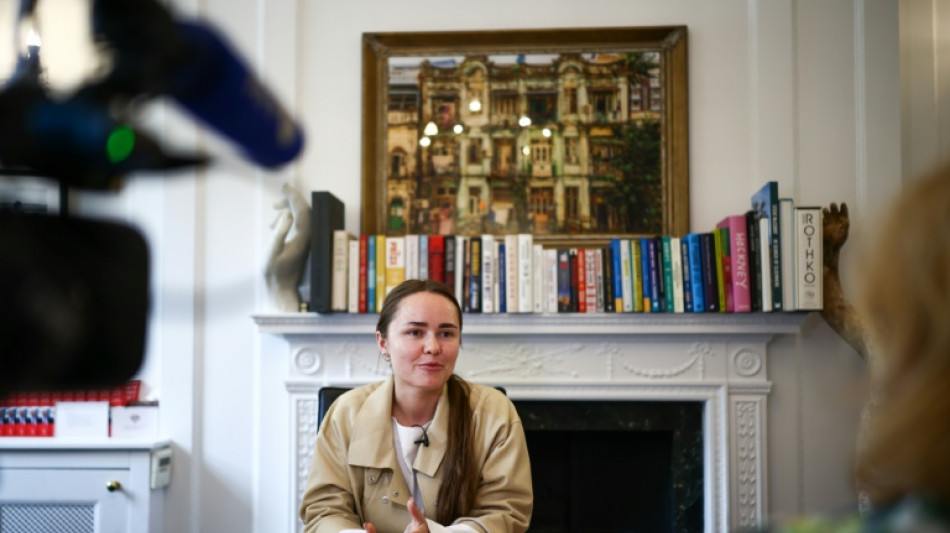
Iryna Terekh: the trained architect behind Ukraine's deep-strike drones / Photo: © AFP
She tours major international defence shows, negotiates with arms manufacturers and takes part in discussions on Europe's rearmament.
At 34, Iryna Terekh, an architect by training, heads Fire Point, a company that has become one of the driving forces behind Ukraine's long-range strike capabilities in the war with Russia.
With her long hair tied back in a ponytail, a white top, beige jacket and wide-legged jeans, she stands out in an industry dominated by men in suits.
She met with AFP away from the exhibition halls at this week's Farnborough International Airshow in the UK, for an interview in Mayfair, central London.
A month after attracting attention at the Eurosatory defence exhibition in France -- where Fire Point repeatedly screened footage of an oil refinery near Moscow engulfed in flames after being hit by one of its drones -- the company opted not to exhibit in Britain.
"The next step has to be even better," Terekh said, explaining she wants Fire Point's next public appearance to make a big impact.
For months, she has been defending Fire Point against allegations of corruption and accusations that have accompanied the company's meteoric rise.
The firm has faced claims that it received preferential treatment from the state and has been drawn into controversy over public contracts.
Terekh says that from 2022 to 2024 Ukrainian authorities were desperately searching for manufacturers capable of supplying weapons, and insists the company welcomes audits, oversight and transparency.
- 'Garage engineering' -
Terekh grew up in Kharkiv, in eastern Ukraine, and from her children's home in Saltivka -- a district now among the areas hardest hit by Russian bombardment -- she could see Belgorod in Russia.
She has long lived in Kyiv and says she has children, but declines to provide further details "for security reasons".
Although trained as an architect she never practised, instead running several construction companies.
When Russia launched its full-scale invasion of Ukraine in 2022, her friend Denys Shtilerman, Fire Point's founder, suggested she help build his company.
According to Terekh, the first ideas for what would become the FP-1 drone were sketched on a napkin in their favourite restaurant in late 2022.
A prototype was assembled in a garage in early 2023, with seven aircraft then built in just three weeks.
"We slept three hours a night and worked in shifts," she recalled.
To critics who dismiss the project as "garage engineering" or amateurism, Terekh says she is "very proud" of their roots.
"The Ukrainian army today relies to a large extent on volunteers," she said, arguing products therefore have to be "simple, clear and easily reproduced".
"If you're the smartest person in the room, you need to leave and find another room where you'll feel like an amateur," she added.
- Thousands of drones -
Western defence experts and industry figures have described Fire Point as one of the key contributors to Ukraine's long-range strikes against Russia.
Terekh declines to disclose the company's revenues but says production now runs into thousands of drones each month.
Previously reported figures of 3,000 drones and 30 Flamingo missiles a month have since increased, she said.
The criticism surrounding Fire Point has had at least one tangible consequence, she acknowledges: some projects with foreign partners were delayed for several months for additional compliance procedures.
Those reviews have now been completed, Terekh said.
Her ambition is now to help create a broad ballistic missile defence coalition -- "something that does not yet exist in the world" -- in which Fire Point hopes to play a central role.
"We have all seen American Patriot systems remotely deactivated because of a political decision," she said.
"We do not want to find ourselves in a situation where such a political decision could be taken for the skies above Paris."
B.Cooper--TNT