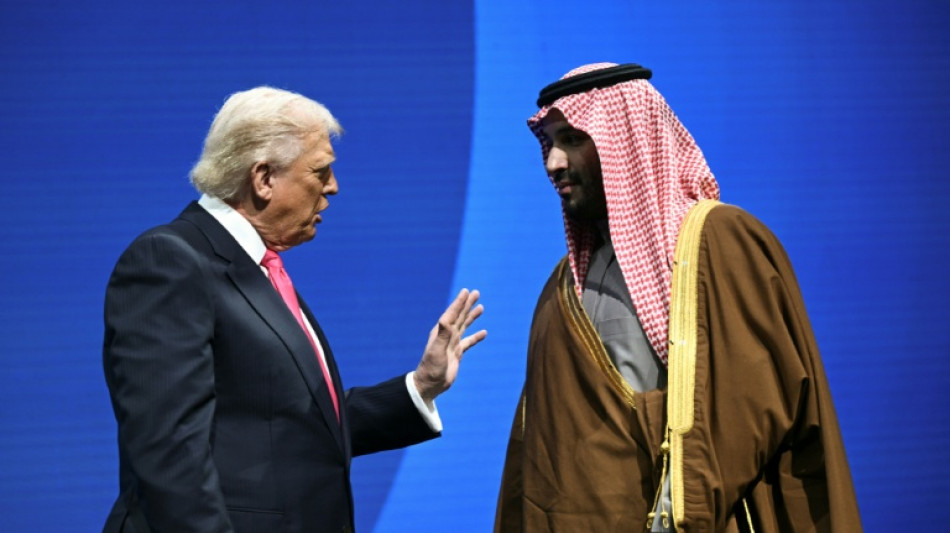
Trump stuns Saudis by pinning nuclear deal to Israel ties / Photo: © AFP
US President Donald Trump said Thursday that a nuclear deal with Saudi Arabia depends on the kingdom recognizing Israel -- throwing the agreement into turmoil just the day after it was signed.
Riyadh has long resisted joining the so-called Abraham Accords with Israel, insisting especially after the Gaza conflict on a pathway to a Palestinian state.
The civilian nuclear deal announced on Wednesday had appeared to be a major win for the Saudis, especially coming as Trump wages war on Iran in large part over concerns about Tehran's own atomic program.
But Trump threw a gigantic spanner into the works with his post on his Truth Social network saying the Saudi deal "will be approved, but is totally subject to Saudi Arabia joining the very respected and successful Abraham Accords."
The White House insisted that the Saudis knew the deal was contingent on recognizing Israel, despite the fact that it was not mentioned when the deal was announced.
"The president is always the final dealmaker, as you know," Press Secretary Karoline Leavitt told reporters, adding that the Abraham Accords were "something that he feels very strongly about and has spoken about it in the past and will continue to uphold."
Leavitt said Washington would "continue to have those conversations with our Saudi counterparts" to finalize a deal including recognition of Israel.
- 'Historic leap' -
Israel's Prime Minister Benjamin Netanyahu said recognition by Saudi Arabia, a regional power and home to Islam's holiest sites, would mark a "historic leap" forward for peace in the Middle East.
Leavitt said she did not know of any calls between Trump and Netanyahu following the announcement of the Saudi agreement.
Should it go through, the deal to establish a civilian nuclear program in Saudi Arabia would generate billions of dollars for American companies, but with Trump's latest announcement, it was unclear whether it would ever see the light of day.
If Washington "tries to force normalization on Riyadh, it's not likely to work out very well", said H.A. Hellyer, senior associate fellow at the Royal United Services Institute for Defense and Security Studies.
"Would Saudi decide to do a complete 180 on what it has declared for the past three years, or 30 years? Quite dubious," he told AFP.
Critics have also insisted that the deal could precipitate a nuclear race in a region already battered by war.
One provision would potentially see US companies build a uranium enrichment facility in Saudi Arabia, The Wall Street Journal reported.
The US Energy Department made no mention of such a provision and did not offer comment when asked about it by AFP.
And Trump seemingly quashed it by saying on Truth Social that there would be "no enrichment of material!"
The deal will be submitted to Congress for review.
US lawmakers from both parties and Israeli officials have previously voiced opposition to such a project over fears Saudi Arabia could eventually convert it to develop nuclear weapons.
US Secretary of State Marco Rubio said that "any agreement that we're going to make with any country in the world on civil nuclear energy is going to be one that will have safeguards in place to ensure that it can't be turned into a weapons program."
- Proliferation concerns -
Riyadh, like Tehran, has long been adamant about its right to pursue a civilian nuclear program. Last year it signed a mutual defense pact with nuclear-armed Pakistan.
Policymakers have long feared that if Iran produced a nuclear weapon, the move would set off an arms race across the Gulf.
US Energy Secretary Chris Wright dismissed concerns, insisting the deal was in Washington's economic and strategic interest and involved the "highest standards of nuclear safety and nonproliferation."
The United States has agreements governing nuclear cooperation with more than 50 countries.
The Saudi deal meanwhile comes as Riyadh looks set to be dragged further into the Middle East war, with Yemen's Houthi rebels starting to attack ships in the Red Sea to enforce what they say is a blockade on Saudi Arabia.
Trump vowed to punish both Iran and the Houthis if the attacks continue.
burs-dk/sst
S.Cooper--TNT