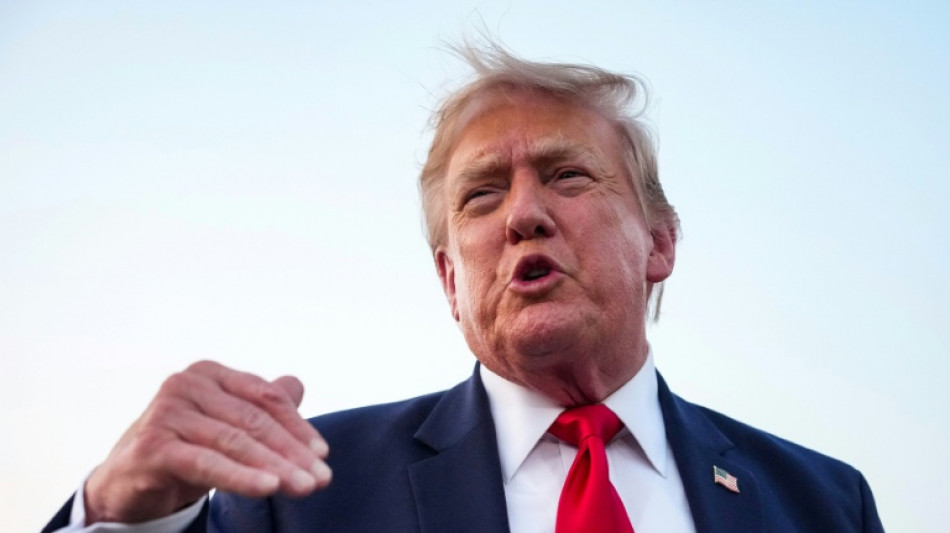
Trump threatens Iran infrastructure, Tehran vows 'eye for eye' / Photo: © GETTY IMAGES/AFP
US President Donald Trump threatened Wednesday to destroy an Iranian bridge or power plant for every attack on shipping in the Strait of Hormuz, drawing an "eye for an eye" warning from Tehran as both sides sharpened threats in the escalating war.
Fighting over the vital energy waterway has collapsed a preliminary deal between the United States and Iran, with Tehran reimposing its blockade and firing on vessels that seek to transit.
"Any time the Islamic Republic of Iran shoots at a ship in the Strait of Hormuz, whether it be by Missile, Rocket, Drone, or any other device or weapon, the United States will bomb and destroy ONE BRIDGE OR POWER PLANT," Trump wrote on social media.
Iranian Foreign Minister Abbas Araghchi said Tehran would respond in kind to any attack on its infrastructure.
"Our defence doctrine is clear: eye for an eye," Araghchi wrote on X. "Any aggression against Iran, including our infrastructure, will compel a powerful and decisive response."
Iran's state broadcaster quoted the military as saying that US threats "will have no result other than the expansion of the war".
Top US diplomat Marco Rubio maintained Washington was still "open to working it out in a negotiated way" through diplomacy.
"But right now, they don't seem to be serious about that," he added.
Iranian foreign ministry spokesman Esmaeil Baqaei had previously said diplomatic exchanges with Washington through mediators were continuing.
On Wednesday afternoon, a US missile hit Larak island in the strait, Iran's Tasnim news agency reported, saying the extent of the damage was being investigated.
Trump has faced intense political pressure to end the conflict, which Defense Secretary Pete Hegseth said Tuesday had cost the United States $37.5 billion, up from nearly $29 billion in mid-May.
But Trump rejected polls showing the war was unpopular as he headed to an airbase for the return of the remains of four US service personnel.
Three were killed in an Iranian attack on a military base in Jordan, and one died during a controlled detonation of an unexploded Iranian drone in Iraq.
"Americans don't want high gasoline prices but they're not against the war," Trump said.
Brent crude, the global oil benchmark, briefly topped $95 a barrel for the first time in nearly six weeks on Wednesday. Crude futures later shed some gains but were still up about three percent.
- Kolang threat -
The US military said it had launched an eleventh consecutive night of strikes intended to "further degrade Iran's ability to threaten commercial shipping in the Strait of Hormuz".
Trump had said earlier that the next US target could be an underground complex known as Pickaxe Mountain, or Kolang in Persian, a site near Natanz where Western intelligence agencies suspect Iran is building an undeclared nuclear enrichment facility.
Iran threatened reprisals, with the Khatam Al-Anbiya military command saying it would strike "all the interests of America, the allies and supporters" if such an attack were carried out, state media reported.
The threats came as Tehran pressed attacks on targets in US-allied Gulf states.
Kuwait's army said its air defences were engaging drones from Iran, while Jordan said it had shot down four missiles and four drones.
Air alert sirens also sounded in Bahrain, with an AFP correspondent in Manama hearing an explosion.
The Iranian military and its powerful Revolutionary Guards confirmed targeting US assets in all three countries.
- Houthi warnings -
After Tehran's Houthi allies in Yemen threatened to blockade Saudi ports, Trump said he would "take care of" the rebels if they followed through.
It remains unclear how the Houthis would enforce such a blockade, but the threat could compound the shock of the Hormuz closure, endangering Riyadh's ability to bypass the strait for some oil exports.
The Houthis have yet to resume attacks on shipping but have been broadcasting radio warnings to vessels, the International Chamber of Shipping told AFP.
Christopher Long, of the maritime security company Neptune P2P Group, said one such message had been recorded by a vessel in the Bab al-Mandab Strait, the Red Sea chokepoint that leads to the Suez Canal.
The message warned that "in case of non-compliance of Yemeni armed forces decision, those ships will be in our target, over".
During the Gaza war that began in October 2023, the Yemeni rebels attacked shipping in the Red Sea and Gulf of Aden, forcing vessels to make a long detour around Africa and prompting a US bombing campaign.
The latest threats appear to have been enough to encourage several vessels to reverse course before entering waters off Yemen, according to shipping tracker Kpler, though nearly 30 ships still crossed the Bab al-Mandab on Tuesday.
Maritime data analysed by AFP showed that at least nine ships had turned back from crossing the strait after the Houthi blockade announcement, including three that had taken on oil at Saudi Arabia's Red Sea Yanbu terminal.
F.Harris--TNT