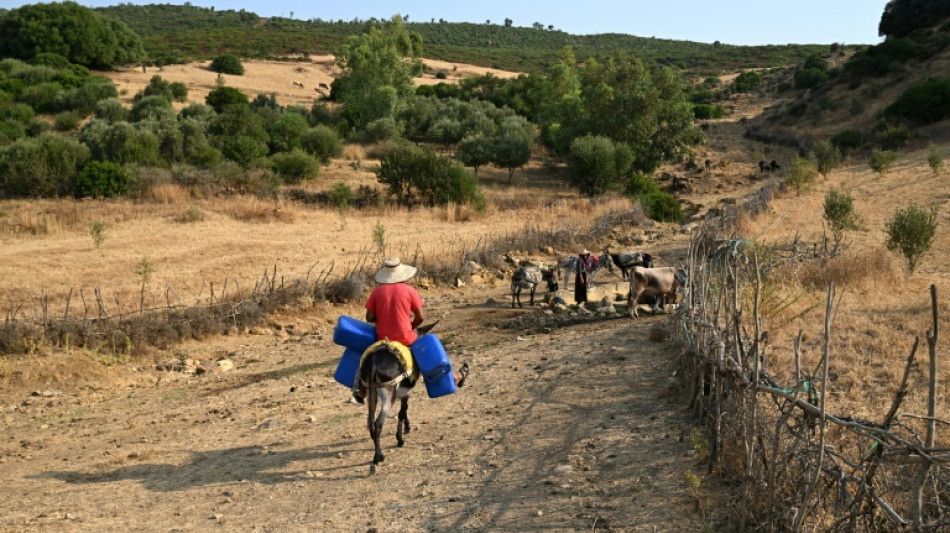
Extreme heatwave grips Tunisia as wide power cuts fuel frustration / Photo: © AFP
In Tunisia long power outages across the country have added to the strain of an intense heatwave, with temperatures as high as 49C, leaving many fearing for their livelihoods.
For days, the STEG state electricity and gas company has been issuing daily heat alerts listing neighbourhoods where it would cut electricity to reduce pressure on the national grid.
STEG Chief Executive Faycel Trifa said heavy air conditioner use had pushed the electricity network to its limit.
Another company official told state television that electricity demand may have reached a record six gigawatts on Tuesday, after hitting 5.6 gigawatts only days earlier.
Power and water cuts have affected parts of Tunisia in previous summers, but this year's outages have spread across much of the country.
Some residents said their electricity had gone off for up to six hours at a time, others said even longer.
"It feels like God has opened the gates of hell," said an employee at a pastry shop in Tunis, where cakes sat in the dark and the refrigerators had stopped running.
The outages have become one of the country's main talking points, both online and in the streets. Some now say they avoid elevators for fear of being trapped inside.
President Kais Saied called the repeated outages abnormal and said those responsible for the failures should be held accountable.
- Ageing grid -
STEG said the controlled outages were necessary to prevent a nationwide blackout.
Hela Tlili, a professor at Tunis El Manar University who has done extensive work on renewable energy, said the power system was struggling under record summer demand and peak tourism.
She also said the electricity network had not kept pace with high consumption.
"Demand is growing much faster than production," she said.
Tunisia still relies heavily on natural gas to generate electricity, but declining domestic production has increased its dependence on imports, while financial pressures have strained the state utility.
Tlili also pointed to an ageing grid and years of insufficient maintenance.
Scientists say human-driven climate change is increasing the length, intensity and frequency of heatwaves.
Tunisian business groups fear the outages are hurting the economy.
Employers' organisation CONECT said the lack of precise schedules for planned cuts made it difficult for companies to prepare for production.
An employee at a factory in a Tunis suburb who requested anonymity said work had almost stopped for two days because of the repeated outages.
One butcher raised concerns over the potential damage to his equipment by the cuts as well as a drop in voltage: "They're going to ruin my refrigerator."
- 'Change of paradigm' -
Tlili said Tunisia also needed to speed up the development of renewable energy.
The country has vast solar potential and favourable conditions for wind power, but the biggest challenge would be storing electricity, Tlili said.
That would require significant public investment, she added, arguing that Tunisia needs "a change of paradigm" diversifying its energy resources.
Meanwhile, many Tunisians struggle to cope with the heat.
Mariem, a resident in the working-class suburb of Bhar Lazreg north of Tunis who asked to use a pseudonym, said she couldn't afford an air conditioner and her fan had broken down.
"I slept on the floor to find a little coolness," she said, adding that her son would sleep with a frozen bottle of water wrapped in a towel on his chest.
The extreme heat has also raised concerns about prison conditions, with inmates held in cells that advocates say are ill-equipped to withstand high temperatures.
Dhaker Lahidheb, a cardiologist with a significant following on social media, called on Saied to grant what he described as "climate pardons" to inmates with chronic illnesses who were not convicted of serious crimes.
C.Stevenson--TNT