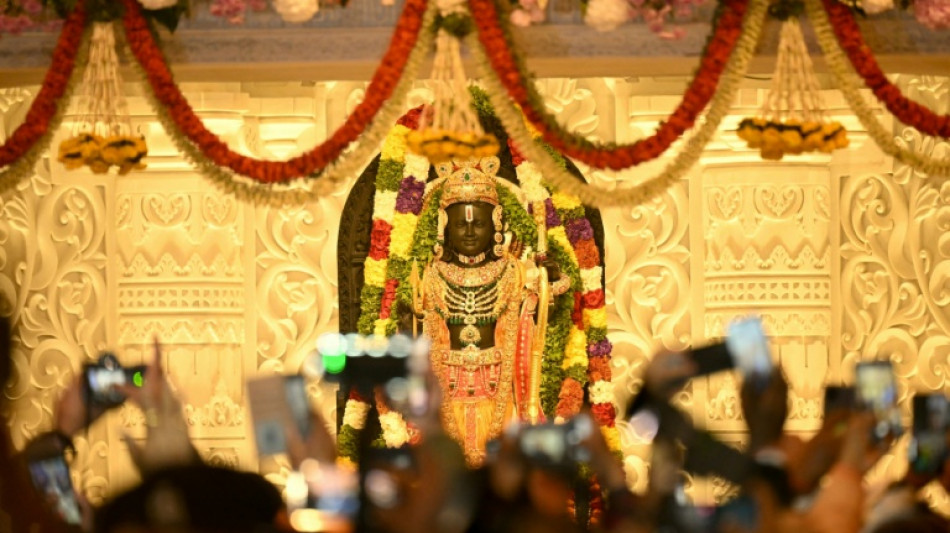
India probe into stolen donations tests trust in temple finances / Photo: © AFP/File
A probe into donations allegedly siphoned off at India's grand Ram temple has renewed scrutiny of how religious sites manage vast amounts of cash and gold entrusted to them by devotees.
Police launched an investigation in June and arrested eight people responsible for handling donations at the revered Hindu shrine in the northern city of Ayodhya.
Authorities have not disclosed the amount allegedly stolen, but media reports say it could amount to 30 million rupees ($314,000).
Ashok Prasad Kushwaha, an auto-rickshaw driver in Delhi who has visited the Ram temple three times in two years, said donations are acts of faith made even by people with modest incomes.
"When we donate, we believe the money is going for God's work," he said.
"Now if that hard-earned money gets stolen from a place like a temple, it feels like personal loss."
The case is the latest in a series of scandals involving donations at major pilgrimage sites, including the Badrinath shrine and Tirumala Tirupati Devasthanams, one of the world's richest temple trusts with assets estimated at $31 billion.
With some religious institutions managing vast sums of money and operating on a scale comparable to major corporations, ensuring transparency is a persistent challenge.
"The core systemic problem is the lack of transparency and accountability," said Rahul Easwar, a Hindu activist and grandson of a former chief priest of Kerala state's Sabarimala temple.
- Fraught history -
Large religious institutions need stronger financial controls, including mandatory receipts, digital accounting systems, CCTV monitoring of donation handling and independent oversight, Easwar told AFP.
The loopholes have been glaring at the Ram temple, with the accused reportedly taking advantage of weak counting processes and surveillance lapses.
Inaugurated in 2024 by Prime Minister Narendra Modi, the Ram temple has become one of India's most prominent religious sites, drawing an average 90,000 visitors every day.
Devotees often bear offerings ranging from cash and gold to silver ornaments, generating a steady stream of donations.
The allegations of wrongdoing are particularly sensitive given the temple's significance, standing on a site that was at the centre of one of India's longest-running religious disputes.
Devout Hindus believe that the god Ram was born there more than 7,000 years ago, but that the Babri mosque was built over his birthplace by a 16th-century Muslim emperor.
The dispute erupted into nationwide unrest in 1992 when Hindu mobs demolished the mosque, triggering violence that killed more than 2,000 people.
In 2019, the Supreme Court awarded the disputed site for construction of the temple, paving the way for a huge fundraising drive across the country to finance the project.
According to the trust which manages the temple, the campaign raised some $341 million.
- Growing market -
India's religious and spiritual market was valued at $70.14 billion in 2025 and is projected to reach $135.41 billion by 2034, according to consultancy firm IMARC.
Legal experts say oversight varies widely across India because religious institutions operate under multiple laws and tax systems.
"There is no uniform national framework prescribing consistent standards of financial transparency across all religious institutions," said Sonam Chandwani, managing partner at KS Legal & Associates.
Easwar pointed to the challenges posed by mass events such as the Kumbh Mela pilgrimage, where millions of devotees gather and large volumes of offerings are collected.
Political analyst Anurag Naidu said temples regularly handling huge amounts of cash need systems comparable to those in large public institutions.
"Religious institutions have grown far beyond traditional places of worship," he said. "They need institutional systems with financial controls and independent oversight."
F.Adams--TNT