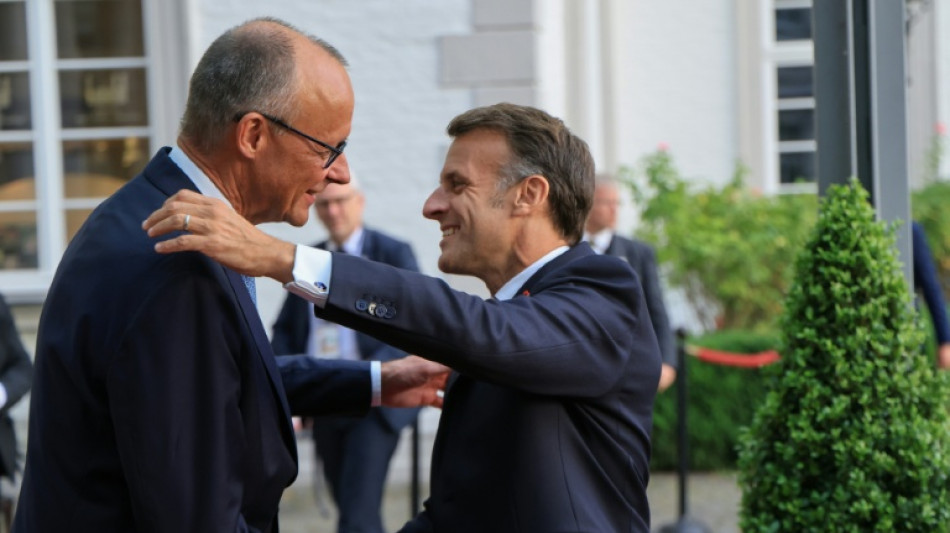
Germany and France seek 'new dynamic' on defence after fighter jet failure / Photo: © AFP
France and Germany will seek to move on from the failure of a tortured fighter jet project and bolster other joint defence plans -- including nuclear deterrence -- at a joint government meeting on Friday.
After one-on-one discussions over dinner on Thursday evening at Bensberg Castle in the town of Bergisch Gladbach, French President Emmanuel Macron and German Chancellor Friedrich Merz will chair Friday's annual meeting, held this time near Cologne.
Speaking to the press before their meeting, the two men struck a warm note, with Macron thanking "my friend the chancellor" for coming to Bastille Day celebrations in Paris earlier this week.
"Whether it concerns investments, innovation, or trade protection... in recent months we have seen a genuine Franco-German convergence," Macron said.
He added that Friday's meetings were aimed at giving a "new dynamic" to defence cooperation as part of creating a "powerful Europe which unites our strengths".
There will also be a Franco-German Defence and Security Council meeting at the Noervenich Luftwaffe air base, symbolically underlining the need for European rearmament to ward off the threat from Russia and compensate for waning US commitment.
Two French Rafale jets -- which can carry nuclear weapons -- were deployed on Thursday to the same airbase, with a German Eurofighter plane being refuelled mid-air by a French aircraft, a Luftwaffe spokesman told AFP.
The French presidency says it wants Friday's talks to advance "concrete" projects in order to "bounce back" from last month's implosion of the joint Future Combat Air System (FCAS) fighter jet project, which fell victim to bickering between Airbus and France's Dassault.
There are also fears for another joint project, the Main Ground Combat System (MGCS), which aims to replace battle tanks used by France and Germany and has been buffeted by internal tensions since Germany's Rheinmetall entered the project.
Air defence has been another bone of contention with Germany pushing its European Sky Shield Initiative (ESSI), which relies heavily on the American Patriot and the Israeli‑American Arrow‑3 systems.
France has refused to take part in this project, arguing that it would increase Europe's dependence on the US and that the continent should instead seek to boost its own defence industry.
- Historic site -
Merz's stated ambition to give Germany the "strongest conventional army in Europe" has been welcomed by Berlin's partners but there are worries in France -- the world's second-largest arms exporter -- over fresh competition from German industry boosted by a borrowing splurge.
Those disagreements, and the fact that Macron will not be president by the time of the next annual meeting, add to the urgency of the two allies making progress on other issues, in particular the idea of a nuclear deterrence scheme led by France.
Macron said earlier this year that Germany was one of eight countries which had agreed to participate in the project.
However he has stressed that France -- one of Western Europe's two nuclear powers alongside the United Kingdom -- will retain tight control over nuclear decision-making.
A German government source said that it was important for any French led project to remain "complementary" to NATO and to avoid creating "different security zones" within Europe.
Friday's meeting will be held at Augustusburg Castle in Bruehl near Cologne, "an important site for Franco-German relations", as Merz pointed out on Thursday alongside Macron.
The castle was where French president Charles de Gaulle and German Chancellor Konrad Adenauer agreed on the idea of a friendship treaty between the two countries in 1962.
At Friday's meetings the two sides are expected to launch a Franco‑German "steering group" to deepen cooperation on radar systems, "deep‑strike capabilities" and missile defence.
Macron and Merz are also set to discuss European competitiveness, the EU's budget, digital regulation and initiatives to fight disinformation.
S.Collins--TNT