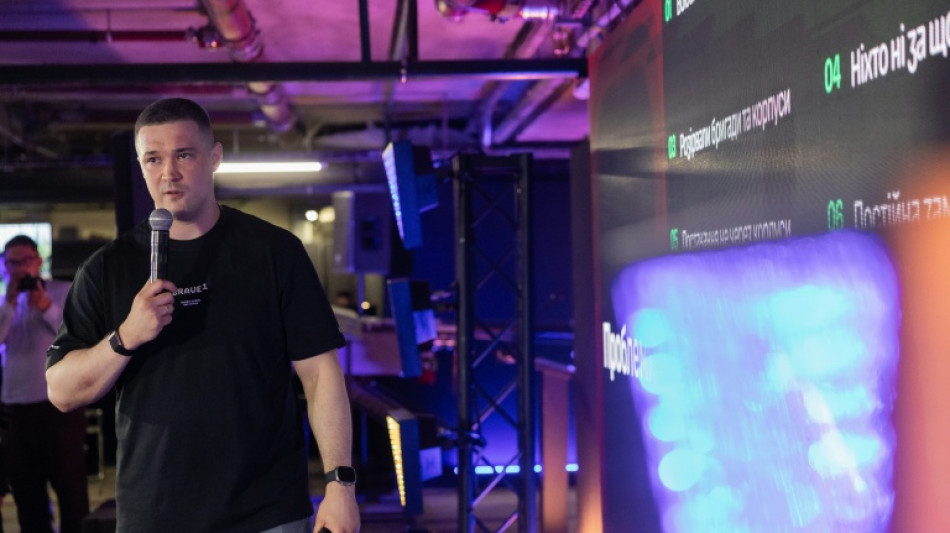
Ukraine's ousted defence chief whose reforms riled army bosses / Photo: © AFP
Ukraine's ousted defence minister Mykhailo Fedorov was just six months in the role before his ambitious drive to reform the military led to unreconciliable clashes with the country's top brass.
He increasingly battled with a top command he cast as out of date, not flexible and bogged down with bureaucracy.
His dismissal triggered rare protests in Kyiv and other cities, and in the chaos it was unclear whether he, or his opponent commander-in-chief Oleksandr Syrsky, would gain the upper hand in the political dogfight.
Famed as a digital disruptor, Fedorov was tasked with modernising the army, fatigued after more than four years of fighting back against Russia's full-scale invasion.
He boosted salaries, announced plans for partial demobilisation and introduced game-like rewards systems for units that kill the most Russian soldiers.
But conflicts with the more traditional guard plagued his tenure.
At a press conference he convened in Kyiv on Thursday, standing in front of a large screen showing images of drones, in a trademark dark T-shirt, Fedorov defended his legacy, and hit out at army chief Syrsky.
"All the initiatives we were proposing started to be blocked, and Syrsky... is not ready to look you in the eye and openly talk about those problems," he said.
"The war has completely changed... We can't keep going on what worked back then."
- 'Unity' -
Syrsky, Fedorov contended, forced Zelensky to choose between them.
Asked about the row, Zelensky acknowledged the two sides were barely on speaking terms, saying he had made the change for the sake of "unity".
From the outset, Fedorov -- who never served in the army -- clashed with the military's command and their traditionally stiff approach.
He held lengthy TED Talk-style briefings, dressed casually and engaged with journalists, trying to inject energy into Ukraine's war machine, four years into the Russian invasion.
Appointed in January, the 35-year-old with short salt-and-pepper hair was Ukraine's youngest ever defence minister.
He took over an apparatus facing stretched air defences, financial uncertainty, stalled peace talks, recruitment problems and widespread bureaucracy and war fatigue.
"We will turn the war into a data platform," he said after being appointed in a speech punctuated with jokes.
"We will take all the data and see what works. Everything that works well will proceed," he said -- a personal mantra that would not appear out of place in Silicon Valley.
He gained fans among Ukraine's Western partners, many of whom, including Palantir CEO Alex Karp, had reached out following the dismissal.
- 'Outsmart the system' -
Even before becoming defence chief, Fedorov spent much of the war promoting advanced technology, like drones, as a way to offset Ukraine's shortages in manpower, money and ammunition.
He began his career in digital marketing and his first roles in government were spearheading online services for citizens, including the country's now‑ubiquitous state services app Diia.
After the Russian invasion, he reached out to US tech titan Elon Musk to secure Starlink satellite connectivity for Ukrainian troops.
Fedorov's bet on drones seems obvious now in a war that has come to be dominated by them -- but he was a rare and early advocate.
One of his other trademark initiatives was a killing-for-points scheme -- a data-driven system designed to reward the most effective army units, which some in the system dismissed as gimmicky.
He also launched a series of reforms on procurement and air defence capacities but struggled to overcome Ukraine's everlasting mobilisation problems.
A June 2026 poll from the Kyiv Institute of Sociology said Fedorov ranked among the country's most trusted public figures.
"Fedorov increasingly came to be seen as a new political star and as the most successful reformer in the current government," Political analyst Volodymyr Fesenko told AFP.
"That may not have appealed to Zelensky," he added.
Shortly after he was appointed in January, his advisor and key backer Sergiy Sternenko was confident he could win over the military insiders to his new approach.
"Much depends on the military command but Mykhailo has a vision of how to outsmart the system," he said.
It remains to be seen if the system got the better of him.
C.Stevenson--TNT