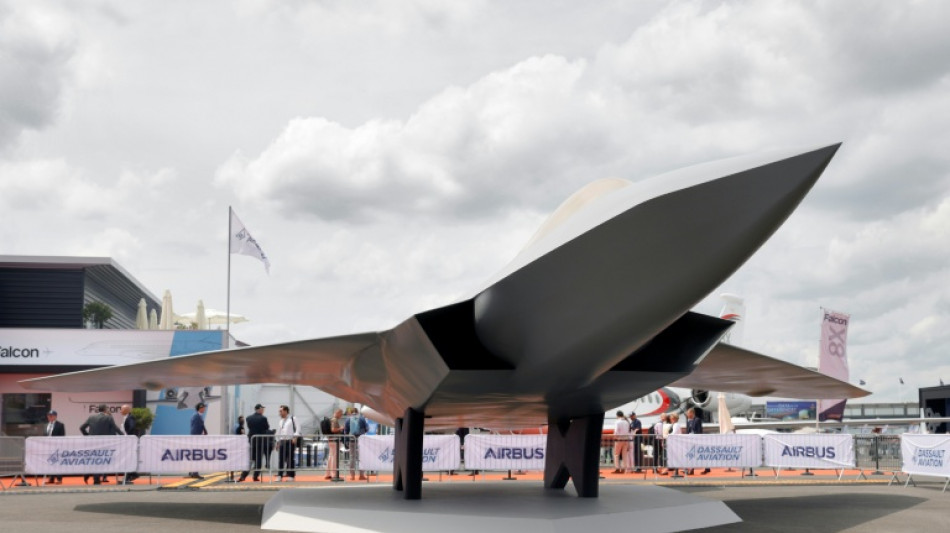
Germany and France seek to 'bounce back' from fighter jet failure / Photo: © AFP
France and Germany will seek to move on from the failure of a tortured fighter jet project and bolster other joint defence plans -- including nuclear deterrence -- at a joint government meeting on Friday.
After one-on-one discussions on Thursday evening, French President Emmanuel Macron and German Chancellor Friedrich Merz will chair Friday's annual meeting, held this time near Cologne.
There will also be a Franco-German Defense and Security Council at a Luftwaffe air base, symbolically underlining the need for European rearmament to ward off the threat from Russia and compensate for waning US commitment.
The French presidency says it wants Friday's talks to advance "concrete" projects in order to "bounce back" from last month's implosion of the joint Future Combat Air System (FCAS) fighter jet project.
Macron said on Monday he "deeply regretted" the failure of FCAS, which fell victim to bickering between Airbus, which represented Germany and Spain, and France's Dassault.
- French 'disappointment' -
There are also fears for another joint project, the Main Ground Combat System (MGCS), which aims to replace battle tanks currently used by France and Germany.
MGCS has also been buffeted by internal tensions since Germany's Rheinmetall entered the project, with disagreements over the concept for the vehicle.
Air defence has been another bone of contention with Germany pushing its European Sky Shield Initiative (ESSI), which relies heavily on the American Patriot and the Israeli‑American Arrow‑3 systems.
In early December, the German military brought into service the first component of the long‑range Arrow missile shield, used for the first time outside Israel.
France has refused to take part in this project, arguing that it would increase Europe's dependence on the US and that the continent should instead seek to boost its own defence industry.
The "disappointment" of French political leaders over ESSI and Germany's earlier purchase of American F‑35 aircraft "turned to anger" over the FCAS debacle, said Jacob Ross, an expert in Franco-German relations, in a recent article.
- Going it alone? -
Merz's stated ambition to give Germany the "strongest conventional army in Europe" has been welcomed by Berlin's partners despite the shadow cast by Germany's Nazi and militarist past.
Nevertheless there are worries in France -- the world's second-largest arms exporter -- over fresh competition from German industry boosted by a borrowing splurge.
There are also doubts over whether Berlin shares Paris's vision of greater European sovereignty.
"The project of having more strategic autonomy in Europe, of having a stronger Europe within a stronger NATO, can't exist without Germany and seeing as Germany is now going it alone, our worry is that we won't be able to manage," a senior French official told AFP.
Those disagreements only add to the urgency of the two allies making progress on other issues, in particular the idea of a nuclear deterrence scheme led by France.
Macron said earlier this year that Germany was one of eight countries which had agreed to participate in the project.
However he has stressed that France -- one of Western Europe's two nuclear powers alongside the United Kingdom -- will retain tight control over nuclear decision-making.
Friday's meetings are expected to launch a Franco‑German "steering group" to deepen cooperation on radar systems, "deep‑strike capabilities" and missile defence.
Macron and Merz -- who will have a one‑on‑one meeting on Thursday evening -- are also set to discuss European competitiveness, the EU's budget, digital regulation and initiatives to fight disinformation.
S.Collins--TNT