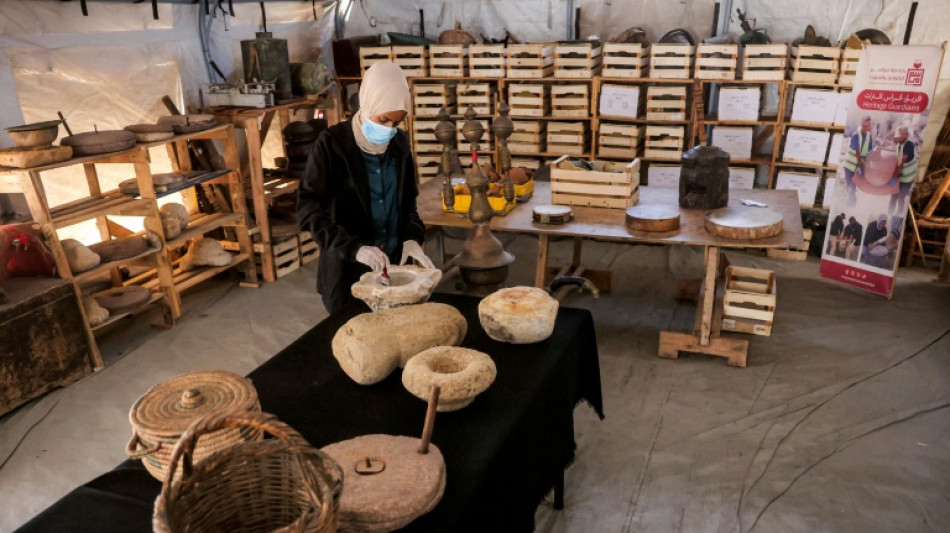
Saving Gaza's past, one artefact at a time / Photo: © AFP
Armed with paintbrushes and wearing surgical gloves, volunteers inside a large tent in Gaza delicately brushed dust from a stone mosaic before placing it into storage, part of an effort to preserve cultural heritage hit by war.
More than 160 historic and cultural sites across the Palestinian territory have been damaged during the conflict between Israel and Hamas, according to the United Nations.
Many of these artefacts date back thousands of years.
"Several mosaic artworks have been lost or destroyed, either completely or partially," said Mohammed Abu Lahia, a Palestinian visual artist taking part in the preservation efforts in the south Gaza city of Khan Yunis.
"It is important that we work to revive this art, remind our children and our community, and send a message to the world that we are committed to our heritage and our Palestinian cause."
Beyond archaeological treasures, more recent cultural artefacts are also at risk of being damaged or buried beneath rubble from shelling and airstrikes.
More than 90 percent of Gaza's buildings have been damaged or destroyed during the conflict, according to the UN.
Over the centuries, Persians, Greeks, Romans, Byzantines and Ottomans all left their mark on Gaza, creating a rich historical landscape of churches, mosques, ports and artefacts, many of which have suffered damage during the conflict.
"This stone is a piece called a mortar, and it was used for grinding grains and herbs. It is approximately 5,000 years old," said Muhannad Abu Lahia, a cultural heritage guide with the Mayasem Association for Culture and Arts, the NGO leading the preservation efforts.
Behind him, artefacts already catalogued for safekeeping were stacked on wooden shelves inside weatherproof plastic containers.
- Preserving the past -
With Israel maintaining tight controls over goods entering the Gaza Strip -- restrictions that have at times contributed to severe shortages of food and other supplies -- volunteers have had to work without professional conservation equipment.
Instead, they gently removed dust from mosaics using ordinary paintbrushes and built a makeshift scanning station by mounting a camera above a box lined with black craft paper.
The improvised scanner allowed volunteers to digitise old photographs and paper documents, which were then uploaded to a computer for preservation.
Not everything entering storage is ancient.
Many items date from the 20th century, including the late Ottoman period, the British Mandate and the Egyptian administration. Their owners sought to save them from destruction or loss after being displaced.
"This is a paper archive containing maps of Khan Yunis and structural maps of the Khan Yunis area from the time of the British Mandate," said 29-year-old volunteer Taghreed Hajjari.
At one table, three women painstakingly rearranged hundreds of fragments to recreate a contemporary mosaic, using a printed copy of the original artwork as a guide and trimming excess stone with carpenter's pincers.
Many artefacts, however, remain beyond the so-called "Yellow Line", which separates territory under Hamas control from areas held by the Israeli forces.
Israel says it now controls more than 60 percent of the Gaza Strip, up from about half when the ceasefire took effect in October last year.
Volunteers say retrieving artefacts from Israeli-controlled areas remains extremely difficult.
Meanwhile, Hajjari said efforts continue to preserve everything still within reach, including documents that chronicle centuries of Gaza's history.
"We also have newspapers and documents here from the British Mandate and the Egyptian era until the arrival of the Palestinian Authority," she said.
"They were collected through visits and conversations with elderly residents.
"We documented their oral histories so they can serve as a reference for future generations."
S.Cooper--TNT