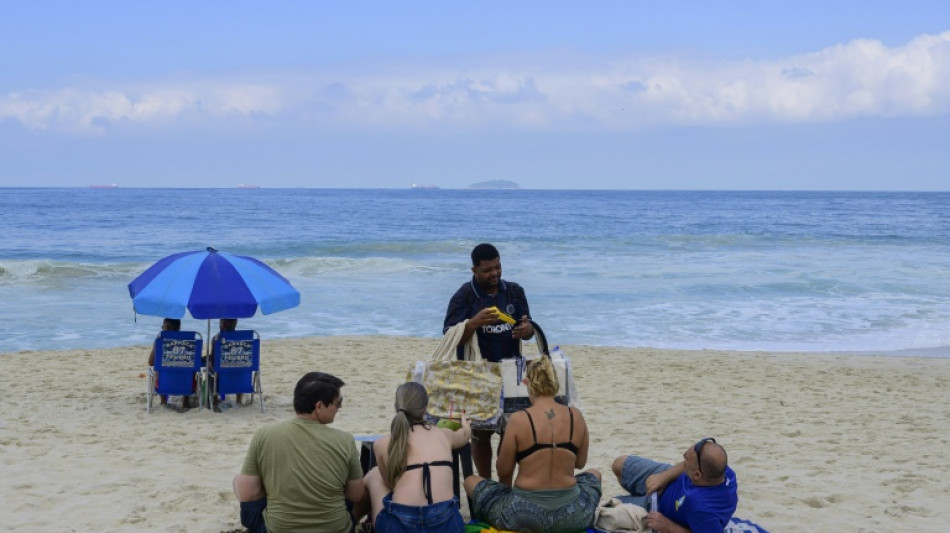
Why does Brazil's PIX payment system bother Donald Trump? / Photo: © AFP
Whether buying a chilled coconut at the beach or paying rent, Brazil's free PIX system has become the dominant way of making payments in Latin America's largest economy, with just a smartphone.
US President Donald Trump does not like it one bit.
The payment system, launched in 2020 by the central bank, has become a bone of contention between Washington and the government of President Luiz Inacio Lula da Silva, who is seeking re-election in three months.
The United States argues that PIX amounts to unfair competition and hurts US credit card companies.
"You don't have to pay any fees for PIX; with banks, you have to pay credit card fees, annual fees, banking fees, fees for this and that," Paulo Ricardo Conceicao told AFP at his drinks kiosk on Copacabana beach.
The perceived unfairness of the PIX system and other alleged discriminatory trade practices has led the US to threaten a 25 percent tariff on some Brazilian exports.
A decision on this measure is expected in the coming days.
- What is PIX? -
According to the central bank, PIX accounts for 54 percent of all payment transactions in Brazil, with millions of transfers per day -- just six years after its launch.
Major financial institutions are obliged to offer the service to their clients, who simply open their banking app and send a payment in seconds using an identifier such as an identity number, key, or email address.
Payments can be even easier using a merchant's QR code.
PIX "successfully reached millions of Brazilians who were previously excluded from the traditional banking system," Brazilian Foreign Minister Mauro Vieira said in a letter to the Office of the United States Trade Representative (USTR).
The system is used by 80 percent of Brazil's 212 million people.
"Before, we had to carry cash and a bunch of stuff in our wallets. Now, you just grab your phone and make a PIX transfer. I think it’s made life a lot easier for everyone," Ingrid Ferreira, a 32-year-old civil servant, told AFP in Brasilia.
- What is the United States' complaint? -
Washington alleges that the central bank, as owner and regulator of PIX, faces a conflict of interest and puts US companies at a disadvantage.
The Trump administration complains about BCB requirements that banks feature PIX on the home screens of their apps and refrain from charging user fees.
The USTR said it was "forcing US providers to promote their Brazilian competitor, without compensation."
The Trump administration has rebuffed calls in the United States for it to create a similar electronic payment system.
A Brazilian government source told AFP that Washington's grievance stems from credit card companies, whose share of transactions in Brazil has dropped from 23 percent to 15 percent since 2020.
"A large part of the Brazilian population works in the informal service sector. They are small business owners who were largely at the mercy of those major credit card operators, paying fees," Professor Marco Sanfins of the Fluminense Federal University told AFP.
- What does Brazil say? -
Brasilia has rejected Washington's accusations, saying that PIX has expanded the entire digital payments system, which increases online activity and benefits US companies like Google.
And the central bank highlights that the number of card users has increased in Brazil since 2020.
Brazil believes that Washington sees PIX and other such payment systems as a potential threat to the international dominance of the dollar.
Kenya, Nigeria, India and Colombia have all developed similar systems.
- Why is this politically sensitive? -
Lula's main rival in the October presidential election is Flavio Bolsonaro, son of far-right former leader Jair Bolsonaro, who is serving a 27-year sentence for attempting a coup d'etat.
Trump imposed tariffs on Brazil last year over the trial against his ally, which the US president described as a "witch hunt". Most of those duties were later lifted.
While Jair Bolsonaro's sons had lobbied for those tariffs during their father's trial, Flavio Bolsonaro is now arguing against new ones, arguing they could boost Lula's electoral campaign.
"PIX is good for Brazil and, incredible as it may seem, it is also good for the United States," Flavio Bolsonaro said after a USTR hearing in Washington, defending the system.
jss-jiog/fb/dw
A.M.Owen--TNT