‘Almost like gold’: water debate rages on Italy’s Aeolian Islands / Photo: © AFP
Without natural drinking water, residents of Italy's Aeolian Islands are mulling whether to build more desalination plants that will also cater to the large number of tourists, or continue bringing in water by ship.
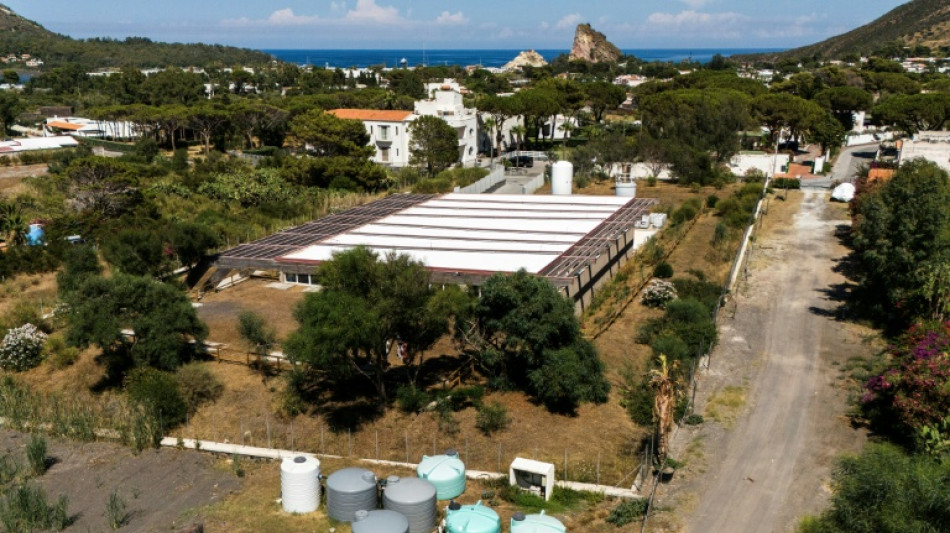
An existing desalination plant with large white silos on Vulcano, one of the archipelago's eight islands, has made it autonomous for drinking water.
But another island, Stromboli, still depends on ships with water cisterns. When they can’t dock in bad weather, "We’re left without water," restaurant owner Angelo Mirabito, 66, told AFP.
In the summer, the influx of visitors is a challenge for the Aeolian Islands. which have only around 15,000 year-round residents.
In 2024, the last year for which official data is available, the number of tourist arrivals on the islands lying to the north of Sicily was 146,000 people.
"For 10 years, we have been producing a constant 300,000 cubic metres per year" of drinking water, said Fabio Pupillo, an engineer for Sopes, the company that manages the desalination plant in Vulcano.
The cost of the drinking water produced by desalination plants on the Aeolian Islands is around two euros per cubic metre.
Water brought by ship is around 14 euros per cubic metre -– a cost covered by the defence ministry which organises the supply route.
- ‘Extremely precious’ -
Italy is second to Spain in the EU for desalination capacity, accounting for around 7.6 percent of daily EU production, according to data from the think tank The European House -- Ambrosetti.
The country currently produces a little more than 657,000 cubic metres per day of desalinated water thanks to 341 plants.
On the Aeolian islands of Alicudi, Filicudi, Panarea and Stromboli, a plan for four new desalination plants proposed by the local municipality is proving divisive.
Some associations and local residents say there is not enough data on the environmental impact in an area with fragile ecosystems.
Giuseppe Amato, a campaigner on water issues in Sicily for environmental NGO Legambiente, said that using desalination plants on small islands was "an appropriate response, particularly taking into account the various hydrological crises brought about by the global climate crisis".
But, those plants need to be planned well and used wisely, he said.
Amato questioned whether the desalination plant proposed for Filicudi should be built for the 250 permanent residents or for the "maximum number of tourists that Filicudi can have during the peak of the season".
In a letter last month to the municipality of Lipari and the Sicily region, the environmental foundation Marevivo called the authorisation procedure for the desalination plants to be suspended.
The foundation believes that alternative and complementary solutions should be taken into account -- like recycling water, collecting rain water and "better management of tourist demand".
Eugenio Vodini, who organises boat trips for holidaymakers, said that "unlike tourists", local residents "know how to manage" their drinking water.
"It is an extremely precious thing, almost like gold, because what can you do without water?" he said.
A.Wood--TNT