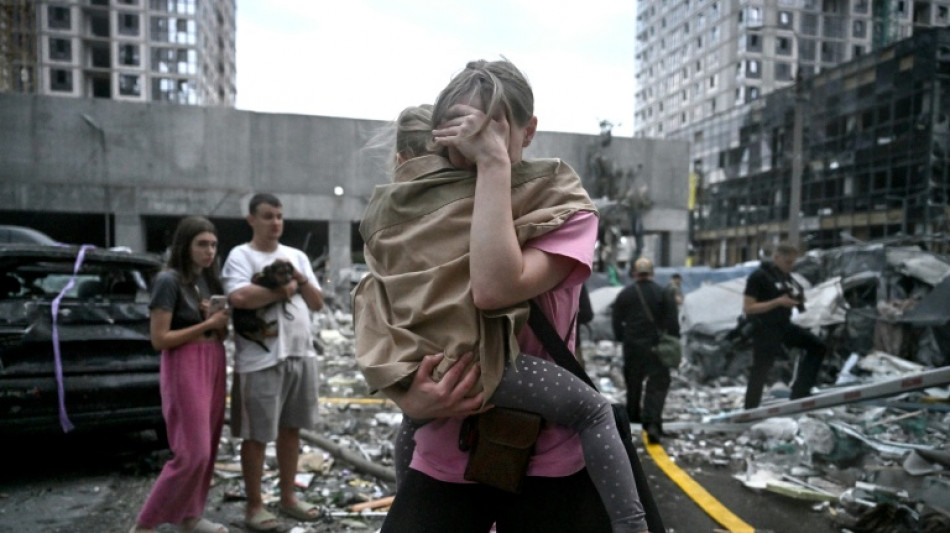
Nerves high in Kyiv as Russia escalates missile attacks / Photo: © AFP
Through more than four years of the Russian invasion, 27-year-old Oleksiy Virskovsky largely hasn't bothered going to to the underground shelter in the building next door -- despite almost nightly missile and drone attacks.
Now, he told AFP in Kyiv, that has changed.
Russia's strikes on the Ukrainian capital have become "more aggressive", "more massive" and "more intense", Virskovsky said.
"It's somehow become more frightening, and I've started going down to the shelter... I've begun to take safety more seriously than before," the student added.
Moscow has been firing missiles and drones at Kyiv since the first day of the invasion.
But a spate of deadly attacks using dozens of ultra-fast ballistic missiles that Ukraine's air defences struggle to intercept have frayed nerves.
More than 50 people have been killed in Kyiv so far in July -- with two of the deadliest strikes on the capital of the entire war coming less than a week apart.
In a strike on the night of July 5-6, Kyiv's defences failed to down a single ballistic missile -- a worrying development for what was previously seen as the best protected area of the country.
In another attack, the blast of a missile over the Kyiv skyline rocked sleeping residents even before the city's air alert sirens managed to sound.
It was a rare, unexplained, glitch in a system that blares out warnings of incoming attacks multiple times a day through loudspeaker announcements on the street and metro, and the collective ping of phone notifications.
- 'Nerve-racking' -
President Volodymyr Zelensky has conceded Ukraine does not have enough US-supplied Patriot missile interceptors to adequately protect the city.
At a NATO summit on Wednesday, US President Donald Trump appeared to give the green light for Kyiv to start manufacturing its own -- but the details remain unclear and it will take months before they can be used.
In the meantime, most people in Kyiv are reassessing the routines they have developed over the last four years.
Through personal experience and helped with a plethora of social media channels that track incoming Russian missiles and drones, many felt they had calibrated a good sense of how real and immediate the danger was at any given point.
But the ballistic strikes -- which can reach Kyiv within just a few minutes -- have upended that.
On days when a big attack is expected, some residents now head straight to metro stations -- the typical underground overnight refuge -- when they finish work, not waiting for the air alert.
The station floors -- packed with people taking their pets, tents, air mattresses, prams and cots -- have become overcrowded.
The Kyiv metro said more than 50,000 camped out inside the network on the night of a recent attack -- the most since the first months of the war.
Veronika Khudenko, in Kyiv for the past month for an internship from London, has spent every single night there.
"The latest attacks are very hard to bear, very nerve-wracking," the 22-year-old told AFP.
"It's very hard to function during the day, because there is strong emotional pressure throughout the night," she added.
- 'Children are afraid' -
Anna Nesterova, a 46-year-old podologist, told AFP she is still hanging tight at home.
"We sit in the hallway," she said, citing a fear of being stuck in a crowded underground during an attack.
"It's more convenient for me and I feel calmer at home."
Her son has been at the front since he turned 18. Nesterova feels a duty to be "calm" for him.
Another who stays at home is Yulia Parkhomenko, a 34-year-old mother of two. The metro is too far from her home and there are no decent shelters or basements nearby.
So as soon as the air alert starts, she takes blankets and pillows into the bathroom with her children and hunkers down.
"With each attack it's getting more and more frightening," she said.
"And the scariest thing is for the children. My children are just very afraid."
afptv-fv/jc/rlp
H.Davies--TNT