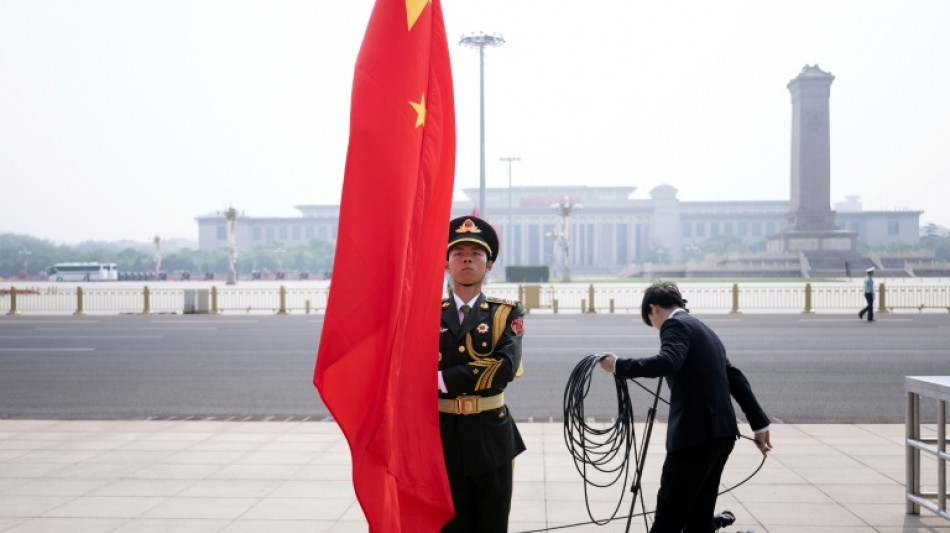
China sends nuclear missile message as US looks elsewhere / Photo: © AFP
China's test of a long-range submarine-launched missile is a stark demonstration of its growing military power at a time when US attention is primarily focused on the Middle East and the Iran war rather than Asia.
The launch of the nuclear-capable weapon earlier this week -- two years after China fired an intercontinental ballistic missile (ICBM) into the waters near French Polynesia -- drew condemnation from countries in the region as well as the United States.
But it was soon overshadowed by the resumption of US strikes on Iran, the latest round of violence between the two countries despite an April 8 ceasefire.
The missile test "suggests Beijing is interested in demonstrating (both to itself and the world) that its emerging nuclear triad is credible," said Nathan Beauchamp-Mustafaga, a senior policy researcher at RAND.
He was referring to the ability to launch nuclear weapons by land, air and sea, which increases the survivability of a country's atomic arsenal -- and thus the threat it poses to adversaries such as the United States.
However, it "appears to confirm already known capabilities in China's nuclear program, so the importance of the test for Washington and the region is less technical than the strategic and political symbolism of China's demonstration," Beauchamp-Mustafaga said.
Details about the weapon that China tested are limited, but Taiwan, the self-governing democracy claimed by Beijing, identified it as a JL-2 -- a submarine-launched ballistic missile with a range of some 7,000 kilometers (4,350 miles) that was fired from the sea's surface rather than from underwater.
Monitors said the missile was launched from a nuclear submarine and appeared to land near the Solomon Islands.
China operates six nuclear-powered ballistic missile submarines that can carry up to 12 missiles each, according to a 2024 Pentagon report to the US Congress.
- Signal to US -
Emma Chanlett-Avery, director for political-security affairs at the Asia Society Policy Institute, said the test "is a signal to the United States, as well as to other regional powers, of China's military might."
"I think it targets the whole idea of US-led alliances in the region," Chanlett-Avery said, noting that China is "consolidating their power in the region at a time when our alliances are under some degree of strain."
Donald Trump and his administration have long demonstrated their disdain for alliances, including with NATO countries, which the US president repeatedly criticized during this week's summit in Turkey of leaders from the trans-Atlantic bloc.
And while successive US administrations have pledged to increasingly shift their focus to countering China, other conflicts -- most recently the Iran war that the United States and Israel launched in late February -- have drawn attention away from the Asia-Pacific region.
Washington slammed the missile test, with the State Department saying Beijing's "rapid and opaque nuclear weapons buildup is of great concern" and urging China to "engage in meaningful arms control discussions."
Jacob Stokes, senior fellow at the Center for a New American Security, said the launch shows China "is looking to consolidate its nuclear triad through more operational tests for what would be real-world use."
"You saw the land-based ICBM in September 2024 and so this is another leg of the triad, the water-based leg," said Stokes, noting that "if the pattern holds, we should see an air-launched ballistic missile in the future."
"This is notable in that we see a very clear progression of China's nuclear forces," he said.
"One of the signals coming out of this is that... China is increasingly in that category with the United States and Russia as a very capable nuclear force."
S.Collins--TNT