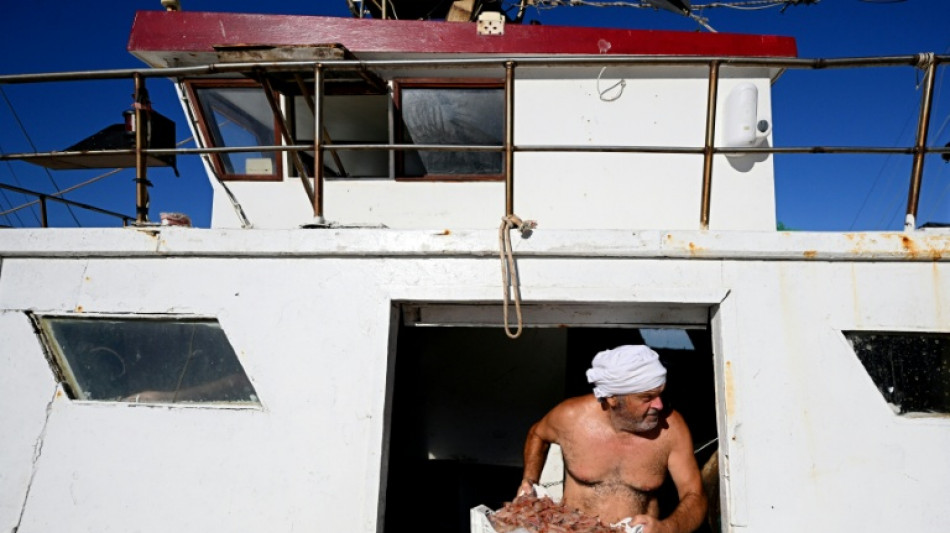
Sunken wrecks, hot seas threaten fishermen on Italian isle / Photo: © AFP
Once the beating heart of this Italian island community, fishermen on Lampedusa are under pressure on multiple fronts, from nets ripped by sunken migrant wrecks to a warming Mediterranean Sea.
The semi-arid outcrop, closer to North Africa than Italy, is a port of call for people attempting the perilous crossing to Europe, and their capsized or abandoned boats dot its emerald depths.
"The nets are continuously torn... there are days when you snag two, three (migrant) boats," 71-year-old fisherman Salvatore Mannino told AFP.
"We map the boats, but they move. They can snag one (fishing boat)" then later "another passes and gets caught too," he said, as he and a fellow fisherman mended a broken net while the sun beat down on the pier.
Mannino comes from generations of fishermen, but has told his children they had no future in the sector.
The island's economy is based largely on fishing and tourism, though its fishing fleet has "shrunk by 50 percent" since the early 2000s, according to Salvatore Martello, head of Lampedusa's fishing co-operative.
- Island's identity -
Some from the younger generations have transformed their family boats into pleasure boats for holidaymakers.
But fishing "gives Lampedusa's tourism its identity," Martello said.
Failing to support the sector will have "an automatic repercussion on tourism, because people come to eat fresh fish," he said.
Fisherman Pietro Riso's sons did follow him into fishing -- catching red mullet, calamari and rose shrimps -- but just last week clashed with a migrant boat.
"It hit under the stern... and could have perforated our vessel, it could even have sunk it," the 67-year-old told AFP.
The tin or iron boats are either shipwrecked, or abandoned after the migrants on board are rescued.
Run-ins happen between seven and 10 times a year, Riso said. The latest caused up to 4,000 euros worth of damage.
It is not the only cost weighing on the sector: fuel prices -- driven up by the Iran war -- are even higher on Italy's islands than the mainland.
The fishermen accuse competitors from Tunisia, Algeria and Egypt of illegally fishing in Italian waters, and say some restaurants on the island serve cheaper frozen fish from Spain instead of the local catch.
The Lampedusa fishermen also have to go further out to catch some species, due to the warming sea.
The Mediterranean is one of the fastest-warming seas in the world, and marine heatwaves are getting longer and more intense due to man-made climate change.
That can cause stocks to decline or move elsewhere, making some traditionally-fished species harder to find.
- Extreme temperatures -
"Extreme water temperatures are pushing species past their thermal limits," Giulia Bonino, research scientist at the Euro-Mediterranean Center on Climate Change (CMCC), told AFP.
That is "hitting Mediterranean aquaculture and fisheries hard, with real economic consequences," she said.
Heatwaves can also affect fish reproduction and growth, according to the CMCC.
Martello said the warming sea has caused a "shift in the Mediterranean's entire fish production".
And it is an effect of climate change that needs to be acknowledged on a national and European Union level, he said.
Fishermen are banned from a certain area off Lampedusa in September because the eggs laid by red mullets traditionally hatch in that period, Martello said.
"But with the warming water, the red mullets are born earlier," he said.
When the ban comes in, they are no longer young fish that need protecting, "but are big -- and ready to be caught."
N.Roberts--TNT