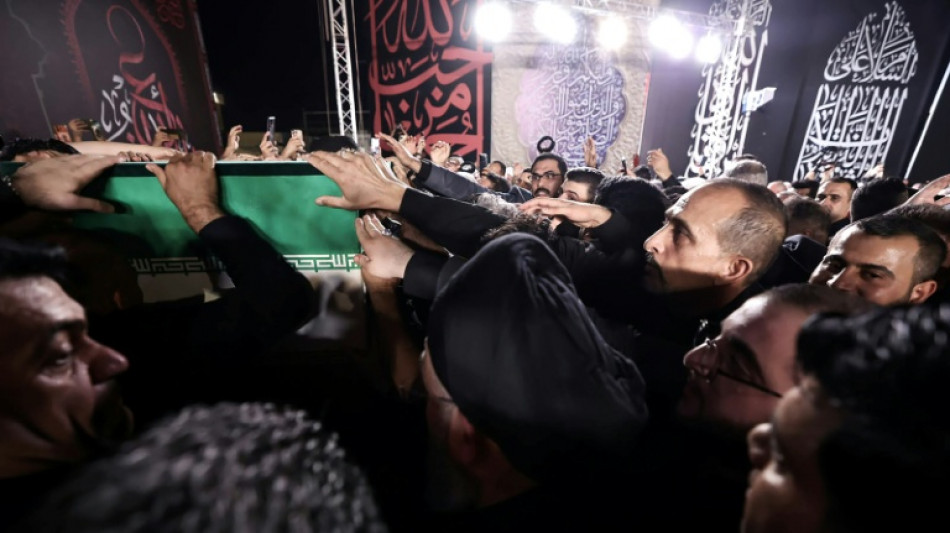
Iraq's holy cities host funeral processions for Khamenei / Photo: © Media office of senior politician and cleric Ammar al-Hakim/AFP
Crowds thronged the streets of Najaf on Wednesday as the coffin of Iran's supreme leader Ali Khamenei moved through the holy city in a procession devoted to Iraq, home to Shia Islam's most sacred shrines.
Iran began six days of public funeral ceremonies for Khamenei on Saturday, including a dedicated day to neighbouring Iraq, a Shia powerhouse with close ties to Tehran.
The Islamic republic hopes the marathon ceremonies will project strength and unity after the Middle East war, which started with US-Israeli strikes that killed Khamenei and several relatives on February 28.
The procession in Najaf came as the United States and Iran renewed hostilities in the Strait of Hormuz, putting more pressure on a deal to end the war.
The US military said it had struck dozens of Iranian targets in response to Tehran's attacks on three ships in Hormuz, with Iran's Revolutionary Guards later saying they had hit US military facilities in Bahrain and Kuwait.
After a massive procession in Iran's holy city of Qom, Iraqi officials and senior politicians received the remains of Khamenei on Tuesday night at Najaf international airport in the presence of Iranian President Masoud Pezeshkian and one of the late leader's sons.
Iraqi authorities declared Wednesday a public holiday, with procession ceremonies starting at at 6:00 am (0300 GMT) in Najaf.
A heavy security deployment was in place as the crowds swelled, with some people pushing close to touch Khamenei's coffin as it rode in the back of a truck en route to the shrine of Imam Ali, the Prophet Mohammed's son-in-law and the first Shia Imam.
At the shrine, dozens of clerics stood ready to pray over the coffin before it was carried on to the city of Karbala.
Khamenei's final burial will take place on Thursday in his hometown of Mashhad in northeast Iran.
His eldest son Mostafa Khamenei was present at the airport on Tuesday, but his successor Mojtaba Khamenei, named supreme leader shortly after his father's killing, has not appeared in public and has only communicated through written statements since his nomination.
- Shrines -
Iraqi Mohammed al-Bayati, 30, who travelled for hours to Najaf, said it was "an opportunity not to be missed to participate in the funeral of the person who challenged the power of America and Israel".
Najaf is the main centre of Shia religious seminaries, and is also home to Grand Ayatollah Ali Sistani, Iraq's top Shia religious authority.
Many senior Shia clerics have studied, taught or lived there, including Khamenei's predecessor Ayatollah Ruhollah Khomeini.
After Najaf, Khamenei's body will be flown to Karbala, about 60 kilometres north, for another procession that will culminate at the shrines of Imam Hussein and his brother Abbas.
The death of Hussein, the third Shia Imam, in the seventh century remains central to Shia history and draws millions of people from around the world to Karbala and Najaf every year.
In Karbala, one banner read "we bid you farewell" and another displayed Khamenei's photo with the caption, "the one who humiliated America".
In both cities, hundreds of volunteer-run stalls serving food and drinks to mourners lined the procession routes.
- 'Spiritual bond' -
The bond between Iraq and neighbouring Iran, both Shia-majority countries, runs deep and is shaped by both religion and politics.
Iranian state media quoted Esmail Qaani, head of the Guards' Quds Force, as saying: "The extensive planning for this historical event by the Iraqi government and people show the depth of the spiritual bond between the two great nations of Iraq and Iran to the whole world."
Ties between Iran and Iraq were not always strong.
In the 1980s, Iraq's late ruler Saddam Hussein, who repressed the Shia population, went to war with the Islamic republic.
But the two countries have become close allies since Saddam's fall in 2003 in a US-led invasion and with the rise to power of Shia-dominated governments in Baghdad.
Today, Iran backs influential politicians but also armed groups, some of which joined the Middle East war after Khamenei's death in support of Iran, attacking US facilities in Iraq.
Haidar Jaafar, who travelled from the southern city of Basra to Najaf, said he expected millions of people to attend Khamenei's procession, "even those who do not align with Iran, just because he was killed by Israeli-American hands".
F.Adams--TNT