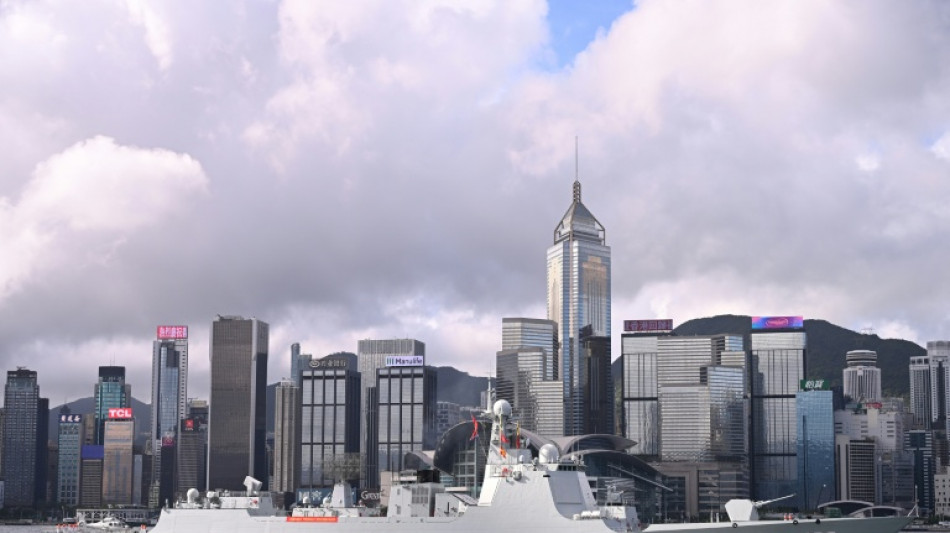
US leads international concern after China test-fires missile into Pacific / Photo: © AFP/File
The United States voiced alarm Monday over Beijing's nuclear program after China test-fired a dummy warhead into the Pacific Ocean, the latest move in its rapid military modernization.
Monday's test came two years after China fired an intercontinental ballistic missile into the waters near French Polynesia, in what had been the first launch of such a missile over international waters in more than 40 years.
Analysts said that the test demonstrated growing Chinese capacity to strike the mainland of the United States, which sees the Asian power as its top adversary despite a reconciliation drive under President Donald Trump.
"At a time when the United States is working harder than ever to prevent nuclear proliferation, China is doing the opposite," State Department spokesman Tommy Pigott said.
"Beijing's rapid and opaque nuclear weapons buildup is of great concern to the region and the world," he said in a statement.
The United States in February allowed the expiration of New START, the last major arms control pact with Russia, as it insisted on a new agreement that also includes China.
The overtures have been rebuffed by China, whose nuclear arsenal is much smaller than Russia's but has been rapidly growing.
The State Department urged China to "engage in meaningful arms control discussions and commit to a regularized notification arrangement for all intercontinental-range ballistic missile and space launches."
New Zealand said that the test took place two hours after China informed Pacific nations of the missile launch, but it was unclear if China gave notice to the United States.
Chinese navy spokesperson Wang Xuemeng said in a statement shared on WeChat that the test launch was "a routine arrangement of China's annual military training," and that "relevant countries were informed in advance."
- Power struggle in Pacific -
Monitors said that the rocket fired from a nuclear submarine appeared to land near the Solomon Islands, the South Pacific nation that forged a secretive security deal with China in 2022 which a new government is reviewing.
Lyle Morris, a senior fellow at the Asia Society Policy Institute, said that the missile demonstrated that China had growing options beyond firing from land.
"A test of this length is a major development and would indicate that China is moving toward a significantly more survivable and longer-range sea-based nuclear deterrent capability," he said.
It shows that China's navy "is capable of targeting the continental United States from bastions close to Chinese waters."
The show of Chinese military might came the same day that Australia and Fiji signed a major defense treaty, part of US ally Canberra's efforts to regain the advantage against China following the controversial Solomon Islands treaty.
Analysts, however, doubted a direct connection, saying that such tests are likely planned well in advance.
Australian Foreign Minister Penny Wong said that the Chinese test was "destabilizing to the region."
Japan, which said it was informed in advance of the launch, said it had strongly urged China to reconsider and voiced "serious concerns" over Beijing's growing military activity.
The relationship between Beijing and Tokyo has become more turbulent since Japanese Prime Minister Sanae Takaichi suggested in November that a potential future attack on Taiwan -- the self-ruled island claimed by China -- could warrant Japanese military involvement.
Russia, a Chinese ally, defended Beijing's test-firing as its "sovereign right" and said that China "is not threatening anyone in the world."
burs-sct/pnb
R.Hawkins--TNT