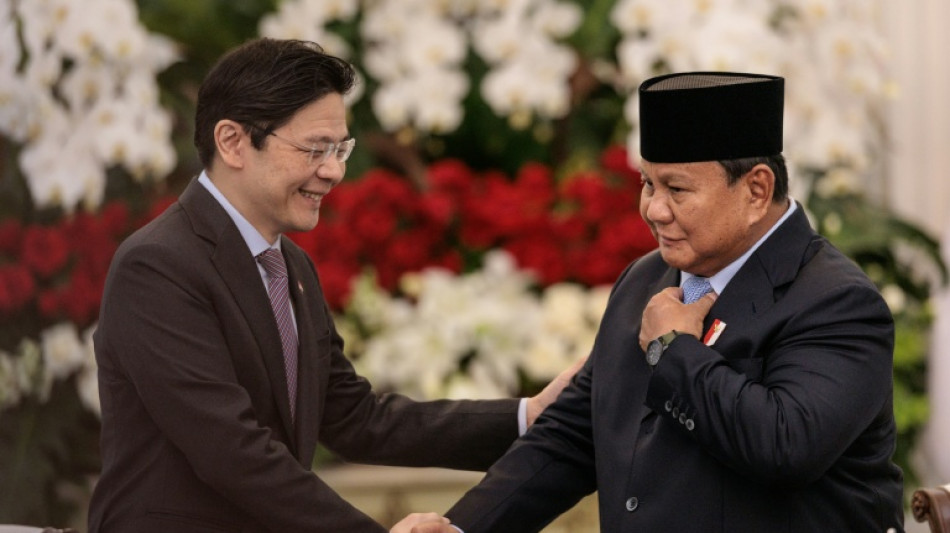
Indonesia, Singapore say key oil passage will remain 'accessible' / Photo: © AFP
Indonesia and Singapore vowed on Monday that the Strait of Malacca, a critical oil transit chokepoint in the region, will remain "accessible" even as Iran imposes fees on ships traversing the Strait of Hormuz.
Indonesian President Prabowo Subianto discussed the matter with Singaporean Prime Minister Lawrence Wong in Jakarta as Southeast Asia reels from the effects of oil prices pushed sky-high by the Middle East war.
The Strait of Malacca, surrounded by Indonesia, Malaysia, Singapore and Thailand, is the world's largest oil chokepoint in terms of transit volume, according to the US Energy Information Administration (EIA).
More than 23 million barrels -- 29 percent of total maritime oil flows -- crossed the strait in the first half of last year, the latest EIA data shows.
In April, Indonesian Finance Minister Purbaya Yudhi Sadewa floated the idea of charging vessels to cross the strait, but later backtracked.
Prabowo said on Monday that Indonesia and Singapore "have an interest in keeping the Strait of Malacca as a free passageway".
"We will continue to coordinate with Malaysia and Thailand so that... the Strait of Malacca will always be open to all, safe and accessible," he said.
Wong said Singapore and Indonesia were committed to upholding freedom of navigation and rights of passage under the UN Convention on the Law of the Sea (UNCLOS).
The strait, he said, must "remain safe, open, accessible to all".
On Sunday, Iran's ambassador to China said ships transiting the Strait of Hormuz would be charged fees, but "friendly" countries would receive special treatment.
The Strait of Hormuz normally carries a fifth of the world's crude oil and liquefied natural gas, but was all but closed by Iran during the Middle East war.
Iran lifted its blockade after striking an initial deal with the US to pause hostilities, and negotiations on a permanent settlement of the conflict are ongoing.
Wong also announced his country was working with Indonesia on a solar power project on the island of Sulawesi, highlighting Indonesia's "tremendous" renewable energy potential.
R.Campbell--TNT