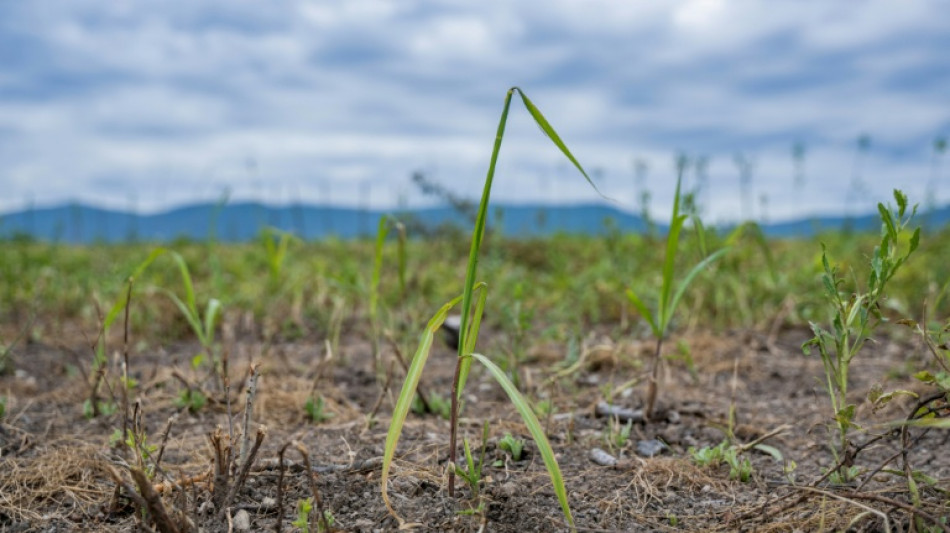
NATO project tests perennial grass to clean Ukraine's war-hit soil / Photo: © AFP
Scientists at a Czech university are studying whether a particular strain of grass could revitalise Ukraine's famed soil after years of war and make it usable again for farming.
Ukraine has often been called the breadbasket of Europe because it is home to the extremely fertile black earth known as chernozem, which has propelled the country to become a major grain producer and exporter.
But nearly four and a half years of fierce fighting have polluted much of the famed farmland.
Under a NATO-sponsored project, the northern Czech Jan Evangelista Purkyne University (UJEP) is working to study whether a certain strain of grass, the giant miscanthus, could remove pollutants like oil products, explosives, and trace elements from the soil.
"The goal is to revitalise contaminated areas while producing biomass," UJEP environmentalist Josef Trogl told AFP in a small experimental field at a former Czech brown coal mine.
Giant miscanthus is native to east Asia but is grown across Europe for biomass, which is used for heating.
Although it takes years to cleanse the soil, early results have been promising, scientists say.
The grass is "capable of growing on degraded and contaminated soils" and "produces extensive root systems that can accumulate metals while simultaneously restoring soil organic matter," Ember Morrissey, a West Virginia University biologist and co-author of a recently published study on giant miscanthus, told AFP.
While the roots trap the pollutants, above-ground biomass from the plant growing up to four metres (13 feet)remains largely clean.
- Fast photosynthesis -
"The plant also sends up to 40 percent of organic material it produces through photosynthesis to the soil via its roots, which is way more than other farm plants", UJEP's Trogl said.
Photosynthesis is a process by which plants turn carbon dioxide into oxygen and carbon-rich glucose.
Giant miscanthus, with fast photosynthesis similar to that of maize or sugar cane, is then able to retain the carbon in the soil, helping it to recover.
"The development of humus and soil fertility is better here than under other plants," said Trogl, adding the grass "supports soil microorganisms to faster degrade organic pollutants such as petroleum".
The UJEP project has run since 2023 and is part of NATO's Science for Peace and Security programme designed to stem "the environmental impact of military activities".
A team led by Ukraine-born Valentina Pidlisnyuk, an UJEP professor, is currently growing giant miscanthus in Vorzel near Bucha, a Kyiv suburb where Russia's army is accused of killing hundreds of civilians.
"The area was occupied by Russian troops between February and March 2022, liberated in April 2022, and subsequently demined in autumn 2022," Pidlisnyuk told AFP.
By then, the local soil was affected by "disturbance, vegetation loss, compaction, and disruption of ecosystem functions," she said.
The project seeks to "support the environmental regeneration of former military sites while mitigating climate change through the implementation of advanced (giant miscanthus) phytotechnology on contaminated military lands," she said.
Analyses conducted so far have revealed "positive effects on soil biological parameters and carbon sequestration", Pidlisnyuk said.
- Long-term -
The NATO-sponsored project worth 346,000 euros ($395,000), run in cooperation with Canadian, Croatian, Kazakh, Ukrainian and US partners, is due to continue until next year.
But Trogl said he hoped for an extension as miscanthus takes years to cleanse the soil.
A recent French study took 13 years to conclude that "perennial bioenergy crops increase soil organic carbon stocks in the long term".
"Ideally, the plant will give enough biomass for 20 to 25 years," Trogl said.
"Then we'll have to dig it out, but hopefully we'll be able to use the soil for regular farming."
P.Sinclair--TNT