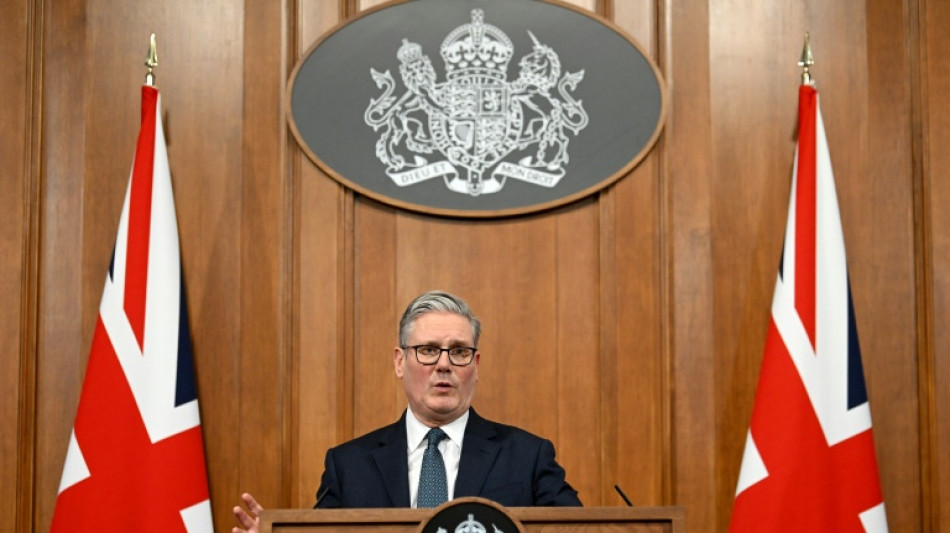
Starmer boosts budget to modernise UK military before exit / Photo: © POOL/AFP
Britain plans to spend almost £300 billion ($397 billion) over the next four years to modernise its armed forces to counter rising threats, outgoing Prime Minister Keir Starmer announced Tuesday.
More drones, uncrewed vehicles and an upgrade to the UK's nuclear deterrent form part of Starmer's long-awaited 10-year Defence Investment Plan (DIP), which he described as his "legacy".
The proposals see an extra £15 billion being pumped into defence spending up to 2030, the year by which UK intelligence has suggested Russia could attack a NATO country.
Starmer called the £300 billion figure a "record investment" that would transform Britain's military, as the nature of modern warfare changes.
"By any measure, this is a huge historic shift for our nation and a legacy in which I take pride," he told reporters.
Starmer is expected to leave office next month after losing the support of Labour members of parliament and urged likely successor Andy Burnham to see through his defence spending commitment.
"I am absolutely certain that this is the platform on which whoever comes after me can build," Starmer added.
The plan follows months of wrangling within the Labour government over the resources required to modernise Britain's fighting capabilities, to counter greater aggression from countries such as Russia, and mitigate for a less reliable United States.
Two defence ministers quit earlier this month in a row over the defence plan, including defence secretary John Healey who said it risked making Britain "less safe".
The resignations highlighted Starmer's weakening authority.
He announced on June 22 he was stepping down after MPs from his ruling Labour party switched their support to veteran politician Burnham.
Burnham, the 56-year-old former Greater Manchester mayor, will take over as prime minister in mid-July if he faces no challengers for the Labour leadership.
- 'Hybrid' vessels -
Starmer's plan includes more than £5.0 billion for drones and autonomous systems over the next four years, the Ministry of Defence (MoD) said in a press release.
The investment will see capabilities ranging from "highly complex autonomous mine-hunting drones to small 'quadcopter' tactical drones, and low-cost 'kamikaze' one-way attack drones", the MoD added.
The wars in Ukraine and Iran have highlighted the increased use of war-fighting robots.
Ukraine uses roughly 200,000 drones a month to defend itself from Russia's invasion, while at the height of the US-Israel-Iran conflict 700 offensive drones were being launched per day, the MoD said.
The plan seeks to develop a "hybrid" Royal Navy by replacing six ageing destroyer warships with smaller, autonomous vessels working alongside crewed ships.
It also allocates more than £8 billion to create the next generation of stealth fighter jet alongside Italy and Japan, and a $64 billion upgrade to Britain's nuclear deterrent.
US President Donald Trump has demanded that NATO members spend five percent of economic growth on defence by 2035 and become less reliant on Washington for security.
Starmer said the defence plan will take defence spending to 4.2 percent of gross domestic product, but did not specify a date.
The £15 billion uplift is well short of the £28 billion that military leaders previously said was needed.
NATO Secretary General Mark Rutte welcomed Starmer's plan.
"Stronger UK defence makes us all safer," he wrote on X.
But the opposition Conservatives' defence spokesperson, James Cartlidge, said the plan was "too little, too late".
"The plan is now almost a year overdue and only being rushed through because Keir Starmer is desperate for a legacy," he added.
G.Waters--TNT