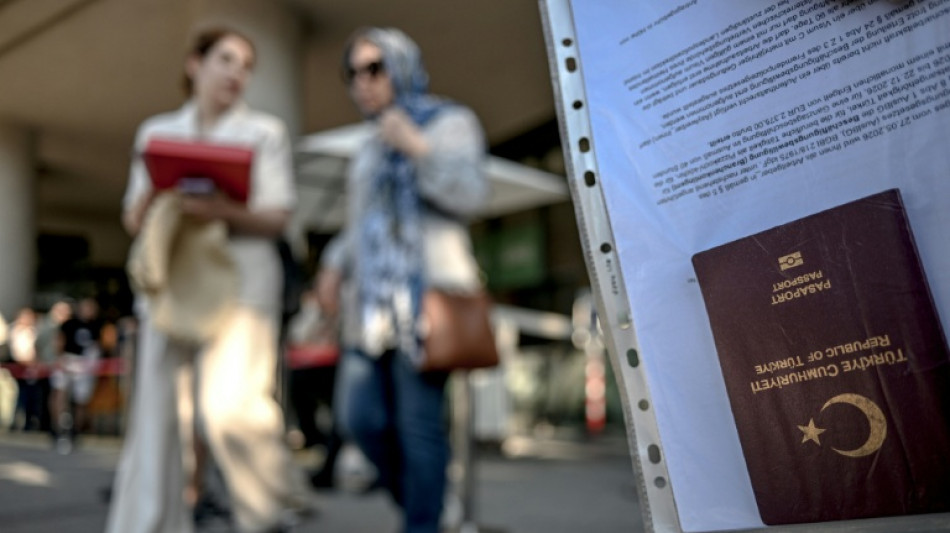
'Waiting like torture': Turks despair as Schengen visa delays mount / Photo: © AFP
Outside the EU's visa application centre in an Istanbul shopping mall, a large crowd waits patiently, clutching thick folders and scanning lists of required documents one last time, their anxiety palpable as they await the security guard's call.
With top European Union officials in Ankara ahead of next week's NATO summit, the recurring issue of Europe's long-promised visa liberalisation scheme was likely hovering over the talks as frustration grows in Turkey over Schengen visa delays and rising rejections.
Guney Hazan, a 19-year-old student, was one of the lucky ones. "Finally!" he shouted after ripping open the envelope containing his passport to find a Schengen visa affixed, opening the door to a university exchange programme in Germany.
"Even though all my documents were in order, I was anxiously awaiting the result. You never know these days," he told AFP.
With demand rising and a mounting backlog, applicants routinely face a long and anxiety-inducing wait that can also be very expensive.
"It's become torture for us. We feel like third-class citizens," said a 25-year-old waitress after dropping off her paperwork, asking to remain anonymous for fear that her visa application for France might be turned down.
"They used to give me a five-year visa, but now I'm only allowed a two-year one. In the meantime, my application has been denied twice without any explanation," she said.
"It's because of the situation in Turkey," her friend said.
"Since Europe doesn't approve of Turkey's policies, it doesn't want its citizens either," she said, also asking to remain anonymous.
In recent years, concerns have spiralled over declining political and civil freedoms under Turkish President Recep Tayyip Erdogan, prompting growing numbers of often younger people to look West for better opportunities, observers say.
- Risk of asylum claims -
Last year, Turkish nationals submitted 1.25 million visa applications for the Schengen zone, up from 906,000 in 2019, European Commission figures show.
Of that number, 1.07 million were approved.
But due to the surge in applications in recent years, the rejection rate has also risen -- from 9.7 percent in 2019 to 14.6 percent in 2025, prompting headlines decrying a "visa crisis".
A diplomatic source at the French embassy said the economic crisis in Turkey, where annual inflation hit 32.6 percent in May, has changed the profile of visa applicants.
"Some aren't granted visas because their economic situation has deteriorated, even though our criteria remain the same," the source said.
To obtain a Schengen tourist visa, applicants most show they've had at least 2,800 euros ($3,200) in their bank account for the past three months -- more than five times Turkey's minimum wage.
And asylum figures don't help, with Turks ranking fifth among asylum seekers in Europe last year, according to the European Union Agency for Asylum (EUAA).
This reality means "Schengen Area countries are strictly applying the criteria and, above all, closely assessing the risk of migration," the source warned.
EU heavyweight Germany said visa liberalisation depended on "reforms".
In 2013, Brussels set out a "roadmap" of 72 conditions Ankara must meet to secure visa-free travel, not all of which have been met, a German federal foreign office spokesperson said.
One requires Ankara to reform an anti-terror law deemed "abusive" by critics.
- Bots hijacking the system -
For applicants, the main challenge is finding an appointment slot to submit their paperwork.
"You can wait nearly a year for an appointment. I was on the waiting list for two months without knowing when I'd get a response," explained a 22-year-old student waiting to start an internship in computer engineering in Germany.
Private agencies authorised by the consulates are responsible for collecting applications and managing appointments in accordance with quotas set by European countries.
Under normal circumstances, a visa application costs 90 euros ($103) plus another 30 euros for the agency fee.
But the system has been hijacked by automated software bots that snap up appointments as soon as they are released, which are then resold for vastly inflated prices to applicants desperate for an appointment.
"We've noticed visa appointments are being sold on the black market at skyrocketing prices -- for up to 300, 500 or even 1,000 euros in urgent cases," said Hamit Kuk, head of the Turkish Travel Agencies Association (TURSAB).
"It's like a game of chance," sighed the young waitress, who knows she might have to do the whole thing again if she's unlucky this time.
"We've rolled the dice, now we wait and see."
T.Ward--TNT