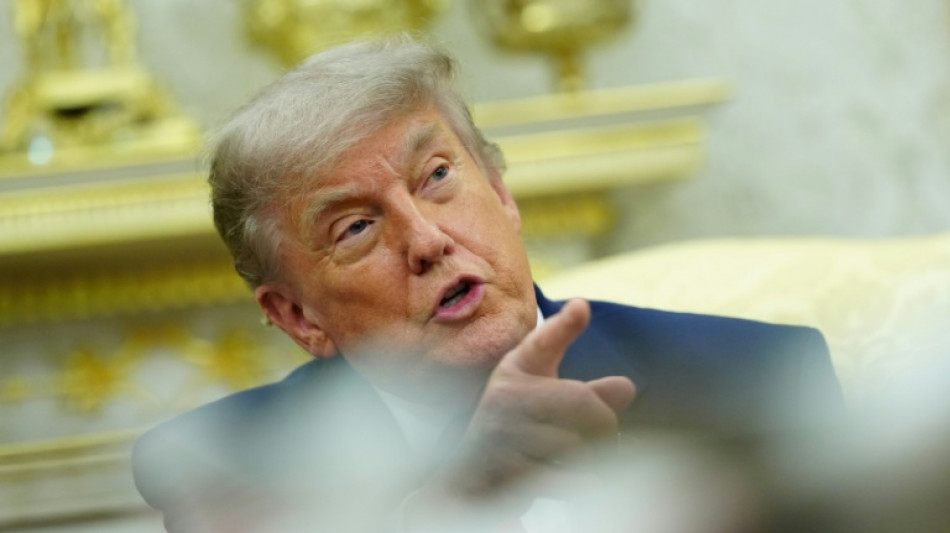
Trump seeks $88 bn in extra funding, mostly for Iran war / Photo: © AFP
US President Donald Trump asked Congress on Wednesday for nearly $88 billion in extra spending, most of it to cover the cost of the Iran war, at a moment of growing unease in both parties over the conflict and its political price.
The White House request for $87.6 billion in supplemental funding includes tens of billions of dollars for the Pentagon, as well as money for US farmers, Ebola response efforts in central Africa and domestic infrastructure projects.
The proposal landed a day after Congress passed a largely symbolic resolution calling on Trump to end US hostilities with Iran unless lawmakers explicitly authorize military action.
It also came as the administration tries to turn a preliminary agreement with Tehran into a final settlement after months of war that rattled global energy markets, pushed up prices and exposed divisions inside Trump’s Republican Party.
White House budget director Russell Vought made the request in a letter to House Speaker Mike Johnson, urging Congress to act quickly on what he called "important and urgent requests."
The bulk of the package would go toward military costs linked to the Iran conflict.
The administration requested about $67 billion for the Pentagon, including $21 billion for munitions and other military capabilities, $17.3 billion for operational costs and $12.1 billion for classified programs.
It also sought nearly $768 million for the Energy Department for nuclear and energy security related to Iran, and $300 million for State Department embassy security and construction in countries around Iran.
- 'Reckless war' -
The request is far smaller than the $200 billion Defense Secretary Pete Hegseth suggested in March the Pentagon might need for the war, which began with US and Israeli strikes on Iran in late February.
The funding request is expected to face a difficult path in Congress, where most Democrats oppose the war and some Republicans have begun questioning its cost, objectives and prospects for ending it.
In the Senate, major spending legislation typically needs 60 votes to advance, meaning Trump would need Democratic support unless Republicans find another legislative route.
Senate Minority Leader Chuck Schumer accused Trump of seeking more money after dragging the country into a "reckless war."
Senator Patty Murray, the top Democrat on the Senate Appropriations Committee, said Trump had launched the war without congressional authorization or broad public support and was now asking taxpayers "to pick up the tab."
The request also includes more than $11 billion in farm aid, after farmers were hit by trade disruptions and economic fallout tied partly to Trump's tariff policies.
Other items include $1.4 billion to respond to Ebola outbreaks in the Democratic Republic of the Congo, Uganda and elsewhere, $1 billion for the renovation of Penn Station in New York and $500 million for restoration and construction projects in Washington.
Republicans have already given the Pentagon $150 billion in new funding through Trump's major tax and spending law, passed last year without Democratic support.
Some conservatives have nevertheless questioned whether the Defense Department needs still more money, while vulnerable Republicans face the prospect of voting to fund an unpopular war months before November's midterm elections.
A.M.Murray--TNT