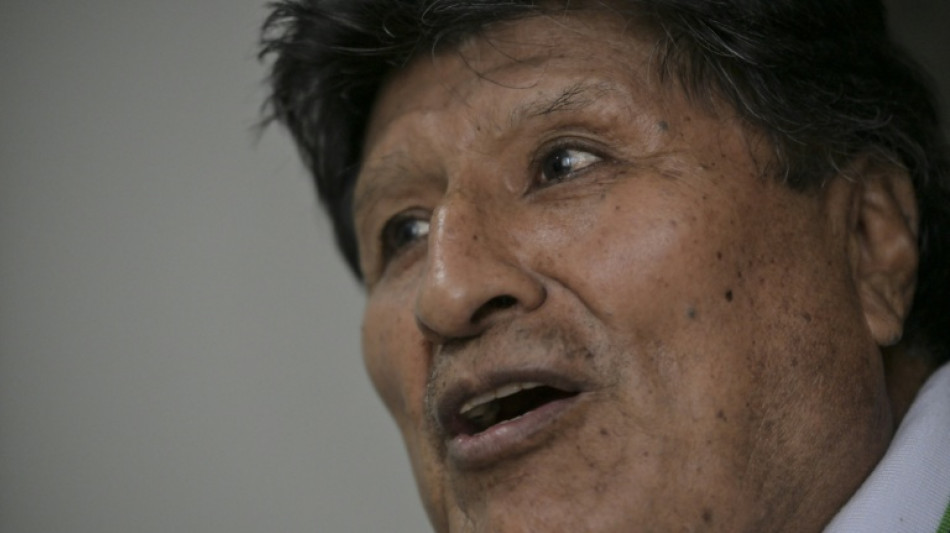
Bolivia's government is 'stoking a civil war,' ex-president Evo Morales tells AFP / Photo: © AFP
Former Bolivian president Evo Morales told AFP in an exclusive interview on Tuesday that the South American country's government is "stoking a civil war" with its "neoliberal politics."
Cities in Bolivia have suffered from shortages of food, fuel and medicine over the past seven weeks due to roadblocks conducted in protest of center-right President Rodrigo Paz, amid the country's worst economic crisis in four decades.
Paz's election last November ended 20 years of leftist rule in Bolivia, and Morales -- who led the country from 2006 to 2019 -- is regarded by the current president as bein
"I'm not going to give up," Morales said from his hideout in the coca-growing region of Chapare, part of his political stronghold in the central Chochabamba department.
Bolivia's government threatened to capture Morales and intervene in Chapare, where his a fugitive on charges of allegedly trafficking a minor. Morales denies the charges and argues they are a form of political persecution.
"Those who negotiate for their survival are not worthy," he added.
Morales was interviewed by AFP in the town of Lauca Ene, where dozens of coca-growing leaders had gathered for a meeting with the former president.
Below are excerpts from the interview, edited for clarity.
Question: What is your take on the protests the past few weeks?
Answer: It is an uprising against the neoliberal model and the colonial state, and the result is a government without authority. For me, this is going to keep going. This "lie-ocracy" provokes a strong reaction from the Bolivian public.
Q: Is the end of the blockades a victory for the government?
A: The government saved itself by providing benefits (to certain sectors) which were negotiated behind closed doors. The only blockades left are here in the Tropics of Cochabamba, which is highly disciplined. We declared an intermission (a pause), but we did not negotiate.
Q: Do you think the government will intervene in Chapare?
A: There is no reason to intervene, there are no blockades. They know that there are going to be problems, we're well organized. They know that our comrades will defend themselves, and defend us. We don't wany any deaths or injuries.
Q: What will you do if they try to intervene?
A: With all the neoliberal politics and the colonial state, they are stoking a civil war. Those who negotiate for their survival are not worthy. I never negotiated. Defending the coca leaf is defending the sovereignty and dignity of the people. The coca war is much more than the war over water or gas. Whatever military or police intervention, (the public) will resist.
Q: What is your response to the allegations of suspected child trafficking?
A: A fabricated case. They can't find anything on drug trafficking or corruption. It's a completely political case. Because Evo is not corrupt, nor is he tied to drug trafficking, they're trying to use the "pedophile" label. People find it laughable.
Q: What is your vision for Bolivia in the coming months?
A: If the structure issue, which is the economic issue, is not resolved, at any moment, any sector could mobilize. If there is no plan for how to reactivate the country's economy, then there will be uprisings and turmoil.
Q: Do you support the demand for President Paz's resignation?
A: That demand has become widespread. I said that maybe a politically sound, constitutional way out is to call an election. But we have never demanded his resignation. The point here is to prevent the privatization of electricity, water, telecommunications, natural resources, healthcare, education. That is the demand.
P.Johnston--TNT