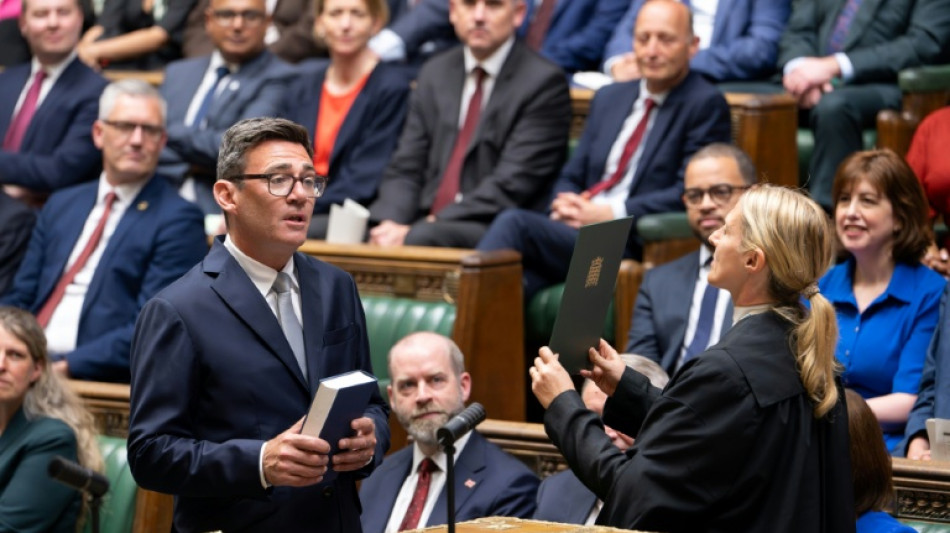
UK and markets await Burnham's economic plans / Photo: © UK PARLIAMENT/AFP
Andy Burnham, expected to become Britain's next prime minister after Keir Starmer resigned, has set out to reassure investors concerned that state spending and debt could rise under his leadership.
Burnham would like to see a partial renationalisation of the UK's water and energy industries, which would cost billions of pounds and follow Starmer's move to bring Britain's train operators under state control.
AFP looks at how the Labour government's economic policies could change under Burnham, who is viewed as more left-leaning than Starmer.
- What course for the economy? -
Burnham, who stepped down as mayor of Greater Manchester ahead of his parliamentary by-election victory last week, has been fairly vague regarding his economic intentions should he become premier.
But after being re-elected as an MP on Friday, he launched an attack on "trickle-down economics" -- the idea that wealth created by the most affluent eventually benefits everyone.
"We do need to bring down water bills, energy bills, rail fares, just as we've brought down bus fares in Greater Manchester to make life more affordable for people," Burnham said.
In the same speech, the advocate of "business-friendly socialism" called for "a new drive of reindustrialisation" across the country, suggesting greater state spending and possible tax increases.
According to Britain's Press Association, Burnham will use a speech next week to confirm that he backs finance minister Rachel Reeves's strict fiscal rule that day-to-day government spending be balanced against tax revenues.
Burnham, who supports a need to bring down government debt, will also use the speech to lay out key aspects of his proposed economic policy.
- What do investors think? -
If under Burnham "the government sets out a credible economic and fiscal strategy then the markets will be fine", Jonathan Portes, a professor of economics and public policy at King's College, London told AFP.
"This doesn't preclude some relatively minor modification of the fiscal rules to allow somewhat more borrowing for investment, but not for current spending," he said.
Financial markets have so far taken Burnham's election win and Starmer's resignation in stride, with the pound avoiding any sharp falls and the UK's benchmark 10-year government bond yield dipping.
"Burnham has been on a charm offensive to win over those all-important bond markets as speculation has been mounting about his likely ascension to the top job," said Danni Hewson, head of financial analysis at the trading group AJ Bell.
But Matthew Ryan, head of market strategy at global financial services firm Ebury, cautioned that the "transition itself will introduce a period of uncertainty that markets will find uncomfortable".
At the same time, Burnham would inherit a British economy that showed signs of picking up before the US-Iran war hindered growth and pushed up inflation.
- New finance minister? -
Energy Secretary Ed Miliband is viewed as a strong favourite to succeed Reeves as finance minister, with her position said to be at risk after Starmer's resignation Monday.
"A change in leadership... may alter the size of the state. But it won't change the fiscal realities," said Ruth Gregory, deputy chief UK economist at Capital Economics research group.
"Those on the 'soft left' of the Labour Party (like Miliband) may be more inclined to raise spending and borrowing than those on the 'soft right', who would probably offset any spending rises with spending cuts elsewhere or tax hikes," she added.
Other names mentioned as a possible replacement for Reeves include interior minister Shabana Mahmood, Foreign Secretary Yvette Cooper and former health minister Wes Streeting, who is backing Burnham to become prime minister.
P.Sinclair--TNT