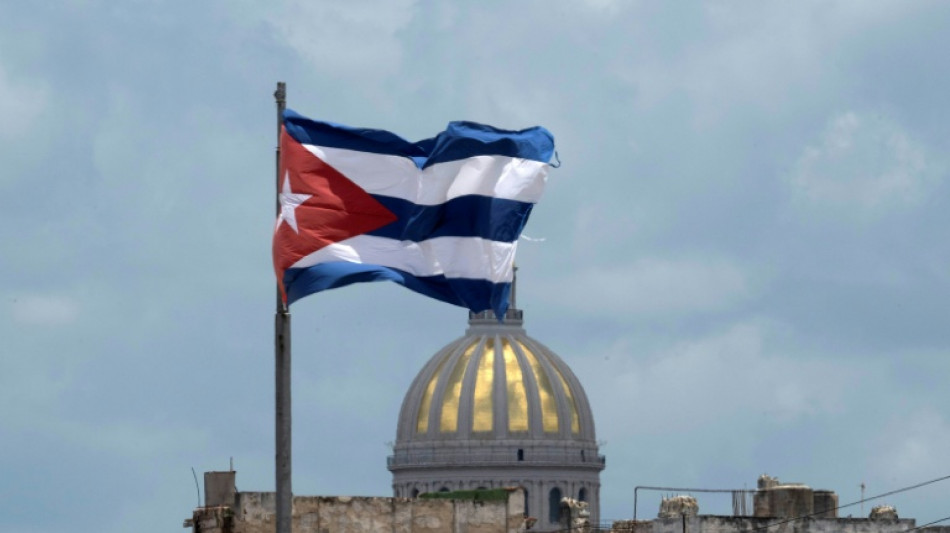
Cuba adopts historic package of free-market reforms / Photo: © AFP
Cuban lawmakers Thursday adopted nearly 200 historic free-market reforms aimed at rescuing the communist island from a severe crisis aggravated by a US oil blockade.
In a landmark speech to the National Assembly, Prime Minister Manuel Marrero unveiled 176 measures aimed at rolling back the state's role in the economy and attracting investment in everything from banking to tourism and agriculture.
Under the reforms, foreign investors are no longer required to form joint ventures with the state, large private enterprises will be authorized and both Cuban and foreign investors will be allowed to acquire stakes in state companies.
These and other huge changes come as the United States exerts relentless pressure on the island, with President Donald Trump musing openly about taking over the Caribbean nation just 90 miles (145 km) from Florida.
Daniel Torralbas, a London-based Cuban economist, described the reforms as "the most profound" since the 1959 revolution led by Fidel Castro.
- 'Socialism or death!' -
They were adopted in a unanimous show of hands by lawmakers at a session which ended with President Miguel Diaz-Canel intoning Castro's famous revolutionary slogan: "Socialism or death!"
Marrero did not give a time-frame for implementing the reforms but Diaz-Canel had on Wednesday argued the need for "urgent changes" to stave off economic collapse.
The oil blockade imposed by Trump in January after his ouster of Cuba ally Nicolas Maduro in Venezuela has brought the island's economy to the brink of collapse, forcing the Communist Party into concessions it previously considered heretical.
While Havana's custom has always been to blame its woes on a more-than-six-decade US trade embargo and more recently the oil blockade, Diaz-Canel admitted to the existence of "obstacles that don't come from outside, nor the blockade."
In usually frank language, he called out "slowness, bureaucracy and norms that impede those who want to produce" as well as "decisions that we have put off."
"Their backs are up against the wall as never before," Michael Bustamante, Cuban studies chair at the University of Miami, told AFP.
"They're in the uncomfortable position of making changes to their economic model, seemingly because of the pressure that's being exerted on them by the United States."
A defiant Diaz-Canel insisted that the government was "not doing this because of pressure from the Yankees," but to "preserve" socialism.
- Collapsing revolution -
Just a single oil tanker -- from Russia -- has docked in Cuba since the beginning of the year.
Power cuts sometimes lasting over 30 hours have become the norm, and food, fuel, drinking water and medicine are in short supply.
The United Nations High Commissioner for Human Rights, Volker Turk, has warned that "children are dying" in Cuba because of a shortage of medical supplies and medication.
Victor Hierrezuelo, a 63-year-old bank worker, told AFP on Thursday that, absent reforms, "the revolution will collapse!"
It is unclear, however, whether the changes will satisfy Trump, who is pushing for a change in Cuba's leaders as well as its economic model.
Asked Thursday if Cuba was now in Trump's sights after he signed a deal to end the Iran war, Vice President JD Vance said Washington wanted Cubans to be "happy and successful."
"We're actually talking to the Cuban government right now about how they could change their ways to change that," he added.
Many disillusioned locals, weary after weeks of power cuts, which causes food to rot in 40C heat, shrugged off the reforms as too little, too late.
But the country's burgeoning small business sector welcomed the changes.
They "offer hope," said Mario Gonzales, the 32-year-old manager of a restaurant in Havana's historic old town, who is hoping for a tourism revival.
J.Sharp--TNT