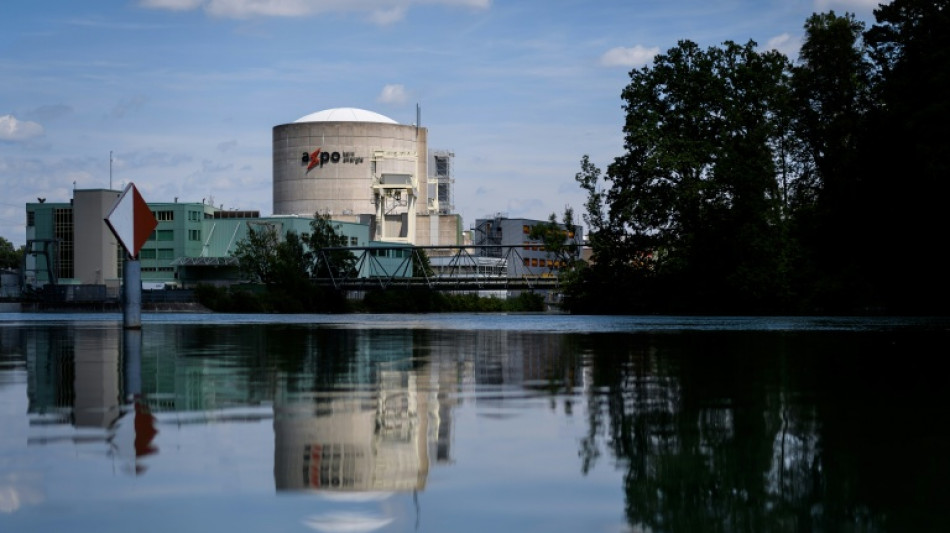
Swiss heading towards referendum on new nuclear plants / Photo: © AFP
Switzerland's parliament on Thursday approved a divisive government plan to build new nuclear power stations, overturning a 2018 ban and putting the country on course for a referendum.
The lower house of parliament joined the upper chamber in backing a government proposal to reverse the ban put in place following a referendum won by anti-nuclear campaigners in 2017.
During the debates in parliament, energy minister Albert Rosti stressed the need to keep the nuclear power option open to guarantee the country's long-term energy supply.
Both houses say authorisation for new nuclear plants can only be granted if the financing is secured.
Swiss voters are meanwhile set to have the final say.
A broad coalition of groups "will launch a referendum", the Green Party said in a statement.
Greens president Lisa Mazzone said the parliament vote "sabotages the rapid development of renewable energies, climate protection and our energy sovereignty".
The collection of signatures for a referendum would begin this month, the party said.
To trigger a referendum under Switzerland's direct democracy system, 50,000 valid signatures must be collected within 100 days of publication of a new law -- a hurdle the coalition is expected to clear.
- 'Insurance policy' -
The Swiss government has been pushing since 2024 to reverse the ban, citing the growing need for domestic low-carbon electricity to achieve its goal of net-zero emissions by 2050.
Fears of shortages linked to world events, such as the US-Israeli war on Iran and Russia's full-scale invasion of Ukraine, and Switzerland's dependence on electricity imports in winter were also cited.
The government project argues that allowing new nuclear power plants to be built would "create an insurance policy for electricity supply" in case renewable energies are insufficient or if there are no other "climate-friendly solutions to guarantee electricity production".
The Swiss approved the gradual phase-out of nuclear power in the 2017 referendum, banning the construction of new power plants.
That law was the result of a long process initiated after the 2011 Fukushima nuclear accident in Japan, which was triggered by a tsunami.
Switzerland continues to operate four nuclear reactors whose construction dates back to the 20th century.
Beznau 1, commissioned in 1969, is the oldest functioning nuclear reactor in Europe. It will cease operations in 2033, while Beznau 2, connected to the grid since 1971, will close a year earlier, in 2032.
Gosgen and Leibstadt began operating in 1979 and 1984, respectively.
R.Evans--TNT