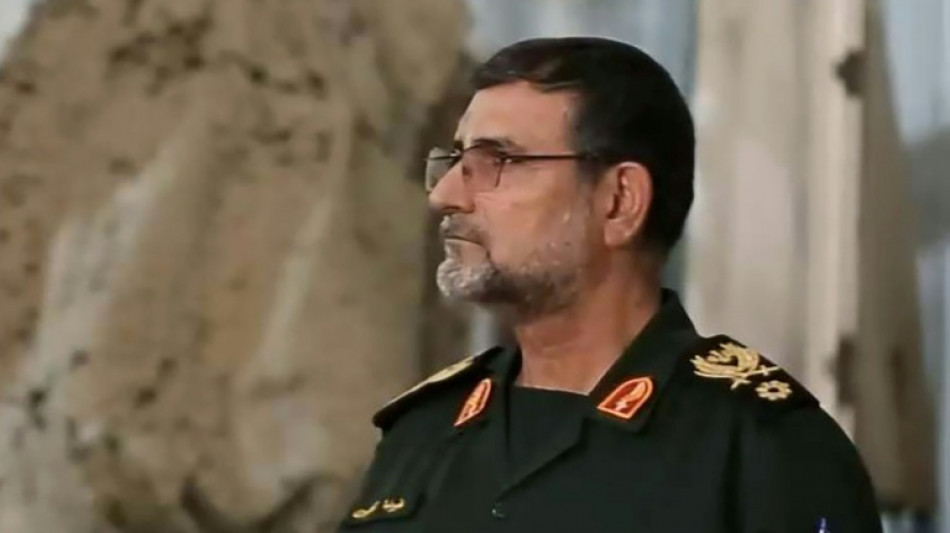
The Iranian leaders killed in Israeli-US war
/ Photo: © SEPAH NEWS/AFP
Over the course of the US-Israeli war on Iran, waves of airstrikes killed an entire echelon of the Islamic republic's political and military elite, starting with supreme leader Ali Khamenei.
President Donald Trump had claimed in March that the campaign had achieved "regime change", but Iran showed resilience in rapidly replacing killed leaders and keeping up the war against the US and Israel.
With Washington and Tehran agreeing on a deal announced Monday to halt the conflict, here is a recap of the some of the key figures killed in the war:
- Supreme leader Ayatollah Ali Khamenei -
Khamenei, Iran's number one since 1989, was killed in the first hour of the war on February 28 in a strike on a meeting of senior officials in Tehran that also left his daughter-in-law, daughter and at least one grandchild dead, according to reports.
His low-profile son Mojtaba survived -- although reportedly with injuries -- and took over as supreme leader. He has yet to make a public appearance.
Ali Khamenei has yet to be buried, with state media reporting on Saturday that his funeral will take place on July 9 in his hometown, the northeastern city of Mashhad, following three days of funeral ceremonies in Tehran and another in the holy city of Qom.
- Security chief Ali Larijani -
The killing of Larijani, who despite not being a cleric was a pillar of the system for decades, was likely the biggest loss to the Islamic republic after the death of Ali Khamenei.
Larijani was killed on March 17 in an Israeli strike, reportedly in the Tehran region and which also killed family members.
The previous week, he had defiantly walked in public in Tehran at a pro-government rally.
- Revolutionary Guards chief Mohammad Pakpour -
Pakpour, previously head of the Guards' ground forces, took over as commander-in-chief in June 2025 after his predecessor Hossein Salami was killed in Israel's 12-day war against Iran.
He was killed on the first day of the war and has been replaced by former interior and defence minister Ahmad Vahidi.
- Guards naval chief Alireza Tangsiri -
A veteran of the 1980-1988 Iran-Iraq war, Tangsiri was one of the longest-serving senior figures in the Revolutionary Guards as the head of its navy since 2018 and one of its highest-profile faces within the Islamic republic.
Israel's defence minister described him as the "man who was directly responsible for the terrorist operation of mining and blocking the Strait of Hormuz".
- Adviser Ali Shamkhani -
Shamkhani, a mainstay of the Islamic republic's armed forces since the 1980s, was killed in an airstrike on the first day of the war.
He was given a public funeral in Tehran's Tajrish Square.
He had been severely wounded, and initially reported dead, in a strike during Israel's June war against Iran but later re-emerged.
- Intelligence Minister Esmail Khatib -
A cleric, Khatib was killed by an Israeli strike in Tehran early on March 18.
As Iran's intelligence minister since 2021, he was accused by rights groups of playing a key role in the suppression of protests.
- Defence Minister Aziz Nasirzadeh -
A veteran of the Iran-Iraq war in the 1980s, Nasirzadeh had served as defence minister since 2024.
He was also killed in a strike on the first day of the war.
- Basij commander Gholamreza Soleimani -
Soleimani headed the Basij, a volunteer paramilitary group that is a branch of the Revolutionary Guards and notorious among rights groups for suppressing protests.
He was killed in an airstrike on March 17.
- Guards spokesman Ali Mohammad Naini -
Naini was killed in March in what the Guards described as a "cowardly" attack by the United States and Israel.
Just before his death was confirmed, the Fars news agency issued a statement quoting Naini as saying Iran's missile production deserved a "perfect score" and was continuing despite the war.
- Head of military office Mohammad Shirazi -
Killed on the opening day of the war, Shirazi had the crucial job of coordinating between the various branches of the Iranian security forces at the office of supreme leader.
- Armed forces chief Abdolrahim Mousavi -
Mousavi, killed on the first day of the war, had only taken up his post -- a senior position that coordinates between the Guards and the regular army -- in June 2025 following the death of his predecessor Mohammad Bagheri in the 12-day war.
C.Stevenson--TNT