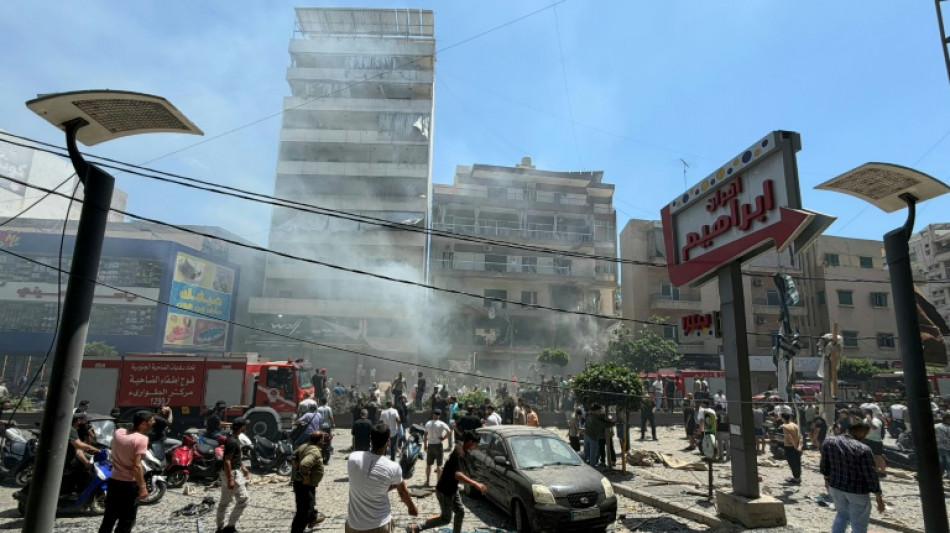
Israel says strikes Hezbollah targets in Beirut's southern suburbs / Photo: © AFP
Israel struck Beirut's southern suburbs on Sunday for the second time in a week in response to what it said was Hezbollah fire at northern Israel, while its military also carried out broader strikes on southern Lebanon.
The latest escalation came despite expectations that a deal between the United States and Iran to end the Middle East war could be imminent, as Tehran insists a ceasefire in Lebanon must be part of any deal.
Lebanon's official National News Agency (NNA) said a strike hit an apartment in the Ghobeiry neighbourhood of Beirut's southern suburbs, a Hezbollah stronghold known as Dahiyeh.
An AFP correspondent saw smoke and dust rising near a heavily damaged apartment as debris covered the street and people searched for survivors, with panic in the area after the strike along a busy road filled with shops.
Israeli officials including Prime Minister Benjamin Netanyahu have warned that Israel would strike south Beirut should the Iran-backed Hezbollah group target northern Israeli communities, a position they say has the backing of Washington.
The Israeli military earlier Sunday said three drones, suspected to have been launched by Hezbollah, struck northern Israel in separate incidents, causing no casualties.
Hezbollah on Sunday claimed several attacks on Israeli troops who have invaded south Lebanon but did not immediately claim any attack on north Israel.
- 'A test' -
Netanyahu's office said that the Israeli military had "carried out strikes in the Dahiyeh district of Beirut against terrorist targets belonging to the Hezbollah terrorist organisation, in response to Hezbollah's firing toward Israeli territory".
Israel's military said it had "precisely struck" a Hezbollah infrastructure site in Dahiyeh.
Two far-right Israeli ministers earlier Sunday had called for retaliatory strikes on Beirut's southern suburbs.
"The shooting at northern communities is a test of the Dahiyeh Doctrine that the prime minister declared. I call on him to implement it decisively and firmly, and to bring down buildings in Dahiyeh," Finance Minister Bezalel Smotrich said on X.
"For every drone -- a missile; for every violation -- fire; for every UAV -- Dahiyeh must tremble," wrote National Security Minister Itamar Ben Gvir on X.
Israel's military also struck Beirut's southern suburbs last Sunday, hitting apartments in two buildings after saying it had intercepted rockets launched by Hezbollah into Israeli territory.
Iran launched missiles towards Israel in response to that attack, triggering Israeli retaliatory strikes before both sides halted fire.
Iran had repeatedly warned it would strike Israel if the Lebanese capital was targeted.
On Sunday, Lebanon's NNA reported Israeli strikes on more than a dozen locations in the country's south, both before and after the Israeli army issued evacuation warnings for almost 30 locations ahead of strikes there.
Israel's military activity in recent days has been focused on the region around the major south Lebanon city of Nabatieh, and many of Sunday's Israeli army evacuation warning locations were north of the city.
- Direct talks -
A military source told AFP on Sunday that a small Lebanese army force which had been present in Kfar Tibnit, adjacent to Nabatieh, evacuated its position there a day earlier after Israeli incursions into the village.
Requesting anonymity, the source emphasised that the Lebanese army was still present at the army barracks in Nabatieh city.
An AFP correspondent saw around a dozen vehicles, including some military trucks and heavy machinery as well as civilian vehicles, heading out of Nabatieh on Sunday.
In April, Israel and Lebanon began landmark direct talks in Washington seeking to halt the hostilities, with a fifth round scheduled later this month between the two countries which have no formal diplomatic relations.
Neither Israel nor Hezbollah have respected a ceasefire announced in April after the first round.
Hezbollah rejects the direct talks and has dismissed a conditional ceasefire announced earlier this month that would require it to cease attacks but made no mention of Israel doing so or withdrawing troops from Lebanon.
The Iran-backed group drew Lebanon into the Middle East conflict on March 2 with rocket fire at Israel to avenge the killing of Iran's supreme leader in US-Israeli strikes days earlier.
Lebanon says Israel's subsequent campaign of airstrikes and ground invasion have killed more than 3,700 people.
burs-lg/jfx
W.Phillips--TNT