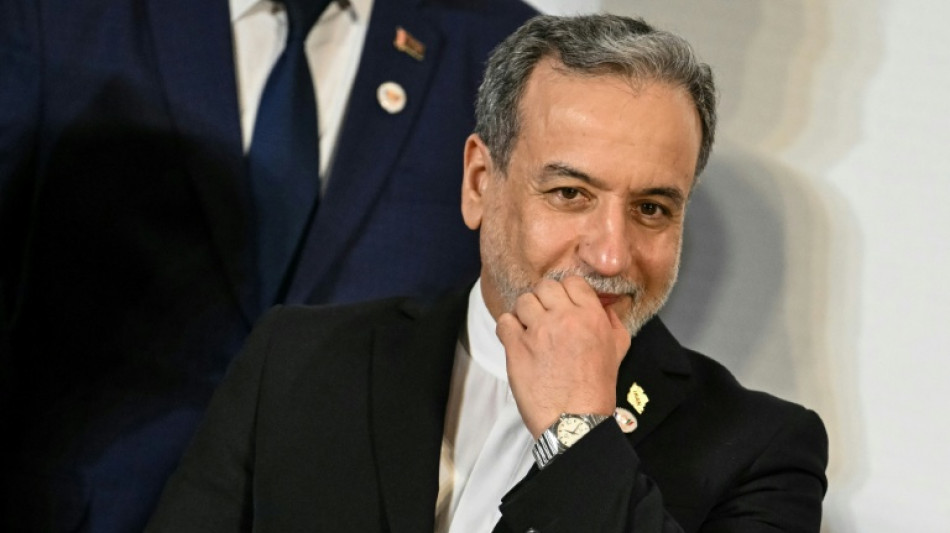
US-Iran deal could be sealed within 24 hours, mediator Pakistan says / Photo: © AFP
The United States and Iran could finalise an agreement to end the Middle East war "within 24 hours", key mediator Pakistan said Saturday, after both sides expressed optimism about the chances of concluding a deal.
The foes and mediators of the conflict have claimed a long-awaited accord is in its final throes, despite new skirmishes in the Strait of Hormuz in the months-long war that has roiled the region and global economy.
Weeks of negotiations on a peace agreement after an April 8 truce have so far not yielded success, with US President Donald Trump repeatedly insisting a deal is near only for the wrangling to drag on.
"We are closer to a peace deal than ever before," Pakistani Prime Minister Shehbaz Sharif, whose country has played a crucial role in peace talks, wrote on X on Saturday.
"With finalisation likely expected in the next 24 hours, Pakistan is preparing for the electronic signing of the peace deal immediately after, followed by technical level talks next week."
Iran's Foreign Minister Abbas Araghchi had written in a social media post Friday that "The Islamabad Memorandum of Understanding has never been closer," referring to the Pakistani capital that previously hosted talks.
But the two parties have released starkly conflicting information about the contents of the deal, as they seek to show they have emerged from the war with the upper hand.
Tehran has insisted on its right to enrich uranium and maintain control over the Strait of Hormuz, which appear sharply at odds with Washington's longstanding red lines.
The strait is a key maritime trade route carrying oil and gas from the Gulf to markets worldwide, but Tehran has blockaded the waterway since the outbreak of war, insisting vessels obtain permission from its armed forces before transiting.
The US military has responded with its own blockade of Iranian ports in an attempt to choke off the country's energy exports and starve it of revenue.
New clashes broke out in the strait on Saturday, with the United States saying it downed multiple Iranian drones targeting commercial ships.
The military's Central Command (CENTCOM), which oversees US operations in the region, posted on X that Iran had "launched multiple one-way attack drones in an attempt to strike commercial ships transiting the Strait".
"US forces have downed all of them in recent hours as traffic flow through the strait continues unimpeded," it added.
- 'Dishonourable' -
Trump on Friday denied that the peace deal being finalised favours Iran.
"The terms that Iran leaked out to the Fake News have NOTHING to do with the terms that were agreed to, in writing," Trump said in a post on his Truth Social network.
Araghchi urged caution, telling Iranian state media that until a complete agreement was reached on all issues, "it cannot be said with certainty that an understanding has been achieved".
He provided some details on the deal, saying it calls for the lifting of the US naval blockade and unspecified changes to the administration of the strait.
He also said the only way to deal with Iran's enriched uranium -- which Washington alleges is part of a nuclear weapons programme -- "is to dilute it inside Iran".
The foreign minister added that any deal would be signed "remotely", though Switzerland on Friday said it had proposed it be signed there.
Pakistan's Foreign Minister Ishaq Dar said in a statement Saturday that he had spoken with his Swiss counterpart about the peace process, their second conversation in as many days.
Araghchi on Friday said the deal could be signed "in the coming days", while a senior US official in a call with reporters also voiced optimism it would be sealed "over the next few days".
- 'Don't trust their word' -
But in the streets of Tehran there was scepticism it would cross the finish line.
"I don't think there is any deal soon," said Saeed Sadeghi, 49.
"I don't trust their word."
Another man in the city of Tonekabon named Ali, who only gave one name, said deal or no deal, Iranians would suffer.
"Neither outcome is in the people's interest. If they reach an agreement and no longer have to worry about the international community, they'll oppress people a thousand times harder," he said of the Iranian authorities.
There were also contrasting views among Iran's major media, with the reformist newspaper Etemad on Saturday welcoming the progress as a way to break "chronic geopolitical and economic deadlock".
But ultra-conservative newspaper Kayhan said Iran's leverage in negotiations lay in its control of Hormuz and that deterrent must be maintained.
"No sane person would bring their greatest strength to the negotiating table," it said.
The war began in late February when the US and Israel launched airstrikes against Iran, killing its supreme leader Ali Khamenei.
On Saturday, Iranian state television announced the slain leader will be buried on July 9 in his hometown of Mashhad, after the service was postponed due to the war.
burs-axn/jfx
T.F.Russell--TNT