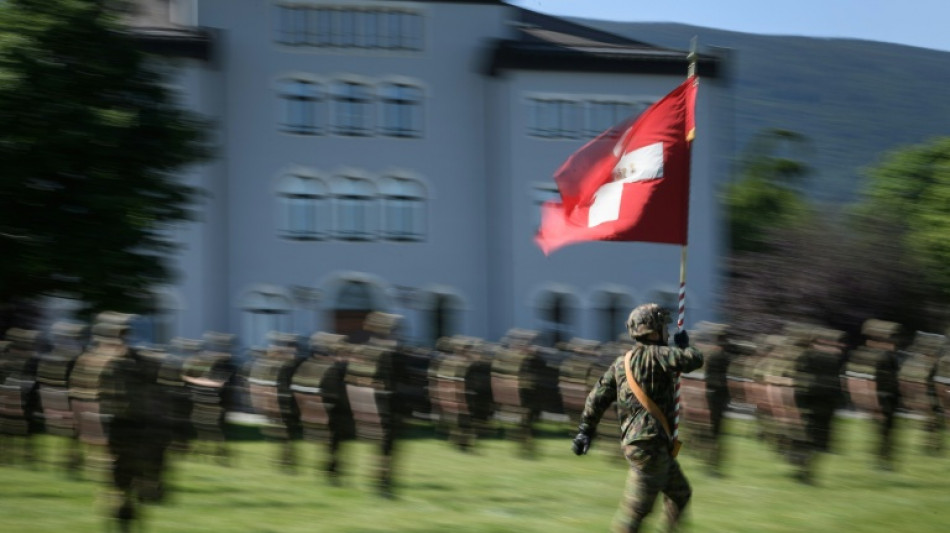
Swiss to vote on stricter rules for conscientious objection / Photo: © AFP
The Swiss will vote Sunday on imposing stricter rules for claiming conscientious objection to military service, as the war in Ukraine and other geopolitical tensions push European countries to bolster army numbers.
The political left in the militarily neutral Alpine country has called a referendum against a new law aimed at making civilian service less attractive and less accessible, warning that the move is "dangerous" and could ultimately lead to that alternative option being scrapped altogether.
The latest opinion poll by gfs.bern, published last week, showed the two sides neck-and-neck, with 48 percent in favour of more restrictions, compared to 46 percent opposed.
Switzerland has compulsory military service for men, who serve in a unique militia system which sees army conscripts do at least four months' service before being called up repeatedly over a decade for weeks-long refresher sessions.
But since 1996, people who conscientiously oppose military service have been permitted to perform civilian service instead.
That option is currently open to anyone fit for military service but claiming a conflict of conscience.
They perform one and a half times the number of days they would have committed to military service, and are put to work in areas of public interest, including in the social sector, education and healthcare.
Those considered unfit for military service fall into a different category called civil protection, where they carry out other duties to protect the public in the event of disasters or other emergencies.
- 'Problematic' -
Since access to civilian service was simplified in 2009, the numbers choosing that option have steadily climbed to a record 7,211 people last year, according to the Federal Statistics Office.
Nearly 26,000 were considered apt for military service in 2025.
The Swiss government considers this development problematic when mounting geopolitical tensions are spurring countries to hike their defence spending and troop numbers.
During a parliamentary debate in April, Swiss President Guy Parmelin warned that civilian service had "become a problematic mass phenomenon", insisting on the need to ensure the option remains "the exception".
The Swiss parliament last year adopted a bill aimed at limiting the appeal and significantly reducing the numbers accessing the option.
The bill primarily targets members of the growing number of armed forces who transfer to civilian service after completing most of their military service, leaving them with relatively few additional days of service.
This is often seen as an attempt to skirt the mandatory annual refreshers and shooting practice.
Under the new rules, those opting for civilian service must serve at least 150 days, and, like their peers in the military, they will be required to take part in an annual refresher course.
Stricter guidelines will also apply for planning civilian service assignments, in a bid to ensure that they do not provide an advantage compared to military service.
- 'Dangerous' -
An alliance of mainly left-wing parties and associations opposed to tightening the rules gathered more than the 50,000 signatures needed to put the issue to a referendum under Switzerland's direct democratic system.
"The reform is not only unnecessary, but also counter-productive and dangerous," Patrick Hassig, a parliamentarian with the Green Liberal Party, told a press conference last month.
Critics, including the Social Democrats and the Greens, argue that civilian service personnel carry out vital duties in sectors plagued by acute staff shortages.
They also dismiss concerns over the depletion of the army, pointing out that the current nearly 150,000 troops exceeds what is supposed to be a maximum threshold of 140,000.
And they fear the measures to tighten eligibility criteria for civilian service could be used to undermine it and ultimately lead to its abolition.
C.Stevenson--TNT