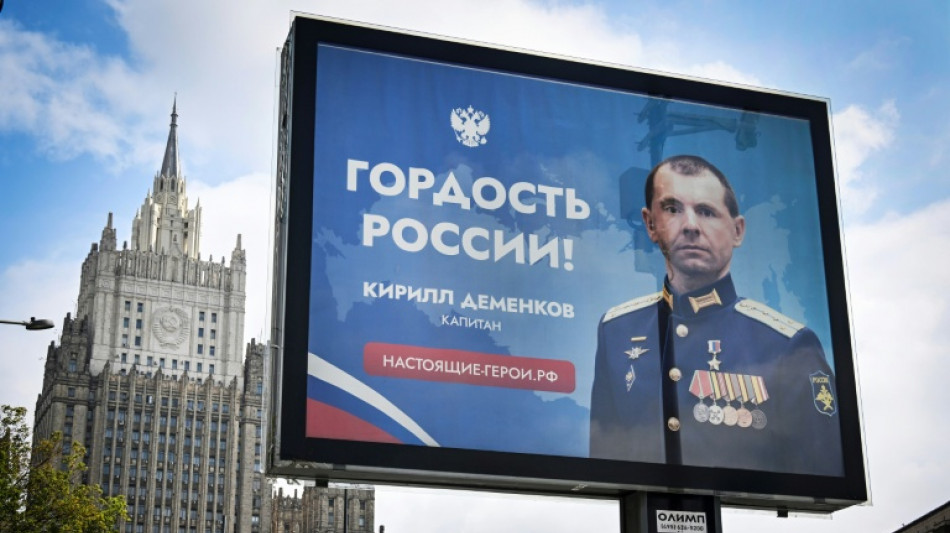
Russia's conscripts recount pressure to fight in Ukraine / Photo: © AFP
After Russian police started using facial-recognition cameras to identify men wanted by military authorities, a young bank worker spent weeks avoiding the Moscow metro.
But on snowy Friday evening in late 2024, heavy traffic pushed him underground to visit his mother. At the next station, two officers entered the carriage and detained him for draft evasion.
Within three days, he was sent to a military unit near Moscow for year-long mandatory service.
Like other Russian conscripts who described their experiences to AFP, he spoke on condition of anonymity for security reasons.
The cases show how, amid the war with Ukraine, Russia has hardened its once-avoidable conscription system and the pressure draftees -- officially not sent to war -- come under to sign contracts to fight in Ukraine once inside the military machine.
"Before 2022, there were many ways to avoid the draft without doing anything illegal," said Artyom Klyga, a lawyer with the Movement of Conscientious Objectors.
"Now very few legal ways remain."
- 'Record numbers' -
It used to be relatively easy to secure a medical exemption, perform alternative civilian service, or avoid the draft by staying in education.
Since invading Ukraine, Russia has made conscription year-round, raised the upper age limit from 27 to 30, tightened medical exemptions and introduced an online summons system.
Timofey Vaskin of Shkola Prizyvnika, or the School of Conscripts, said the demand to find ways out of service had "risen sharply".
In Moscow, facial-recognition cameras and a unified recruitment system have made men easier to find and faster to process.
Once conscripted, the pressure to sign a fully-fledged army contract often starts within days.
"They are without means of communication, without access to parents, right groups or journalists," Klyga said.
One common tactic is to present a military contract as a normal job, Vaskin said.
Conscripts are told they can work "from nine to six", earn far more and avoid routine duties.
Others are promised roles as drivers or clerks, or that the contract will last "just one year".
In fact, army contracts are effectively open-ended.
"It is a major success of the Russian authorities that they have convinced many people that conscripts simply serve for a year," Klyga said.
"As a result, conscripts are now ending up in the war in record numbers."
- 'People like you' -
Last year, 422,000 Russians signed voluntary contracts to fight in Ukraine, according to ex-president Dmitry Medvedev -- six per cent down on 2024.
At the same time, some 295,000 people were called up for military service.
If conscripts sign a contract to fight, they can end up on the front "within a month," Klyga said.
After being caught on the metro, the former bank worker was held for three days in a detention centre without a shower or change of clothes.
No one forced him to sign-up, he said, but the idea was constantly present.
"You're a good fit, we need people like you," he was told.
"You could get a decent role, earn money and not do the usual duties," he recalled his superiors saying.
Some in his unit agreed immediately. For a while, he considered it.
A DJ from Moscow who tried to avoid service told AFP he could not obtain a driving licence or international passport without proper military papers.
He gave in and was assigned to an army medical unit for a year -- where he met contract soldiers trying to find a way out.
"None of them want to serve," he said. "They all want out."
He recalled some commanders telling him: "Don't sign anything. Don't ruin your life."
- 'Break a person' -
In one case, Vaskin reported a prohibited phone was planted on a conscript, who was told to choose between detention or signing a combat contract.
Klyga's organisation has documented complaints from conscripts being kept awake all night in heavy chemical protection suits, forced to dig holes and then refill them, and others who said their signatures were forged on enlistment documents.
"Under constant pressure they break a person," he said.
One conscript told AFP that a man in his unit swallowed a needle in an attempt to get discharged.
"He was covered in blood when they brought him in," he said.
He survived and was eventually discharged.
Those that end up fighting -- through pressure or coercion -- often do not tell their relatives.
"They simply leave, and the family only finds out later," Klyga said.
In some cases, parents only discover what happened after their son has been killed at the front.
T.F.Russell--TNT