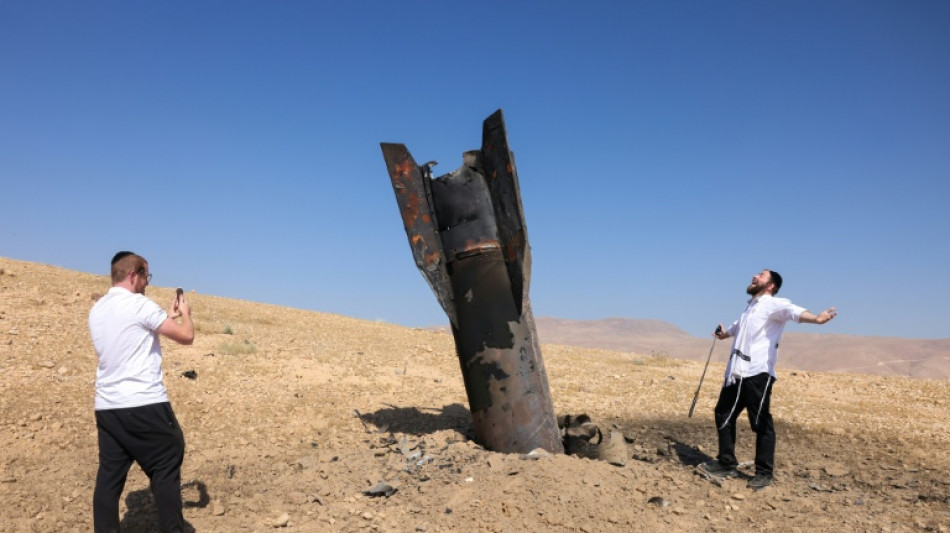
Iran halts Israel operation after first post-truce clash / Photo: © AFP
Iran on Monday said it was ending its latest military operation against Israel after the first exchanges of fire between the foes since a shaky ceasefire began, but warned it could inflict a more "crushing" response.
US President Donald Trump earlier on Monday told both Iran and key ally Israel to stop fighting, against the background of reports of an increasingly testy relationship between the US leader and Israeli Prime Minister Benjamin Netanyahu.
Iran fired dozens of missiles at Israel overnight and Israel responded by targeting military sites in the Islamic republic, sparking fears the escalation could usher in a new full-scale conflict after the April 8 truce.
"Israel and Iran must immediately stop 'shooting.' President DONALD J. TRUMP," the US leader wrote on his Truth Social network.
Minutes later, he added in a new post that "final negotiations" towards peace were proceeding "subject to ignorance or stupidity getting in its way."
Iran's military command then said it was halting the operation against Israel after delivering a "painful response".
But it warned "that should acts of aggression and hostility continue, including in southern Lebanon, much more severe and crushing measures than before will follow".
Shortly after, Israel's army intercepted three projectiles fired from Lebanon, according to an AFP journalist near their shared border, with the military confirming the munitions had targeted its forces operating in Lebanon's south.
"Some of the projectiles were intercepted prior to crossing into Israeli territory, and an additional projectile fell near IDF soldiers. No injuries were reported," the military said.
Tehran's earlier strikes followed attacks by Israel against targets of the Iran-backed Lebanese Shia group Hezbollah in the southern suburbs of Beirut.
Iran had repeatedly warned it would strike Israel if the Lebanese capital was targeted.
- 'People frustrated' -
On Monday in Tehran, there was little sign of any return to war, with cafe terraces packed.
Traffic seemed lighter than usual for a weekday, suggesting that some people had stayed home and there were also many more people queuing at gas stations.
Maryam, 41, an accountant in Tehran, described "a sense of uncertainty and confusion."
"You don't know if there's going to be a war, nor do you know if the peace agreement will last. Nothing is clear. People are frustrated," she said.
Residents of Tel Aviv meanwhile went to shelters as sirens went off.
"I hope it will be short, but you can never know. Last time we thought it will be short and then it was a month, so I don't know," said Jonathan Ariel, 30.
Oil prices surged more than five percent on worries that war could break out again, with hopes now punctured of a rapid end to the standoff that has seen shipping limited through the key Strait of Hormuz trade bottleneck.
The strikes also came at a critical moment with diplomatic efforts to end the conflict involving mediator Pakistan on a knife-edge.
Iranian foreign ministry spokesman Esmaeil Baqaei warned at a press conference in Tehran attended by AFP that diplomacy was continuing but risked being "affected" by the escalation.
As he was speaking at the foreign ministry, a huge explosion shook the building, followed by repeated explosions believed to be from air defence systems, the AFP reporter said.
Pakistan Interior Minister Mohsin Naqvi visited Tehran to deliver what he said was a "special letter" to Iran's supreme leader Mojtaba Khamenei, according to Iranian state television.
He has since travelled back to Pakistan, an official Pakistani source said on Monday.
Iranian President Masoud Pezehskian wrote on X that Tehran was still "at the negotiating table".
- 'Prepared for long-term war' -
No casualties have been reported in either Israel or Iran after the exchange of fire.
The Israeli military said it struck and dismantled Iranian defence systems deployed across several areas in the country. Iran fired nearly 30 missiles towards Israel since Sunday night, an Israeli military official said.
An AFP correspondent also saw a missile fall in agricultural land in the area of Najha, in the countryside of the Syrian capital Damascus, causing a fire around the impact site but no reported human casualties.
"Material damage is minor, but the psychological impact is significant. The area is home to children, farm caretakers, livestock and solar power installations," said Fadil Ataya, a local farmer.
A military source told the Tasnim news agency that "Iran is prepared for a long-term war with the Zionist regime and for strikes against US interests" in the region.
It also remains unclear who is leading decision-making in Tehran with Mojtaba Khamenei, said to have been wounded in a US-Israeli strike, yet to appear in public after taking over from his father Ali Khamenei who was killed on the first day of the war on February 28.
The European Union's top diplomat Kaja Kallas called on both sides to "sit down to a negotiation table and agree", adding that "the region does not need an escalation."
D.S.Robertson--TNT