Swiss healthcare united against immigration cap plan / Photo: © AFP
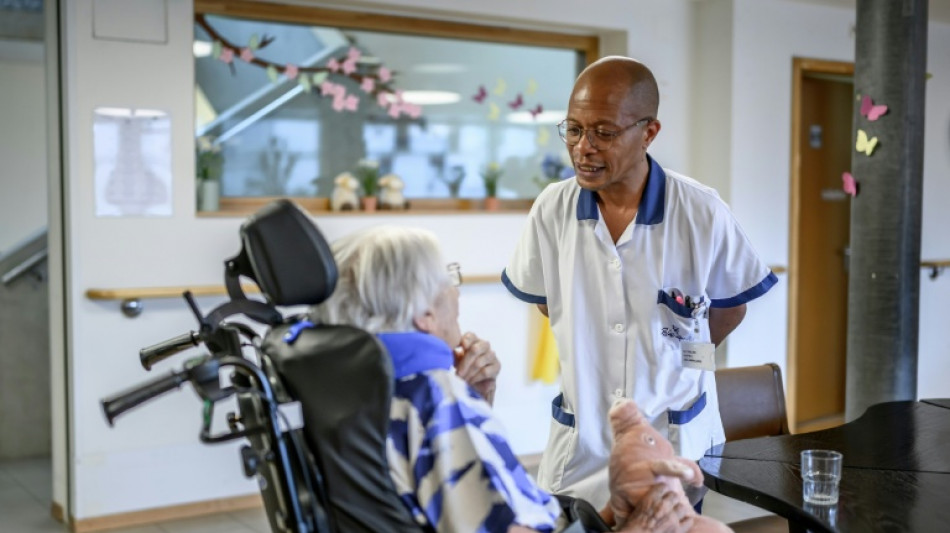
At a Swiss nursing home, Marcelle Mivelaz celebrated her 80th birthday surrounded by friends, as a team of mostly foreign nurses and caregivers ensured the day ran smoothly.
Swiss healthcare facilities like this one, in Cheseaux-sur-Lausanne in the west of the country, are heavily reliant on foreign workers amid chronic staff shortages.
Now the sector fears that a popular vote on June 14 on a proposal to dramatically slash immigration could cripple the industry, with a potentially critical outcome.
"If there aren't enough caregivers, our healthcare system is headed for disaster," Carine Savioz, a Swiss nurse at the Cheseaux-sur-Lausanne home, told AFP.
"This worries me," acknowledged 81-year-old Marie-Therese Barraz, standing next to Mivelaz.
"We must have respect for the people who care for nursing home residents."
Put forward by the hard-right Swiss People's Party (SVP), the "No to a Switzerland with 10 million!" proposal wants the wealthy Alpine nation's population -- currently 9.1 million -- capped below 10 million until 2050.
The initiative faces broad opposition across the government, parliament and business sector, but opinion polls suggest the vote could be tight.
The healthcare sector, which struggles to recruit Swiss nationals put off by the notoriously demanding nature of the work and relatively unattractive salaries, has been front and centre in the debate.
- 'Chaos initiative' -
For Christian Weiler, director of the Primeroche Foundation which looks after some 360 people across several establishments, including the Cheseaux-sur-Lausanne nursing home, the situation is clear.
"We have some 240 employees, nearly 80 percent of whom are foreign nationals," he told AFP.
He said his foundation would like to open other nursing homes, but feared it would struggle to find staff.
"Currently, 240 people are waiting for a place in the Lausanne area," he pointed out, warning that lacking spots could have dire societal implications.
"If there aren't enough places, they'll go to the hospital," he said.
And "when hospitals are full of elderly people, they won't be able to fulfil their role, and the system will become very problematic" as the population ages.
The Swiss government also warns that the proposal "threatens the proper functioning of society", with hospitals and nursing homes unable to care for the sick and elderly the way they do today.
The SVP rejects that.
It is calling for more Swiss staff to be trained and points out that its proposal would still allow 40,000 foreigners to immigrate each year.
However, the business and healthcare sectors say that is not enough.
An alliance of major players in the sector, including the Swiss National Association of Hospitals and Clinics and the Swiss Nurses' Association, has formed a committee to denounce what it calls the SVP's "chaos initiative", warning it "endangers" patients.
The committee fears that if services are understaffed or forced to rely on less qualified personnel, the "risk of mortality increases", particularly in emergency situations.
- 'Urgent' need for staff -
According to the Swiss Medical Association (FMH), the country "remains far from being able to ensure the replenishment of its medical workforce on its own".
The healthcare system is structurally dependent on doctors trained abroad. They account for 43 percent of all doctors -- a figure which continues to rise.
"Each year, our universities award between 1,200 and 1,300 medical diplomas," but "we would need 3,500 to 4,000 young doctors per year," FMH vice-president Philippe Eggimann told the Swiss newspaper Le Temps.
Thomas Blasi, an SVP parliamentarian and an independent pharmacist in Geneva, charged that the sector's reliance on immigrants was taking a toll on Swiss health workers.
"Despite the urgent need for healthcare staff, our young graduates cannot find employment because we prefer to rely on foreign workers," he said.
Others, however, highlight a persistent shortage of Swiss candidates.
At Geneva University Hospitals (HUG), nursing director Sandra Merkli said 200 to 300 nurses needed to be recruited each year -- while the Geneva canton's medical school only provides 150 to 160.
In 2025, nearly one in two of HUG's approximately 13,000 staff was a foreign national, with the proportion reaching around 60 percent for nursing staff and 45 percent among doctors.
G.Morris--TNT