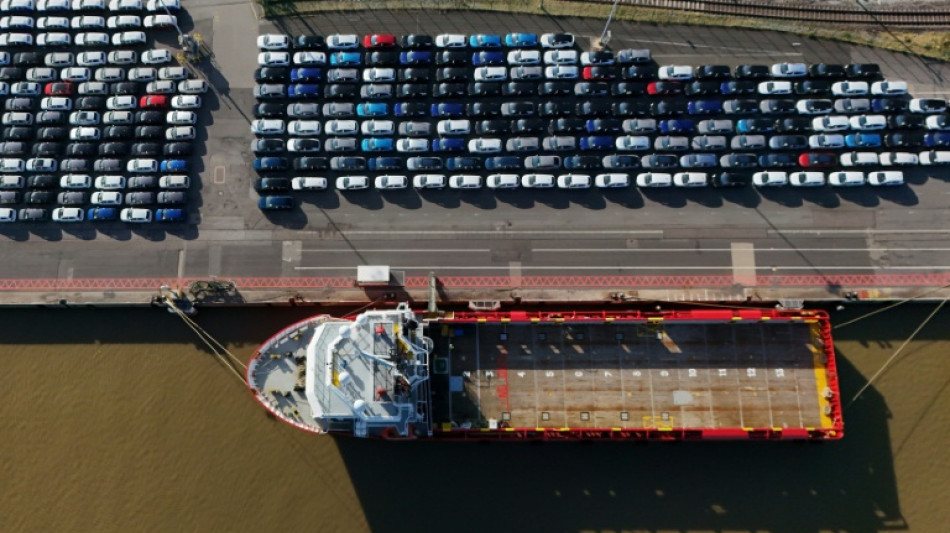
German carmakers weigh China, defence tie-ups for idle plants / Photo: © AFP
Germany's beleaguered carmakers are desperately seeking solutions for their under-used factories, with speculation swirling that Chinese manufacturers or weapons makers could move in.
Across Europe, carmakers are in trouble due to growing Chinese competition, weak demand and a choppy transition to electric vehicles (EVs), leaving many plants operating way below capacity.
One solution is to open up factories for Chinese manufacturers to produce cars in Europe as they seek to get around EU tariffs on EVs, a step recently taken by Stellantis which owns Jeep and Fiat.
Chinese brands, including BYD, MG and Chery, are gaining ground in Europe fast and now make up around nine percent of the region's overall sales, according to consulting firm Dataforce.
Germany's Volkswagen -- Europe's biggest automaker -- said in April it is also open to the idea of "partnering" with Chinese manufacturers at its plants.
VW, in the process of slashing thousands of jobs as profits and sales suffer, is seeking to reduce global production capacities by around one million vehicles -- half in China and half elsewhere, particularly Europe.
Officials in regions hosting Volkswagen plants have welcomed the idea of bringing VW's joint venture partners from China onto the production lines of German factories.
- 'Securing the future' -
Dirk Panter -- economy minister of the state of Saxony, whose VW plant in Zwickau faces an uncertain future -- notes that other Chinese manufacturers are starting to produce cars around Europe, including through such tie-ups.
"To secure the future of the automotive industry in Saxony and in Germany, it is essential not to ignore this reality," he told AFP.
The Handelsblatt financial daily has reported that VW -- a 10-brand manufacturer, whose models range from Audi to Seat and Skoda -- already held talks in 2024 with Chinese carmakers but they ended with no result.
VW has more recently sought to dampen talk of imminent deals, with a spokesman telling AFP that "there are currently no plans or discussions regarding the production of Chinese vehicles in the German plants of the Volkswagen Group".
While some analysts believe there could be a reluctance to give Chinese carmakers easier access to Europe, others think it is the Chinese firms themselves that are hesitant due to high costs in Germany.
"I think that the hesitation on the part of the Chinese manufacturers is very great," Frank Schwope, an auto industry consultant and lecturer at the FHM Berlin university, told AFP.
"The offer would have to be very attractive."
Stellantis's announcements so far have mainly focused on Spain and France, where costs are lower.
- Switch to armoured vehicles? -
German manufacturers are also said to be considering opening up or even selling plants to defence companies, which are expanding rapidly as Germany and other European countries rearm.
Der Spiegel recently reported that French-German tank and weapons maker KNDS is in talks to take over a Mercedes-Benz plant at Ludwigsfelde south of Berlin that produces vans and convert it to make armoured personnel carriers.
A KNDS spokesman would not confirm the report, telling AFP only that it was "seeking suitable partner companies for the planned ramp-up in the defence sector".
Mercedes told AFP that "our goal is to develop a future-ready solution for Ludwigsfelde".
Volkswagen has confirmed it is in talks with defence companies about taking over one of its smaller plants in the city of Osnabrueck, where production is due to end as part of its cost-cutting drive.
Reports say the group has held talks with Israel's Rafael Advanced Defence Systems about making components there for the Iron Dome air defence system, including heavy-duty trucks and electricity generators but not the projectiles themselves.
Discussions have also reportedly taken place with KNDS about the factory.
Still, entering the defence sector could prove controversial for Volkswagen.
The group was founded when the Nazis were in power, produced military equipment for Germany during World War II and used forced labour.
"In historical terms, it's not an easy issue for Volkswagen to share locations with defence companies," Stefan Bratzel, an auto industry expert at the Center of Automotive Management in Germany, told AFP.
T.Allen--TNT