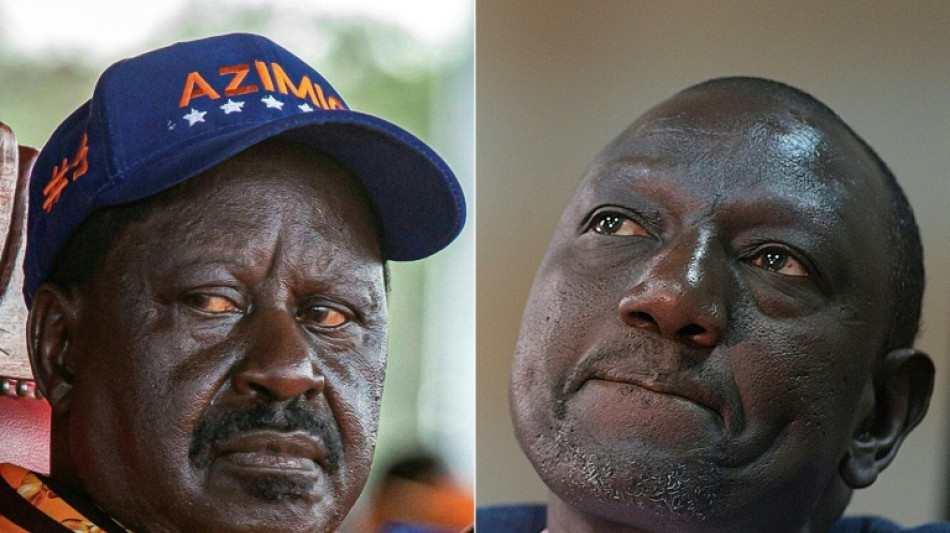
Kenya set to learn outcome of tight election race / Photo: © AFP/File
Kenya is expected Monday to learn the outcome of its closely-fought presidential election after a long wait for results that has put the nation on edge.
Deputy President William Ruto was leading with slightly more than 51 percent of the vote against 48 percent for Raila Odinga, based on official results from more than 80 percent of constituencies, according to a tally published by the Daily Nation newspaper.
At church services on Sunday in the largely Christian country, both men had appealed for calm as the wait for final results of the August 9 vote dragged on.
Polling day passed off largely peacefully in the East African political and economic powerhouse, but memories of vote-rigging and deadly violence in 2007-08 and 2017 still loom large.
And the Independent Electoral and Boundaries Commission (IEBC) is under intense pressure to deliver a clean poll in a country regarded as a beacon of stability in a troubled region.
Results must be issued by the end of Tuesday at the latest, according to Kenya's constitution.
"I am ready for whatever outcome. Whether it is Ruto or Raila we must move on. We have waited for too long," said Livingstone Wabwire, 27, a shoe shiner in downtown Nairobi.
- Disenchantment -
Ruto, 55, is deputy president but effectively ran as challenger after outgoing President Uhuru Kenyatta threw his support behind his former foe Odinga, the 77-year-old veteran opposition leader making his fifth bid for the top job.
Kenyans voted in six elections to choose a new president as well as senators, governors, lawmakers, women representatives and some 1,500 county officials.
Kenyatta, the 60-year-old son of the first post-independence president, has served two terms and could not run again.
The winner of the presidential race needs to secure 50 percent plus one vote and at least a quarter of the votes in 24 of Kenya's 47 counties.
If not, the country will be forced to hold a runoff within 30 days of the original vote.
Observers say that with the race so close, an appeal to the Supreme Court by the losing candidate is almost certain, meaning it could be many weeks before a new president takes office.
Turnout on polling day was lower than expected at around 65 percent of Kenya's 22 million registered voters, compared with about 78 percent in the last election in 2017.
Observers blamed disenchantment with the political elite, particularly among young people in a country battling a severe cost- of-living crisis and a punishing drought that has left millions hungry.
- 'At breaking point' -
Lawyer David Mwaure -- one of the four presidential candidates along with former spy George Wajackoyah -- conceded on Sunday, endorsing Ruto, whose party won a key gubernatorial race when Johnson Sakaja secured control of Nairobi, Kenya's capital and richest city.
The Star newspaper on Monday said "public anxiety" over the election results was at "breaking point."
But, it noted, Kenyans had conducted themselves peacefully during and after the election with no significant incidents reported.
"The will of the people is supreme. We must all accept and respect that decision despite the pain of loss," it said in an editorial.
The IEBC had faced sharp criticism over its handling of the August 2017 poll, which in a historic first for Africa was annulled by the Supreme Court after Odinga challenged the outcome.
Dozens of people were killed in the chaos that followed the election, with police brutality blamed for the deaths.
Kenyatta went on to win the October rerun after a boycott by Odinga.
The worst electoral violence in Kenya's history occurred after a disputed vote in 2007, when more than 1,100 people were killed in bloodletting between rival tribes.
P.Jones--TNT