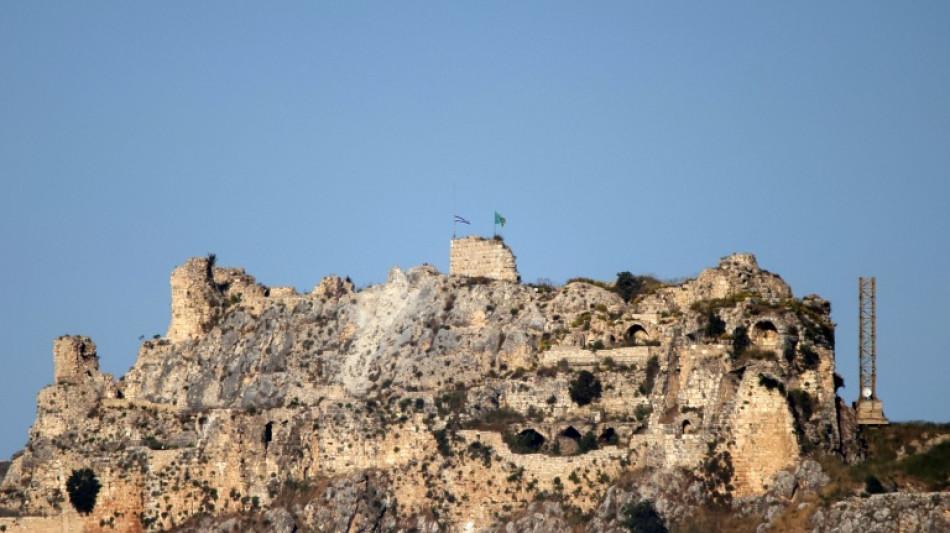
Israel risks new quagmire in Lebanon / Photo: © AFP
Israel has portrayed the capture of a Crusader-era fortress as a turning point in its offensive against Hezbollah, but the operation has also sparked fears of a new quagmire in south Lebanon.
Israeli authorities praised the symbolism of the capture of Beaufort, perched atop a rocky outcrop, as they announced its capture in an assault documented by military drones.
Almost 44 years to the day earlier, Israeli forces had seized the same commanding position overlooking a valley, later turning it into a key base during their two-decade occupation of southern Lebanon.
By rapidly distributing footage of troops entering the fortress, the military echoed a famous 1982 image showing then-defence minister Ariel Sharon and prime minister Menahem Begin at the same spot.
For many Israelis, however, the fortress remains a symbol not of victory, but of a costly military entanglement that ultimately failed to eradicate the Lebanese armed group Hezbollah.
"The conquest of Beaufort is the most blatant sign that we haven't learned a thing," Israel's Reichman University professor Nadav Pollak said on X.
- 'Stupid PR photo-op' -
The Middle East lecturer and former Israeli intelligence officer decried a "stupid PR photo-op" and described Beaufort as "a place that to many Israelis is a symbol of the stupidity of staying in south Lebanon."
More than 1,200 Israeli soldiers were killed and thousands more wounded in Lebanon before Israel withdrew in 2000.
The military, now conducting its deepest incursion into Lebanon since the withdrawal, argues the site holds genuine strategic value.
It says Iran-backed Hezbollah has launched 400 projectiles toward Israel from the area since fighting resumed in early March.
Avigdor Kahalani, who commanded the assault on Beaufort in 1982, recalled fierce battles against Palestine Liberation Organisation (PLO) fighters entrenched there at the time.
Though pleased to see the Israeli flag flying over the fortress once again, he told AFP he viewed the operation as a symbolic milestone and a stepping stone northward, rather than a decisive turning point.
"I will be excited the moment they will destroy Hezbollah," said Kahalani, a former minister of internal security.
- 'Historic opportunity' -
According to Lebanese authorities, Hezbollah has accepted a US proposal for a "mutual cessation of attacks", while President Donald Trump hoped that fighting between the two sides would stop for "eternity".
Yet, despite an apparent pause in Israeli strikes on Beirut under US pressure, Prime Minister Benjamin Netanyahu has vowed to press ahead with operations in southern Lebanon.
The military says it wants to establish a security zone under its control in the Litani River area, about 30 kilometres (19 miles) from the border with Israel.
Sarit Zehavi, a reserve lieutenant-colonel, told AFP that most Israelis have little appetite for a return to Lebanon.
"I grew up in an atmosphere when I was a child that every morning you opened the radio to hear the news of who was killed tonight in Lebanon," said the 50-year-old expert on security challenges on Israel's northern borders.
"My father fought in Lebanon. My husband fought in Lebanon. I lost friends in Lebanon. And I lost my cousin's son last week, not in Lebanon, but on the border," said Zehavi, who lives close to Lebanon's border.
Zehavi still believes that Israel has a "historic opportunity" to eliminate Hezbollah which she views has been weakened.
With Iran under intense US pressure, Lebanon's government engaged in talks with Israel and much of south Lebanon's population displaced, she believes Israel has an unusually favourable strategic opening.
- 'This is the moment' -
Sam Heller, an analyst at the US-based Century Foundation, is unconvinced.
For him, the images of the Israeli flag over Beaufort do little to alter what he sees as the most likely outcome: a new and prolonged quagmire in Lebanon.
Israel's most pressing challenge, he argues, is Hezbollah's explosive drones, which have already killed several Israeli soldiers.
A buffer zone in southern Lebanon would do little to eliminate that threat, Heller told AFP, "for which it doesn't seem like the Israelis have an effective countermeasure."
Kahalani, however, was confident that Israel's military would eventually find a solution.
"I think the Israelis don't have a dream to stay there," he said, but "we have to destroy the Hezbollah. This is the moment."
M.A.Walters--TNT