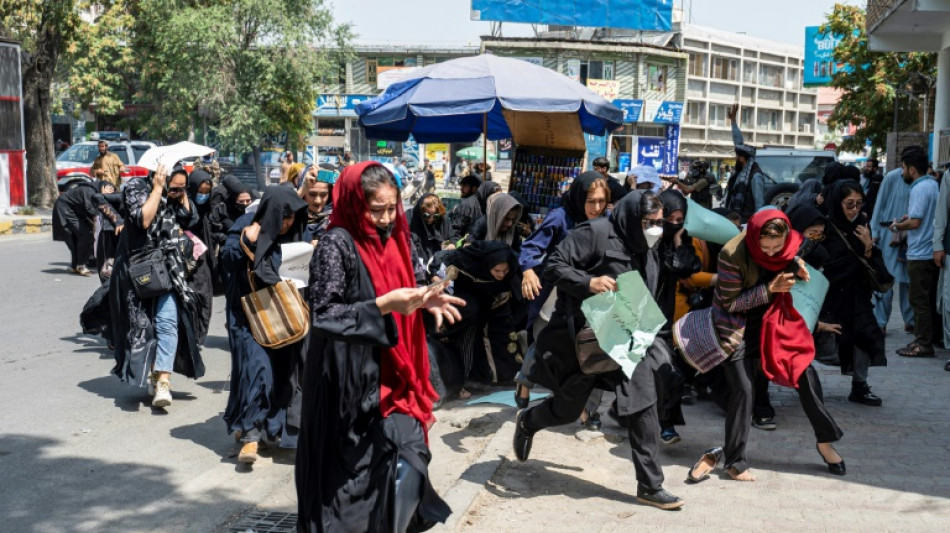
Taliban violently disperse rare women's protest in Kabul / Photo: © AFP
Taliban fighters beat women protesters and fired into the air on Saturday as they violently dispersed a rare rally in the Afghan capital, days ahead of the first anniversary of the hardline Islamists' return to power.
Since seizing control on August 15 last year, the Taliban have rolled back the marginal gains made by women during two decades of US intervention in Afghanistan.
About 40 women -- chanting "bread, work and freedom" -- marched in front of the education ministry building in Kabul, before the fighters dispersed them by firing their guns into the air, an AFP correspondent reported.
Some women protesters who took refuge in nearby shops were chased and beaten by Taliban fighters with their rifle butts.
The demonstrators carried a banner which read "August 15 is a black day" as they demanded rights to work and political participation.
"Justice, justice. We're fed up with ignorance," they chanted, many not wearing face veils.
"Unfortunately, the Taliban from the intelligence service came and fired in the air," said Zholia Parsi, one of the organisers of the march.
"They dispersed the girls, tore our banners and confiscated the mobile phones of many girls."
But protester Munisa Mubariz vowed to continue fighting for women's rights.
"If the Taliban want to silence this voice, it's not possible. We will protest from our homes," she said.
Some journalists covering the demonstration -- the first women's rally in months -- were also beaten by the Taliban fighters, an AFP correspondent saw.
- 'Making women invisible' -
While the Taliban authorities have allowed and even promoted some rallies against the United States, they have declined permission for any women's rally since they returned to power.
After seizing control last year, the Taliban promised a softer version of the harsh Islamist rule that characterised their first stint in power from 1996 to 2001.
But many restrictions have already been imposed, especially on women, to comply with the movement's austere vision of Islam.
Tens of thousands of girls have been shut out of secondary schools, while women have been barred from returning to many government jobs.
Women have also been banned from travelling alone on long trips and can only visit public gardens and parks in the capital on days separate from men.
In May, the country's supreme leader and chief of the Taliban, Hibatullah Akhundzada, ordered women to fully cover themselves in public, including their faces -- ideally with an all-encompassing burqa.
Since the secondary school ban was announced in March, many secret schools for these girls have sprung up across several provinces.
The United Nations and rights groups have repeatedly slammed the Taliban government for imposing the restrictions on women.
These policies show a "pattern of absolute gender segregation and are aimed at making women invisible in the society", Richard Bennett, UN special rapporteur on human rights in Afghanistan, told reporters in Kabul during a visit in May.
Human Rights Watch on Thursday called on the Taliban to "reverse their horrifying and misogynistic" decision to bar women from education.
"This would send a message that the Taliban are willing to reconsider their most egregious actions," Fereshta Abbasi, Afghanistan researcher at the rights group, said in a statement.
Some Afghan women initially pushed back against the curbs, holding small protests.
But the Taliban soon rounded up the ringleaders, holding them incommunicado while denying they had been detained.
S.O'brien--TNT