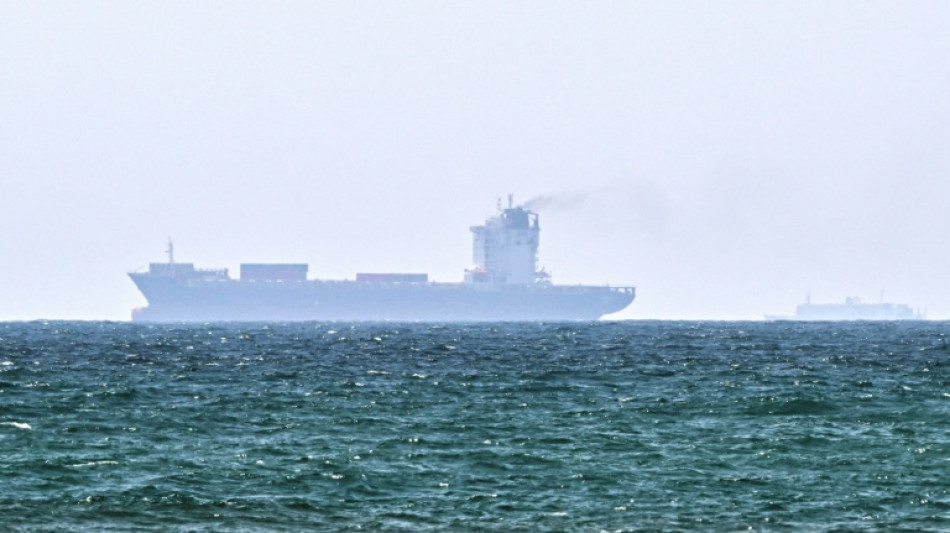
Possible Iran-US deal: What we know / Photo: © AFP
The United States and Iran appear closer than ever to a deal that would end a war that has engulfed the Middle East and disrupted the global oil market.
US Secretary of State Marco Rubio said the world might "get some good news", soon after President Donald Trump announced an agreement had been "largely negotiated" and would include the reopening of the Strait of Hormuz.
Before Trump's announcement, Iran's Foreign Ministry spokesman Esmaeil Baqaei spoke of "a trend towards rapprochement" with Washington, but warned that "it does not necessarily mean that we and the United States will reach an agreement on the important issues."
He said on state television that Iran's "intention was first to draft a memorandum of understanding, a kind of framework agreement," before a final deal is reached within 30 to 60 days.
What do we know about the possible agreement?
- Nuclear question -
Baqaei said that the nuclear issue was not part of an initial framework. It will rather be "subject to separate discussions" at a later stage.
But the New York Times, citing two unnamed American officials, said a key element of the proposed agreement was an apparent commitment by Tehran to give up its stockpile of highly enriched uranium."
The question of how Iran would do so would be discussed in "later round of negotiations over Iran's nuclear program," according to the paper.
But Iran's Fars and Tasnim news agencies reported that Iran made no commitments regarding its nuclear programme.
"Iran has made no commitment in this agreement to hand over nuclear stockpiles, remove equipment, shut down facilities, or even commit not to build a nuclear bomb," Fars said.
Both agencies said that nuclear-related issues would be negotiated within 60 days of the understanding being signed.
- How will Hormuz reopen? -
A key sticking point in the talks is traffic through the Strait of Hormuz, a vital global conduit for oil shipments that has come under Iranian control since the outbreak of the war.
Iran has insisted that vessels must obtain permission from its armed forces.
Trump said Saturday that "in addition to many other elements of the Agreement, the Strait of Hormuz will be opened," a development that would bring relief to global energy markets.
But, Fars news agency said that, if finalised, the potential agreement would preserve Iran's management over the strategic waterway.
Tasnim reported that "the status of the Strait of Hormuz would not revert to its pre-war situation."
It added that the "the naval blockade, according to the reported framework, would also need to be fully lifted within 30 days," referring to the US blockading Iranian ports.
- Funds and sanctions -
Iran has long demanded the release of its frozen assets held under longstanding US sanctions.
According to Tasnim, "Iran has insisted that any initial understanding must be conditional on at least partial access to the assets."
It quoted an informed source as saying that Iran "has stressed that there will be no agreement unless a specified portion of Iran's frozen assets is released at the very first stage".
A clear mechanism must also be "established to guarantee the continued release of all blocked funds".
Tasnim's source warned that "disagreements over this matter are among the reasons why no final understanding has yet been reached".
According to Fars, a potential understanding would also see the US temporarily lifting sanctions on oil, gas, and petrochemicals during the negotiation period.
- Is Lebanon included? -
Israel has been carrying out daily strikes in Lebanon despite a ceasefire agreement brokered by the United States, saying it is targeting the Iran‑backed group Hezbollah.
Iran has previously said that any ceasefire must apply to all fronts of the regional war, including Lebanon, and Hezbollah has said it is confident that its ally will not abandon it.
Tasnim reported that "a memorandum of understanding (MOU) would first be announced, stressing an end to fighting on all fronts, including in Lebanon."
"Under the arrangement, Israel, as a US ally, would also be expected to halt the war in Lebanon," it added.
Baqaei told state television that "at this stage, we will not discuss the details of the nuclear issue... we have decided to prioritise an urgent issue for all of us: ending the war on all fronts including Lebanon."
burs-rh/dc
F.Lim--TNT