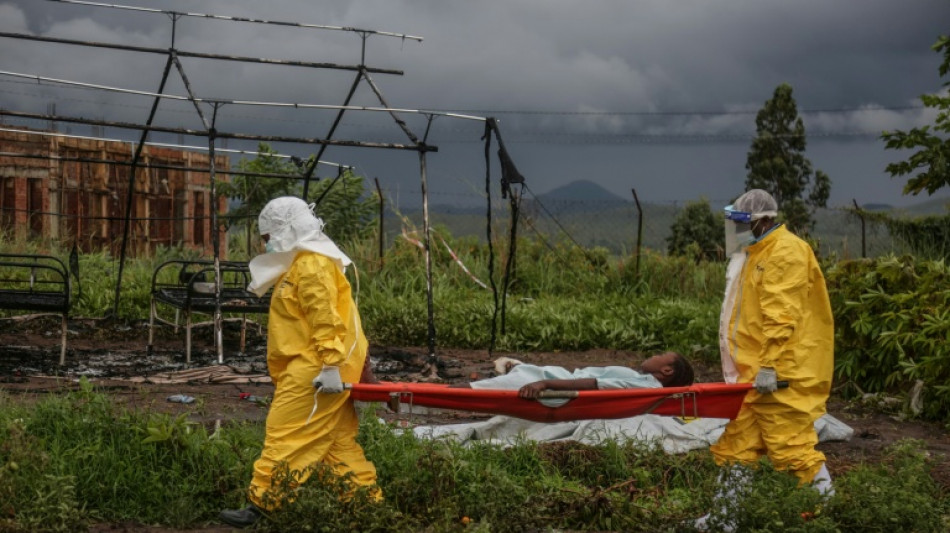
Ebola toll tops 200, other African countries seen at risk / Photo: © AFP
Officials in the Democratic Republic of Congo updated the death toll from the Ebola outbreak to 204 late Saturday, hours after the Red Cross said three volunteers had died there and Uganda confirmed three new Ebola cases.
A health ministry statement said 204 deaths had been recorded in three provinces of the vast central African country, from 867 suspected cases. The last World Health Organization toll on Friday put the number of deaths at 177 from 750 suspected cases.
The World Health Organization has declared the outbreak of the highly contagious haemorrhagic fever an international emergency.
On Saturday, the African Union's health agency warned that more countries on the continent were at risk of being affected by the Ebola virus, in addition to the DRC and Uganda.
"We have 10 countries at risk," said Jean Kaseya, head of the Africa Centres for Disease Control and Prevention (Africa CDC), listing Angola, Burundi, the Central African Republic, the Republic of Congo, Ethiopia, Kenya, Rwanda, South Sudan, Tanzania and Zambia.
Kaseya said "high mobility and insecurity" in the region were helping spread the disease.
The new cases confirmed in Uganda on Saturday bring to five the total confirmed in the east African country since it was detected there and in the DRC on May 15. One person in Uganda has died.
The health ministry named the new patients as a Ugandan driver, a Ugandan health worker and a woman from the DRC. All are alive.
Ebola is a deadly viral disease that spreads through direct contact with bodily fluids. It can cause severe bleeding and organ failure.
The current epidemic centres on the conflict-wracked eastern DRC, where it was detected in Ituri province, which borders Uganda, before spreading to South Kivu.
- First known victims -
The Red Cross said on Saturday that three Congolese volunteers had died in Ituri after apparently contracting Ebola there.
The three "were carrying out dead body management activities on March 27 as part of a humanitarian mission unrelated to Ebola", said the International Federation of Red Cross and Red Crescent Societies (IFRC).
"At the time of the intervention, the community was not aware of the Ebola virus disease outbreak... They are among the first known victims."
Ebola has killed more than 15,000 people in Africa in the past half-century.
On Friday, the WHO raised the risk from Ebola in the DRC to its highest level -- "very high".
It said the risk in central Africa was "high" but the global risk remained "low".
The outbreak, which experts suspect was circulating under the radar for some time, is caused by the less common Bundibugyo strain, for which there are no approved vaccines or treatments.
On Thursday, Uganda suspended public transport to the DRC after confirming its first two cases -- one infection and one death -- involving Congolese nationals who crossed the border.
It said the driver confirmed infected on Saturday had been at the wheel of the vehicle in which one of the ill Congolese nationals had travelled to Uganda.
The health worker was exposed to the virus when treating that Congolese patient.
The third case was a Congolese woman who had visited Uganda and tested positive for Ebola after returning to the DRC.
- 'Everyone's problem' -
The eastern DRC has been plagued for three decades by conflict involving numerous armed groups.
State services in rural areas of Ituri have been largely absent for decades.
South Kivu is controlled by the Rwandan-backed armed group M23, which has never had to manage an epidemic like Ebola.
He said the Kinshasa government needed to have "total control" of the DRC territory to stop the virus spreading.
D.Cook--TNT