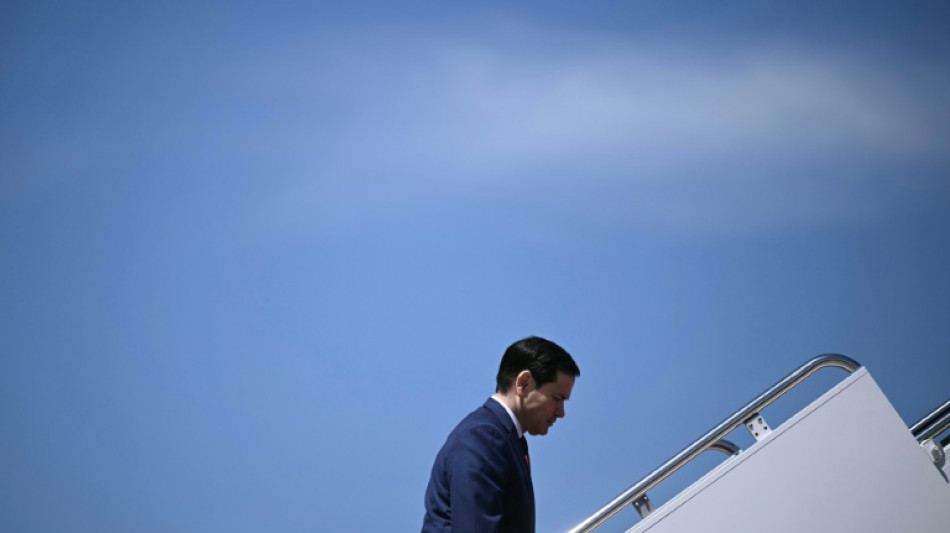
'Confusing': NATO allies sound out US on Trump's troop moves / Photo: © AFP
NATO's European members scrambled Friday to get clarity from US Secretary of State Marco Rubio on troop shifts by Washington, as they sought to placate President Donald Trump's ire on Iran ahead of a July summit.
Trump left heads spinning as NATO foreign ministers gathered in the Swedish city of Helsingborg by announcing he would send 5,000 troops to Poland, in an apparent reversal of Washington earlier calling off the planned deployment.
The shift was welcomed by NATO chief Mark Rutte and Poland's foreign minister, but it fuelled concerns about a lack of coordination between the United States and its allies.
"It is confusing indeed, and not always easy to navigate," said Swedish foreign minister Maria Malmer Stenergard.
Trump's seeming U-turn came after Washington earlier this month abruptly announced it was withdrawing 5,000 troops from Germany following a spat between Trump and Chancellor Friedrich Merz.
A string of NATO ministers said that US drawdowns on the continent were widely expected as Washington focuses on other threats and Europe ramps up its defences.
"What is important is that it happens in a structured manner, so that Europe is able to build up when the US reduces its presence," Norwegian foreign minister Espen Barth Eide said.
The meeting in Sweden comes after Trump has lashed out at Europe over its response to his war on Iran -- and threatened he could consider quitting NATO.
Diplomats said the aim was to turn the page ahead of the alliance summit in Ankara so that they could focus on showcasing increased spending by Europe.
Judging by Rubio's comments as he set off for the talks -- denouncing NATO for failing to weigh in behind Trump on Iran -- the United States may not be willing to move on too fast.
The US president is "not asking them to send their fighter jets in. But they refuse to do anything," the US top diplomat told reporters. "We were very upset about that."
Though himself a long-term supporter of the alliance, Rubio has already warned Washington needs to "re-examine" its ties to NATO after European nations restricted access to bases for US Iran operations.
In a bid to calm the storm, some allies have dispatched vessels closer to the region to help in the Strait of Hormuz when the war ends.
"Europeans have heard the message," Rutte said.
But Washington could deliver more bad news for NATO with expectations that it will cut the number of troops it puts at the alliance's disposal in case of crisis.
- Ankara overshadowed? -
Since Trump's return to power last year, NATO has weathered a series of crises including talking him down from trying to seize Greenland.
Now the fallout from the Iran war threatens to overshadow the summit in the Turkish capital Ankara.
NATO had been hoping to focus on showing Trump that allies were making good on their promise to him at last year's summit to ramp up defence-related spending to five percent of GDP.
Diplomats say a spate of arms deals are being lined up to show the US leader that Europe is putting its money where its mouth is.
Beneath the scramble to please Trump, there is an acceptance among Europeans that they will have to stand increasingly on their own feet.
Led by big-spending Germany, there is an increasing mood of steeliness -- but for now discussions are on building up Europe's role in NATO rather than creating an alternative.
"As the US reevaluates it level of engagement and presence in Europe within the alliance, it is exactly the opportunity... to Europeanise NATO," said French foreign minister Jean-Noel Barrot.
One area where the Europeans are already standing more on their own is backing Ukraine.
Rutte is pushing to get more commitments to buy weapons from the United States to give to Kyiv.
In a bid to ensure all countries pulled their weight, he floated a plan to get European countries and Canada to vow 0.25 percent of GDP to arm Ukraine.
Rutte admitted that his proposal had been quickly rebuffed.
Major economies like France, Spain and Italy have been accused of punching below their weight.
"What I want to achieve is that the burden is more evenly spread, that there is more burden sharing here," Rutte said.
"At the moment it is only six or seven allies who are doing the heavy lifting."
A.M.James--TNT