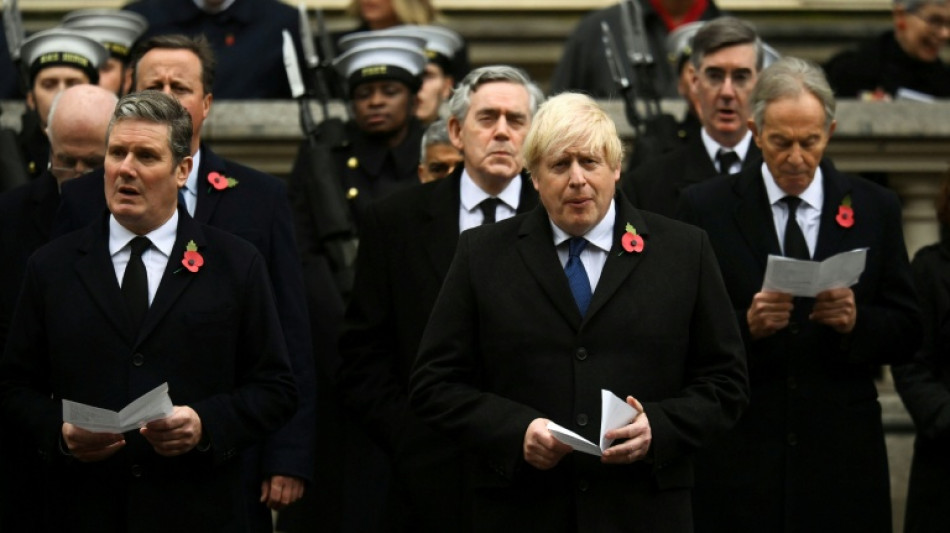
'Ungovernable' Britain? Once-stable politics in freefall / Photo: © POOL/AFP
For years, under long-serving leaders such as Margaret Thatcher and Tony Blair, the worst mid-term challenge a British prime minister might face was a rowdy jeering in parliament.
Now, leaders in the country of the wartime slogan "keep calm and carry on" regularly fear for their jobs, with the latest, Keir Starmer, facing intense pressure this week to quit too.
Six people have held the post in a decade of turbulence driven by the wake of the global financial crisis, Brexit and Covid.
"Is it because the PMs are no good, or because the office has become impossible, or because the situation's become impossible?" mused historian Anthony Seldon, who has authored books on the last four prime ministers.
"The answer is: it's a mixture of all three of those," he told AFP, judging the churn of leaders since 2016 "without precedent".
For voters, the situation borders on farce.
"We've had so many prime ministers in the last few years, it's ridiculous," Londoner Claudio, who declined to give his surname, said Wednesday, calling Starmer's precarious hold on power "unfortunate".
"But he's just not doing the right job anymore," he added.
- Seven-week term -
When David Cameron and his centre-right Conservatives ousted centre-left Labour in 2010, he became only the fifth prime minister in three decades.
Cameron quit six years later, after calling and then losing the referendum on remaining in the European Union, heralding an era of rare political instability.
There followed the ill-fated Downing Street tenures of Conservatives Theresa May, Boris Johnson, Liz Truss and Rishi Sunak.
Truss lasted just seven weeks -- a term memorably compared in the media to the lifespan of a rotting lettuce.
Starmer's 2024 victory, with a landslide number of parliamentary seats, was supposed to bookend that chaotic period.
But the Labour leader -- who won largely thanks to the splintering of votes on the right -- now faces being forced out, less than two years on.
Growing numbers of his own MPs and ministers have deserted him after a scandal over the appointment of an ambassador with links to the US sex offender Jeffrey Epstein.
- 'Ungovernable' Britain? -
Seldon argued that Starmer, Johnson and Truss "never learned how to do the job", while acknowledging that it "has become more difficult" in the age of social media, constant polling and modern "instant gratification" culture.
London School of Economics politics expert Tony Travers warned Britain now risks appearing "ungovernable", echoing a sentiment heard on political panel shows on TV.
"It begins to look like countries that people in Britain used to make fun of in the past," he told AFP, with Italy's recent decades of political dysfunction one example typically cited.
Breaking the cycle, Travers said, would require working out "how to stop senior MPs thinking that somehow changing their leader all the time is the solution to other problems".
"Those problems include not enough growth, high and rising prices, inflation, and the general sense that politics is now fragmenting."
- Brexit impact -
Political analysts agree that meagre economic growth since the 2008 financial crisis has left successive governments with little to offer in the form of tax cuts or increased spending.
"Voters want politicians to make them richer. They cannot do that, but they pretend that they can," Vernon Bogdanor, professor of government at King's College London, told AFP.
Seldon said servicing the country's huge debt has also become "an enormous constraint" as crises spook investors and make that more costly.
With foreign wars fuelling global instability, plus Covid and persistent inflation, British leaders have also had to contend with the country's highly disruptive EU departure in 2020.
"Brexit had a big effect... on stability in UK politics in a number of ways," said another King's political scientist, Anand Menon.
"It rearranged political affiliations," he told AFP. "It undoubtedly played a role in encouraging populist thinking and populist political forces."
- Populist 'danger' -
That in turn has strained Britain's traditional two-party political system, drawing scrutiny of the first-past-the-post voting system which does not reward smaller parties, reinforcing some voters' sense of being ignored.
Far-right anti-immigration party Reform UK has emerged as a major challenger to Starmer's Labour and the leftist Green party has also made electoral gains.
In 2024 however, Labour won 63 percent of the seats in the lower house of parliament despite winning just under 34 percent of the national vote.
For Menon, a government with such a huge majority being unable to govern is "worrying".
"There's a real danger that the longer this instability lasts, the more potential there is for us to end up with a populist government after the next election," due by 2029, he added.
R.T.Gilbert--TNT