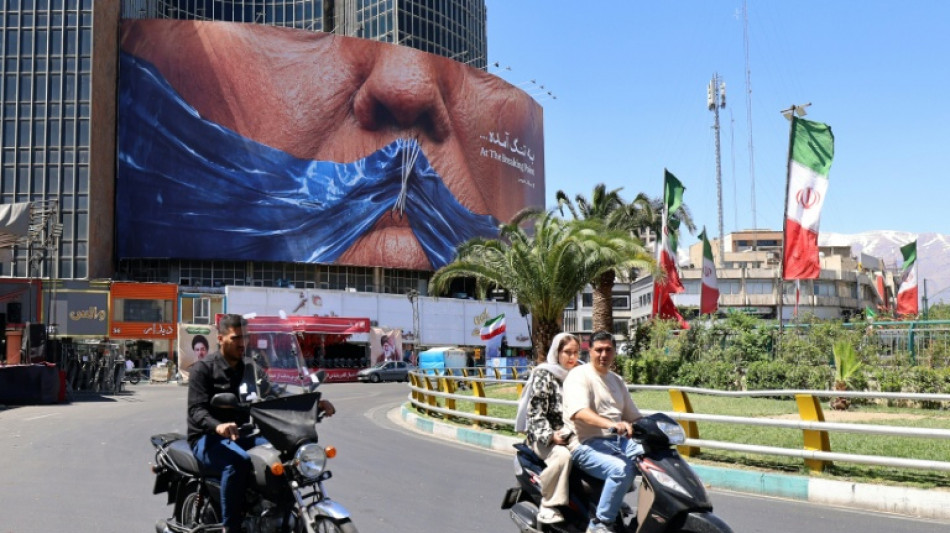
Frustrated Trump learns he doesn't have the cards on Iran / Photo: © AFP
One of President Donald Trump's favorite metaphors is that he's got the cards -- that through the might of the United States and his own acumen he can overpower any adversary.
On Iran, the former casino owner is learning that he, in fact, doesn't have such a strong hand after all.
As he travels this week to China on a trip already delayed by his war, Trump will not project strength as a victor but instead will remain beleaguered both by Iran's stubborn refusal to accept an agreement on his terms and dwindling approval from Americans who did not support the conflict and are now paying higher prices at the pump.
"I don't see how the president has many, if any, good cards to play at this moment in time," said Mona Yacoubian, director of the Middle East program at the Center for Strategic and International Studies.
Trump joined Israel in attacking Iran on February 28, with strikes quickly killing the longtime supreme leader, Ayatollah Ali Khamenei, and much of the other top brass.
But Iran quickly hit back by exerting control over the Strait of Hormuz, the narrow passageway through which one-fifth of global oil once sailed, and it has rained missiles and drones on US-allied Gulf Arab monarchies, shattering the oil-rich countries' hard-earned reputation for stability.
The United States would need massive force to dislodge Iran from the strait, which would cause major new havoc on global markets and new threats to Gulf Arabs, Yacoubian said.
Iran's cleric-run state ruthlessly crushed protests in January and is now dominated by the elite Revolutionary Guards, who are even less interested in compromise with the United States.
"I think that the administration has fundamentally misjudged the character and the approach of the regime in Tehran," Yacoubian said.
- 'Very desperate' -
Trump declared a ceasefire on April 8 and has indefinitely extended it, even as he was twice forced to abort trips by top US officials to negotiate in Pakistan after Iran balked at attending.
Trump last week announced "Project Freedom" in which US forces would help ships through the Strait of Hormuz, before suspending the operation two days later as Gulf Arabs worried about coming under fresh attack.
Trump then spent the weekend building anticipation for any Iranian response, only to declare Monday that Tehran's counter-proposal was "garbage."
"Trump's actions over the last month show a leader who's very desperate to end this conflict, but he continues to threaten more conflict if he doesn't get what he wants," said Brian Katulis, a senior fellow at the Middle East Institute.
"That shows that he simply does not know how to get a better deal. He could have gotten a better deal before the war began," he said.
Trump just last year had berated past US leaders for Middle East interventionism and has described China as the main challenger to the United States.
But he now arrives in China "with a much weaker hand," Katulis said.
"The US military has expended a lot of its armament and weaponry in just a month and a half, and China knows it."
- Wanting to turn the page -
Trump and his top aides last week said that the offensive part of the war, at least, was over, as the administration would otherwise need authorization from Congress.
But Israeli Prime Minister Benjamin Netanyahu, in an interview that aired Sunday with CBS News' "60 Minutes," said the war was not over as there was a need to seize uranium from Iran's disputed nuclear program.
Garret Martin, a foreign policy expert at American University, said that the only way out for Trump could be a negotiated agreement -- which may wind up being less rigorous than one reached without war in 2015 by former president Barack Obama, which Trump railed against as the "worst deal ever."
The end effect on the US image would be the opposite of January, when Trump voiced triumph after ordering a raid into Venezuela that quickly deposed and snatched Venezuela's leftist leader Nicolas Maduro and installed a compliant successor.
"Nobody is questioning that the American military is mightier and stronger than the Iranians'," Martin said.
"But that's not enough when the adversary is fighting what they see as an existential conflict."
N.Roberts--TNT