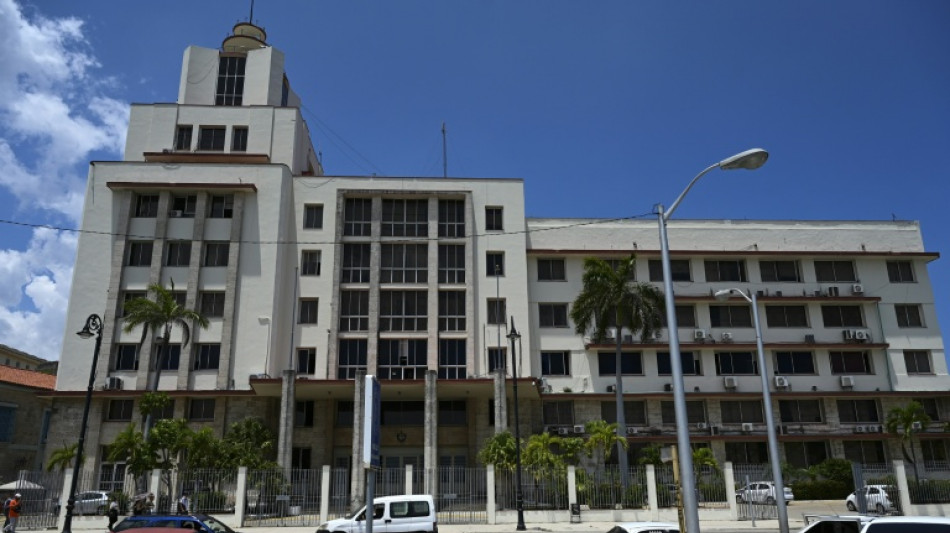
US targets Cuban military, mine in new sanctions / Photo: © AFP
The United States on Thursday imposed sanctions on a Cuban military conglomerate that controls nearly 40 percent of the island's economy, as well as a Canadian mining company, as part of a mounting pressure campaign.
The sanctions announced by Secretary of State Marco Rubio target the Gaesa conglomerate as well as a joint venture involving Canadian mining company Sherritt, which in a near simultaneous announcement said it was leaving Cuba.
Gaesa was already under US sanctions.
The new measures were imposed under an executive order signed last week by President Donald Trump that outlines parts of the Cuban economy for which foreign banks would incur sanctions if they have transactions.
"Just 90 miles from the American homeland, the Cuban regime has brought the island to ruin and auctioned off the island as a platform for foreign intelligence, military and terror operations," said Rubio, a Cuban-American and vociferous critic of Havana.
"Additional designations can be expected in the following days and weeks," he warned.
Rubio said that Gaesa was "designed to generate income not for the Cuban people, but only for the benefit of its corrupt elite."
The sanctions also targeted the conglomerate's president, Brigadier General Ania Guillermina Lastres Morera.
A Miami Herald investigation based on purported leaked documents estimated that Gaesa had $18 billion in assets in early 2024, in line with the level of expenditure by the state itself.
Writing on X, Cuban Foreign Minister Bruno Rodriguez said that "with the additional measures of collective punishment announced today against Cuba, the US government confirms its genocidal intention against the Cuban nation and clears all doubts on the false nature of its pretexts to attack our country."
- 'Exploited Cuban resources' -
Besides Gaesa, Rubio was also harshly critical of the Cuban investments of Sherritt, which mines for nickel and cobalt in the northeast of the island.
He said that Sherritt's joint venture with the state had "exploited Cuba's natural resources to benefit the regime at the expense of the Cuban people" and that it "profits from assets that were originally expropriated by the Cuban regime from US persons and corporations."
In a statement Sherritt announced the immediate suspension of its participation in all joint ventures in Cuba and the repatriation of its expatriate staff.
It said the sanctions "materially alter" Sherritt's ability to continue business in Cuba and "may also result in financial or other providers being unable or unwilling to continue to support Sherritt's operations or other business activities."
In mid-February, the company had already announced the suspension of its operations in Cuba due to the oil embargo imposed by the United States on the island.
Trump has mused about taking over arch-foe Cuba, which has been under a US embargo almost continuously since the 1959 communist revolution of Fidel Castro.
In January, he halted oil shipments from Cuba's main supplier Venezuela and threatened other countries with tariffs if they sought to make up the shortfall.
Since then he has allowed only one Russian oil tanker through.
Three UN special experts said jointly Thursday that the fuel blockade amounted to "energy starvation," and had "grave consequences" for human rights and development.
Lewis--TNT