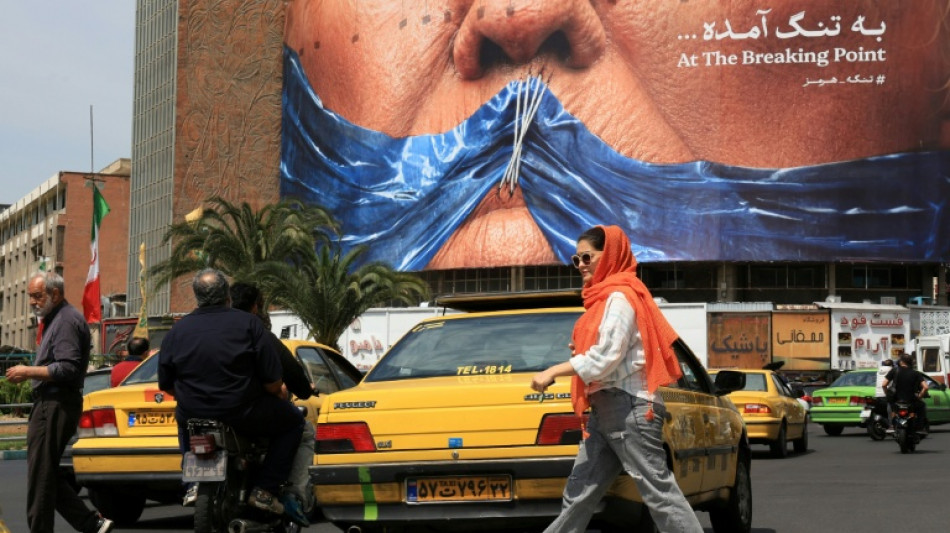
Iran military official says renewed war with US 'likely' / Photo: © AFP
A senior Iranian military officer said on Saturday that renewed fighting with the US was "likely", hours after President Donald Trump said he was not satisfied with an Iranian negotiating proposal.
Iran delivered the new draft to mediator Pakistan on Thursday evening, state media reported, without detailing its contents.
The war, launched by the United States and Israel in late February, has been on hold since April 8, with one failed round of peace talks having taken place in Pakistan since then.
"At this moment I'm not satisfied with what they're offering," Trump told reporters, blaming stalled talks on "tremendous discord" within Iran's leadership.
"Do we want to go and just blast the hell out of them and finish them forever -- or do we want to try and make a deal?" he added, saying he would "prefer not" to take the first option "on a human basis".
On Saturday morning, Mohammad Jafar Asadi, a senior figure in the Iranian military's central command, said "a renewed conflict between Iran and the United States is likely", in quotes published by Iran's Fars news agency.
"Evidence has shown that the United States is not committed to any promises or agreements," he added.
- 'Stuck in purgatory' -
Iran's judiciary chief Gholamhossein Mohseni Ejei said on Friday that his country had "never shied away from negotiations", but would not accept an "imposition" of peace terms.
The White House has declined to provide details on the latest Iranian proposal, but news site Axios reported that US envoy Steve Witkoff had submitted amendments to a previous one putting Tehran's nuclear programme back on the negotiating table.
The changes reportedly include demands that Iran not move enriched uranium from bombed sites or resume activity there during talks.
News of the Iranian proposal briefly pushed oil prices down nearly five percent, though they remain about 50 percent above pre-war levels amid the ongoing closure of the Strait of Hormuz.
Iran has maintained a stranglehold on the strait since the war began, choking off major flows of oil, gas and fertiliser to the world economy, while the United States has imposed a counter-blockade on Iranian ports.
Speaking at a rally on Friday, Trump said "we're like pirates" as he described an earlier helicopter raid on an oil tanker under the blockade.
Despite the ceasefire in the Gulf, fighting has continued in Lebanon, where Israel has carried out deadly strikes despite a separate truce with the Iran-backed armed group Hezbollah.
Lebanon's health ministry said 13 people were killed in strikes in the south, including in the town of Habboush, where the Israeli military had issued an evacuation warning.
Meanwhile, Washington announced late Friday it had approved major arms sales to its allies in the Middle East, including a $4 billion Patriot missile deal with Qatar and nearly $1 billion in precision weapons systems to Israel.
- 'Terminated' -
In Washington, lawmakers were wrestling with a legal dispute over whether Trump had breached a deadline to seek congressional approval for the war.
Administration officials argue that the ceasefire pauses a 60-day limit, after which congressional authorisation would be required -- a claim disputed by opposition Democrats.
Trump faces growing domestic pressure, with inflation rising, no clear victory in sight and midterm elections approaching.
"There has been no exchange of fire between United States Forces and Iran since April 7, 2026," Trump said in letters to congressional leaders, adding that the hostilities "have terminated".
In Iran, the war's economic toll is deepening.
Washington has imposed new sanctions on three Iranian currency firms and warned others against paying a "toll" for safe passage through Hormuz, as demanded by Iran.
The US military says its blockade of Iranian ports has stopped $6 billion in Iranian oil exports, while inflation in Iran, already high before the war, has surged past 50 percent.
"Everyone is trying to endure it, but... they are falling apart," 40-year-old Amir, a Tehran resident, told an AFP reporter based outside the country.
"We still have not seen much of the economic effects because everyone had a bit of savings. They had some gold and dollars for a rainy day. When they run out, things will change."
Supreme leader Ayatollah Mojtaba Khamenei said on Friday that "the owners of damaged businesses should avoid, as much as possible, layoffs and separation of their workforce".
burs-dcp/smw
C.Blake--TNT